
Competency: Application & Evaluation
(Hypothetical data.) An aircraft flies level at a height of km at twice the speed of sound. In a simple model (still air, with the same speed of sound at all heights), the shock wave that causes the sonic boom is a cone that trails behind the aircraft, with the aircraft at its tip and the line of flight as its axis. At this speed the half-angle of the cone is . So a point that is km behind the aircraft, measured parallel to the line of flight, lies on the cone when its distance from the line of flight is km.
On a ground plan, take the point directly below the aircraft as the origin. The ground track (the line on the ground directly below the line of flight) is the -axis, with measured backwards from , and the -axis is level and at right angles to the track; lengths are in km. The figure shows the curve along which the cone meets the ground at this instant (the boom edge). It meets the track at .
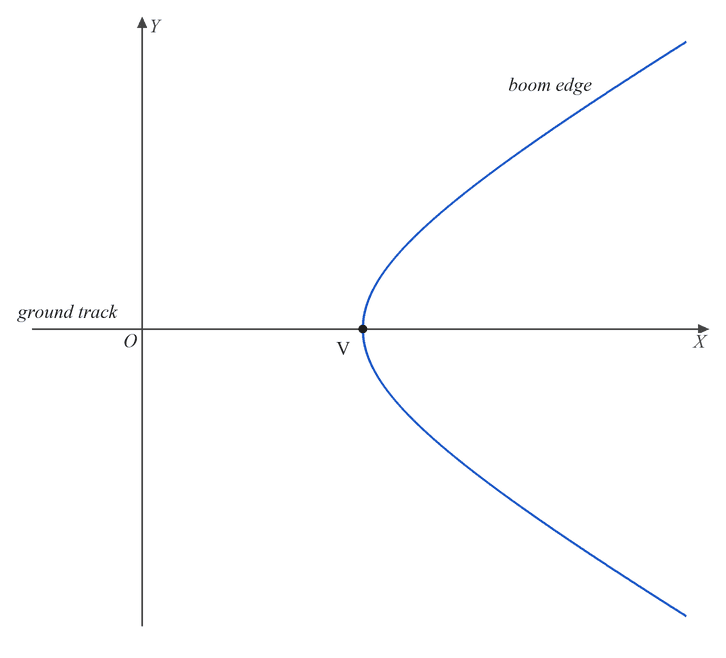
(a) A ground point with is km from the line of flight. Show that the boom edge is the branch, with , of the hyperbola , whose transverse axis lies along the -axis. How far behind is ?
(b) Find the eccentricity and the foci of this hyperbola, and the length of its latus rectum through the focus behind the aircraft. What does this length tell you about the boom edge km behind ?
(c) Three villages lie at these distances from the ground track.
| Village | P | Q | R |
|---|---|---|---|
| Distance from the track (km) |
For each village, find how far the aircraft has gone past it, measured along the track, when the boom edge reaches it. Give each answer to the nearest km. A news report says: “Village R is four times as far from the track as village P, so the aircraft is four times as far past R as past P when the boom arrives.” Is the report right?