
Question 73 marksMedium
Find the coordinates of the foci, vertices, eccentricity and the length of the latus rectum of the hyperbola
(i)
(ii)
(iii)
(iv)
Confirming your payment
Sign up now and get 250 free tokens.
Hyperbola · Question 7 of 37
Find the coordinates of the foci, vertices, eccentricity and the length of the latus rectum of the hyperbola
(i)
(ii)
(iii)
(iv)
Solution:
Concept: The two standard forms of a hyperbola have these facts:
In both forms is the denominator under the positive square term, each latus rectum has length , and ; so the focal distance (from the centre to each focus) satisfies .
Watch out: The letter always belongs to the transverse axis (the positive square term), even when that term is the term.
(i)
Step 1 — Write the equation in standard form. We divide both sides by so that the right side becomes :
The positive term is the term, so the transverse axis is the -axis.
Step 2 — Read off and . We compare with the standard form:
So and .
Step 3 — Find the focal distance . We use :
Step 4 — Find the eccentricity. We divide by :
Step 5 — Find the length of the latus rectum. We use the formula :
So the foci are and the vertices are . The figure shows the two branches, the foci , , the vertices and the latus rectum through .

(ii)
Step 1 — Write the equation in standard form. The equation is already in standard form:
The positive term is the term, so the transverse axis is the -axis.
Step 2 — Read off and . We compare with the standard form:
So and .
Step 3 — Find the focal distance . We use :
Step 4 — Find the eccentricity. We divide by :
Step 5 — Find the length of the latus rectum. We use the formula :
So the foci are and the vertices are . The figure shows the two branches, the foci , , the vertices and the latus rectum through .
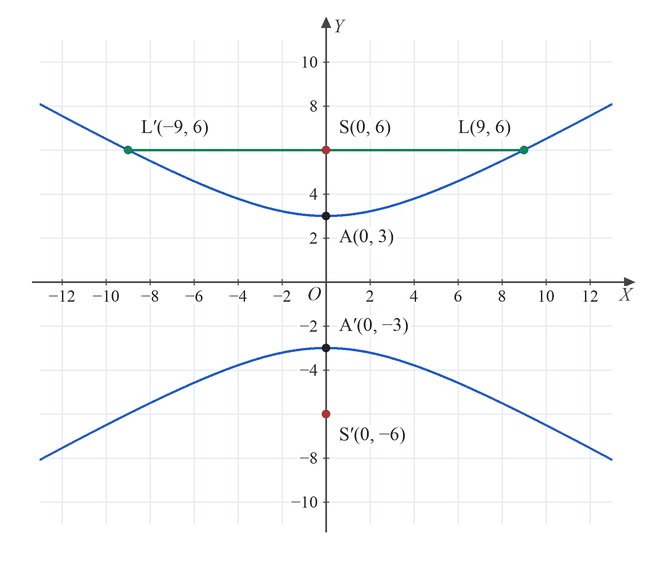
(iii)
Step 1 — Write the equation in standard form. We divide both sides by so that the right side becomes :
The positive term is the term, so the transverse axis is the -axis.
Step 2 — Read off and . We compare with the standard form:
So and .
Step 3 — Find the focal distance . We use :
Step 4 — Find the eccentricity. We divide by :
Step 5 — Find the length of the latus rectum. We use the formula :
So the foci are and the vertices are . The figure shows the two branches, the foci , , the vertices and the latus rectum through .
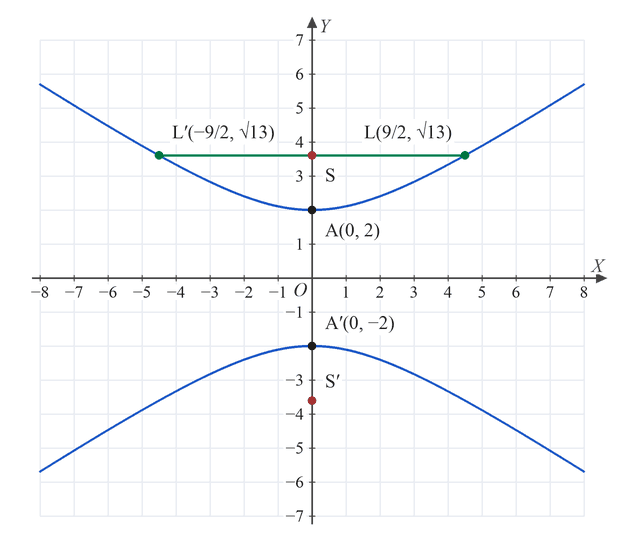
(iv)
Step 1 — Write the equation in standard form. We divide both sides by so that the right side becomes :
The positive term is the term, so the transverse axis is the -axis.
Step 2 — Read off and . We compare with the standard form:
So and .
Step 3 — Find the focal distance . We use :
Step 4 — Find the eccentricity. We divide by :
Step 5 — Find the length of the latus rectum. We use the formula :
So the foci are and the vertices are . The figure shows the two branches, the foci , , the vertices and the latus rectum through .
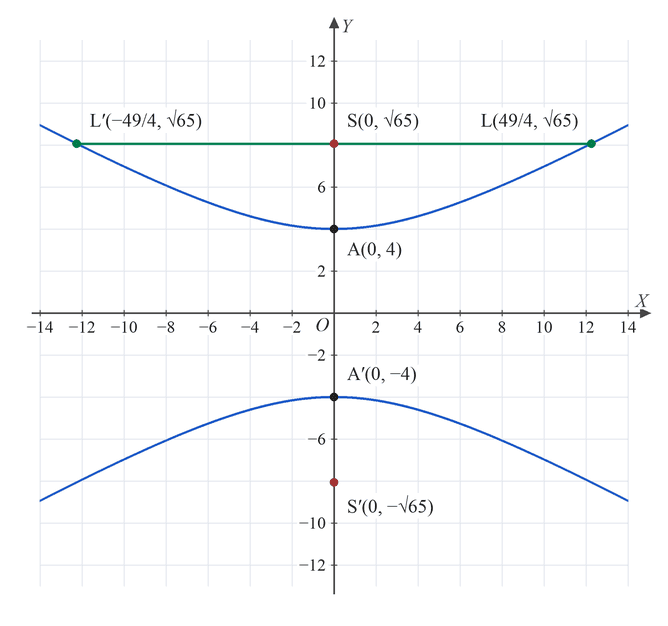
Therefore, (i) foci , vertices , , latus rectum ; (ii) foci , vertices , , latus rectum ; (iii) foci , vertices , , latus rectum ; (iv) foci , vertices , , latus rectum .