
Opening your dashboard
Class 11 Maths Chapter 16: Ellipse Solutions
46 textbook questions with step-by-step answers, free to read, for ISC 2026-27.
Get talked through Ch 16, not just shown the answer
Reading a finished solution is not the same as being able to do it. The AI tutor takes one question at a time and works it with you, in your own words, until you can.
- Ask it out loud, in your own words
- It gives you the next step, not the answer
- Stuck on part (ii)? Start there
46 questions with solutions
1–3 marks · Mixed difficulty
The first 6 solutions are on this page. This chapter is a long one, so the rest open on their own page to keep this one quick to load.
- 13 marks
Question 1
Find the eccentricity of the ellipse of which the major axis is double the minor axis.
Solve with AIWritten solution
Solution:
Concept: For an ellipse with semi-major axis and semi-minor axis (), the eccentricity () is fixed by the relation , so that . The major axis has length , the minor axis has length , the foci are at distance from the centre, and the latus rectum has length .
Step 1 — Write the condition in terms of and . The major axis is double the minor axis :
Step 2 — Find . We substitute in the formula for :
Step 3 — Take the square root. The eccentricity is positive, so we take the positive root:
Therefore, the eccentricity is .
- 23 marks
Question 2
If the minor axis of an ellipse is equal to the distance between its foci, prove that its eccentricity is .
Solve with AIWritten solution
Solution:
Concept: For an ellipse with semi-major axis and semi-minor axis (), the eccentricity () is fixed by the relation , so that . The major axis has length , the minor axis has length , the foci are at distance from the centre, and the latus rectum has length .
Step 1 — Write the condition. The minor axis is and the foci are apart, so
Step 2 — Square and use the basic relation.
Squaring gives .
We substitute this in :
Step 3 — Solve for . We divide both sides by (as ) and collect the terms in :
Since , we take the positive root:
Therefore, the eccentricity is , as required.
- 33 marks
Question 3
Find the latus rectum and eccentricity of the ellipse whose semi-axes are and .
Solve with AIWritten solution
Solution:
Concept: For an ellipse with semi-major axis and semi-minor axis (), the eccentricity () is fixed by the relation , so that . The major axis has length , the minor axis has length , the foci are at distance from the centre, and the latus rectum has length .
Step 1 — Identify and . The longer semi-axis is the semi-major axis, so
Step 2 — Find the latus rectum. We substitute in :
Step 3 — Find the eccentricity. We substitute in :
Since , . The figure draws this ellipse with its major axis along the -axis: the foci are , and is a latus rectum.

Therefore, the latus rectum is and the eccentricity is .
- 43 marks
Question 4
Find the eccentricity of the ellipse whose latus rectum is
(i) half its major axis,
(ii) half its minor axis.
Solve with AIWritten solution
Solution:
Concept: For an ellipse with semi-major axis and semi-minor axis (), the eccentricity () is fixed by the relation , so that . The major axis has length , the minor axis has length , the foci are at distance from the centre, and the latus rectum has length .
(i) Latus rectum equal to half the major axis.
Step 1 — Write the condition. Half the major axis is , so
Step 2 — Find . Dividing by gives the ratio , which we substitute in the formula for :
Since , we take the positive root:
(ii) Latus rectum equal to half the minor axis.
Step 1 — Write the condition. Half the minor axis is , so
We divide by (as ):
Step 2 — Find . We square to get in terms of :
Dividing by gives the ratio , which we substitute in the formula for :
Since , we take the positive root:
Therefore, (i) ; (ii) .
- 53 marks
Question 5
If the eccentricity is zero, prove that the ellipse becomes a circle.
Solve with AIWritten solution
Solution:
Concept: For the ellipse , the semi-axes and the eccentricity are linked by . A circle with centre at the origin and radius has the equation .
Step 1 — Find when .
We put in the relation between , and :
Both and are positive lengths, so .
Step 2 — Substitute in the equation. The equation of the ellipse becomes
We multiply both sides by :
Step 3 — Interpret the result. This is the circle with centre at the origin and radius . The two foci both move to the centre , and the major and minor axes become equal diameters.
Therefore, when the eccentricity is zero the ellipse becomes the circle .
- 63 marks
Question 6
Find the equation to the ellipse with axes as the axes of coordinates.
(i) major axis , minor axis ;
(ii) which passes through the points and ;
(iii) axes are and and the major axis along
(a) the axis of ,
(b) the axis of ;
(iv) major axis and eccentricity , where the major axis is the horizontal axis;
(v) latus rectum is and eccentricity ;
(vi) foci are and ;
(vii) distance between the foci is and its latus rectum is ;
(viii) distance of the focus from the corresponding directrix is and eccentricity is ;
(ix) the minor axis is equal to the distance between the foci, and the latus rectum is .
Solve with AIWritten solution
Solution:
Concept: When the axes of the ellipse are the co-ordinate axes and the major axis lies along the -axis, the equation is with . Then:
- the vertices are and the ends of the minor axis are ;
- , where is the eccentricity;
- the foci are and the directrices are ;
- the latus rectum has length .
When the major axis lies along the -axis, the equation is and every and above changes places.
Watch out: In parts (i), (v), (vii), (viii) and (ix) the question does not say which co-ordinate axis carries the major axis. As in part (iv), we take it along the -axis; along the -axis the roles of and in the answer are interchanged. In part (ii) no choice is needed, because the two given points fix the ellipse completely.
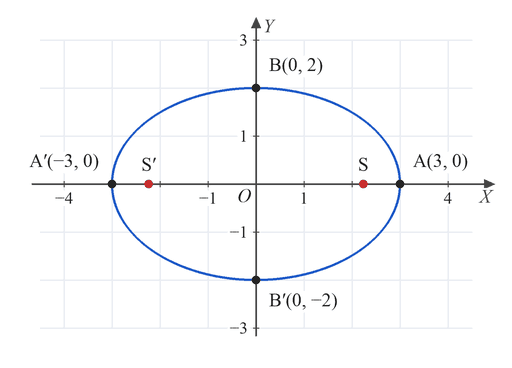
(i) Major axis , minor axis .
Step 1 — Find and . The major axis is and the minor axis is , so we halve each length:
Step 2 — Write the equation. We put and in the standard form and multiply by :
(ii) Passing through and .
Step 1 — Set up two equations. We do not know which axis is longer, so we write the equation as and let , . Each given point satisfies the equation:
Step 2 — Solve for and . We take from the first equation and substitute it in the second:
Then the value of is
Step 3 — Write the equation. We substitute and back and multiply by :
Here the denominator under is larger than the denominator under , so the major axis lies along the -axis, as the figure shows.

(iii) Axes and .
Step 1 — Find and . The longer axis is the major axis and the shorter axis is the minor axis :
Step 2 — Major axis along the -axis, part (a). Here stands under ; we multiply by :
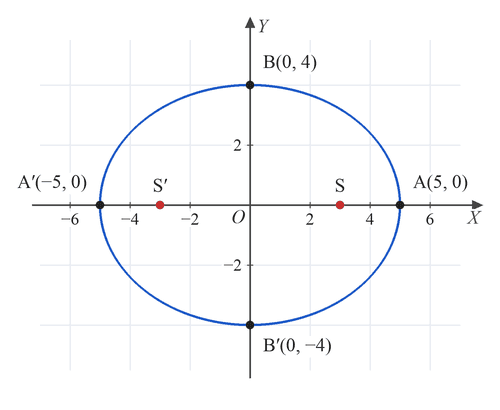
Step 3 — Major axis along the -axis, part (b). Now stands under ; we multiply by :

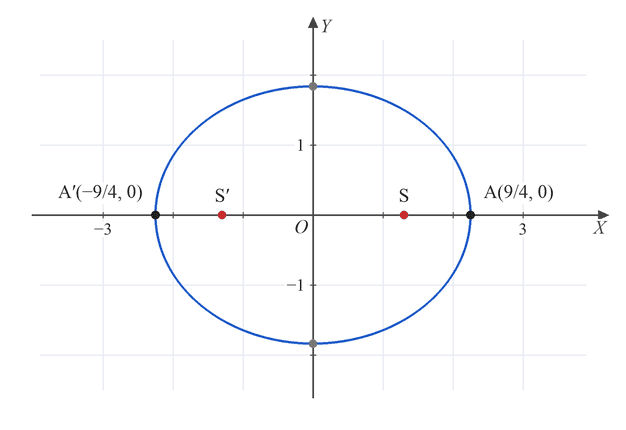
(iv) Major axis , eccentricity , major axis horizontal.
Step 1 — Find . We halve the major axis:
Step 2 — Find . We use , where is :
Step 3 — Write the equation. We put and in the standard form:
We multiply both sides by to clear the fractions:
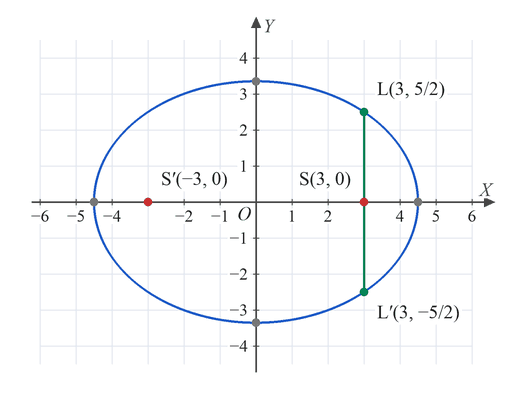
(v) Latus rectum , eccentricity .
Step 1 — Write two expressions for . The latus rectum gives one expression, and the eccentricity gives another:
The relation , where is , gives the second one:
Step 2 — Find and . We equate the two expressions and divide by (as ):
Then follows from :
Step 3 — Write the equation. We put and in the standard form:
We multiply both sides by , the lowest common multiple of and :
The focus is , and the ends of the latus rectum are , so the latus rectum is long.
(vi) Foci and .
Step 1 — Find . The foci are , so
Step 2 — Find . We use :
Step 3 — Write the equation. We substitute these values in the standard form and multiply by (the product ):

(vii) Distance between the foci , latus rectum .
Step 1 — Write the two conditions. The foci are apart and the latus rectum is :
Step 2 — Form an equation in . We use , which here reads :
Since , we keep .
Step 3 — Find and the equation. We substitute in the expression for :
Then the standard form, multiplied by , becomes
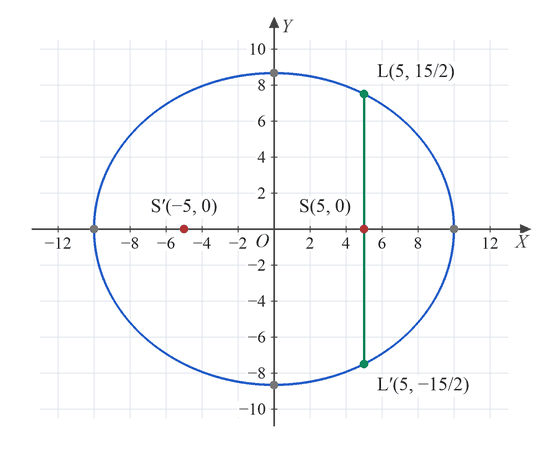
(viii) Distance of a focus from the corresponding directrix , eccentricity .
Step 1 — Write the distance. The focus and the directrix lie on the same side of the centre, so their distance is the difference:
Step 2 — Find . We put :
Step 3 — Find and the equation. We use :
So the equation is
The focus is units from the directrix , as required.
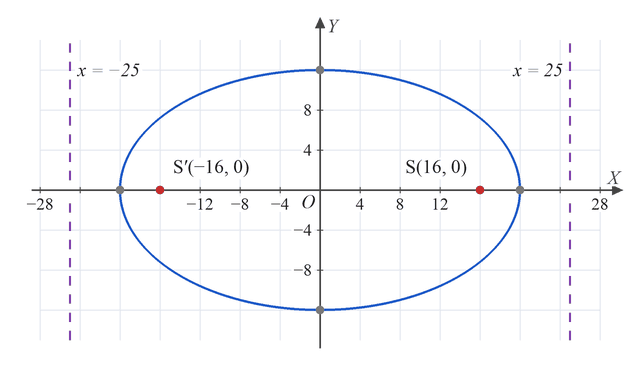
(ix) Minor axis equal to the distance between the foci, latus rectum .
Step 1 — Use the first condition. The minor axis equals the distance between the foci:
Step 2 — Find in terms of . We also have . Adding the two forms gives
Step 3 — Use the latus rectum. We replace by in the latus-rectum condition:
Then half of gives
Step 4 — Write the equation. We substitute these values and multiply by :
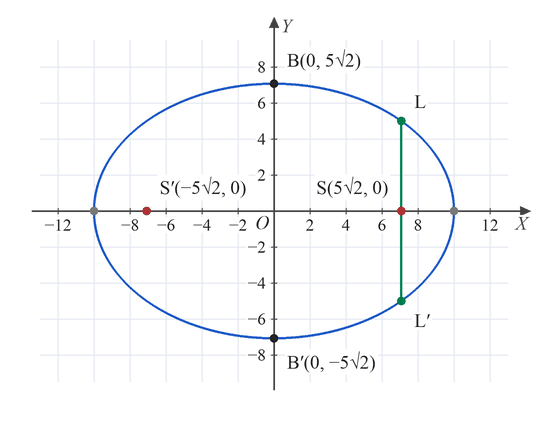
Therefore, (i) ; (ii) ; (iii) (a) , (b) ; (iv) ; (v) ; (vi) ; (vii) ; (viii) ; (ix) .
- 73 marks
Question 7
Find the equation of the ellipse whose centre is at and whose semi-axes are and , when the major axis is
(i) parallel to the axis of ;
(ii) parallel to the axis of .
- 83 marks
Question 8
Find the equation of the ellipse with its centre at , focus at , and passing through .
- 93 marks
Question 9
Find the equation of the ellipse whose centre is at and major axis along the axis of and whose minor axis is equal to the distance between the foci and whose latus rectum is .
- 103 marks
Question 10
Find the equation of the ellipse with
(i) focus at , directrix , and ; (Use definition)
(ii) focus at , eccentricity is , and directrix is . (Use definition)
- 113 marks
Question 11
A point moves so that the product of the slopes of the two lines joining to the two points and is . Show that the locus is an ellipse and locate its centre.
- 123 marks
Question 12
Find the eccentricity, the coordinates of the foci, and the length of the latus rectum of the ellipse .
- 133 marks
Question 13
For the ellipse, , find the semi-major axis, the semi-minor axis, the eccentricity, the coordinates of the foci, the equations of the directrices, and the length of the latus rectum.
- 143 marks
Question 14
Find the length of the axes, the co-ordinates of the foci, the eccentricity, and latus rectum of the ellipse .
- 153 marks
Question 15
Find the distance between a focus and an extremity of the minor axis of the ellipse
(i) .
(ii) .
- 163 marks
Question 16
Given the ellipse , find the equations and the lengths of the focal radii drawn through the point .
- 173 marks
Question 17
The focal distance of an end of the minor axis of the ellipse is and the distance between the foci is . Find the lengths of the semi-axes.
- 183 marks
Question 18
Find the eccentricity of the ellipse whose latus rectum is and distance of the vertex from the nearest focus is cm.
- 193 marks
Question 19
The directrix of a conic section is the line and the focus is . If the eccentricity is , find the equation to the conic section.
- 203 marks
Question 20
Find the equation to the conic section whose focus is , eccentricity is and the directrix is the line . Is the conic section an ellipse?
- 213 marks
Question 21
Find the equation of the ellipse whose foci are and and whose major axis is .
- 223 marks
Question 22
Find the ellipse if its foci are and the length of the latus rectum is .
- 233 marks
Question 23
Find the eccentricity of the ellipse of minor axis , if the line segment joining the foci subtends an angle at the upper vertex. Also, find the equation of the ellipse.
- 241 mark
Question 24
Find the coordinates of the focus, axis, the equation of the directrix and the length of the latus rectum of the ellipse .
- 251 mark
Question 25
The major and minor axis of the ellipse are ……
- 261 mark
Question 26
The eccentricity of the ellipse is ……
- 271 mark
Question 27
Find the coordinates of the foci of the ellipse .
- 281 mark
Question 28
Find the equation of the ellipse whose eccentricity is and whose foci are at the points .
- 291 mark
Question 29
Find the equation of the ellipse whose minor axes is and which has a distance of units between foci.
- 301 mark
Question 30
Find the eccentricity and the equations of the directrices of the ellipse .
- 311 mark
Question 31
Find the equation of the ellipse with foci at and as one of the directrices.
- 321 mark
Question 32
What is the eccentricity of the curve ?
- 331 mark
Question 33
Find the equation of the ellipse whose vertices are and foci are .
- 341 mark
Question 34
Find the equation of the ellipse whose vertices are and foci are .
- 351 mark
Question 35
If the eccentricity of an ellipse is and the distance between its foci is , then find the latus rectum of the ellipse.
- 361 mark
Question 36
The length of the latus rectum of the ellipse is
- 371 mark
Question 37
If is eccentricity of the ellipse (where ), then
- 381 mark
Question 38
If the distance between the foci of an ellipse is and the distance between its directrices is , then the length of its latus rectum is
- 391 mark
Question 39
If the coordinates of the points and and respectively and is any point on the curve, , then is equal to
- 401 mark
Question 40
If and are the ends of minor axis and and are foci of the ellipse , then the area of the rhombus will be
- 411 mark
Question 41
Let the length of the latus rectum of an ellipse with its major axis along the -axis and center at the origin be . If the distance between the foci of the ellipse is equal to the lengths of its minor axis then which one of the following points lies on it?
- 421 mark
Question 42
and are the foci of an ellipse and is the end point of the minor axis. If is equilateral triangle, the eccentricity of the ellipse is
- 431 mark
Question 43
Find the equation of the ellipse whose focus is , directrix is the line and eccentricity .
- 441 mark
Question 44
A circle with centre passes through the foci of the ellipse . Find the radius of the circle.
- 451 mark
Question 45
A point on the ellipse is at a distance of units from a focus. If the eccentricity of the ellipse is , then the distance of from the corresponding directrix is
- 461 mark
Question 46
The equation of the ellipse having vertices at and foci is
What Class 11 Maths Ch 16 covers
The sections of the chapter, in the order the book takes them. Every question above comes from one of these.
- 01Definition of an Ellipse and its Standard Equation
- 02Vertices, Foci, Eccentricity, Directrices and Latus Rectum
- 03Ellipse as a Central Curve and its Focal Property
- 04Finding the Equation of an Ellipse from Given Conditions
More ways to study this chapter
The same chapter asked three other ways. Practise it, revise it, and see what the board has set on Ch 16 before.
Class 11 Maths Ch 16 questions students ask
How many questions are there in Class 11 Maths Ch 16?
46 questions. Every one is solved step by step on this page.
Are these Class 11 Maths solutions free?
Yes. Every question and its full working is free to read, with no account needed.
Can I download the Class 11 Maths Ch 16 solutions as a PDF?
There is no PDF to download. Every solution is on this page instead, which means it is searchable, always the current syllabus, and readable on a phone. Use your browser's print option if you want it on paper.