
Question 163 marksMedium
Given the ellipse , find the equations and the lengths of the focal radii drawn through the point .
Confirming your payment
Sign up now and get 250 free tokens.
Ellipse · Question 16 of 46
Given the ellipse , find the equations and the lengths of the focal radii drawn through the point .
Solution:
Concept: For a point on with foci and , the focal distances (focal radii) are and .
They come from the definition , using the directrices, and they add up to , the length of the major axis.
Step 1 — Write the standard form. We divide by :
So , , and the eccentricity follows:
Step 2 — Find the foci. We multiply by :
So the foci are and . The point is on the ellipse, because its co-ordinates satisfy the equation:
Step 3 — Find the equation of . Both and have -co-ordinate , so the focal radius is the vertical line
Step 4 — Find the equation of . The slope of through and is
We use the point-slope form through and multiply by :
Step 5 — Find the lengths. We put in the focal-distance formulae:
The other focal radius is
Check: The two lengths add up to the major axis :
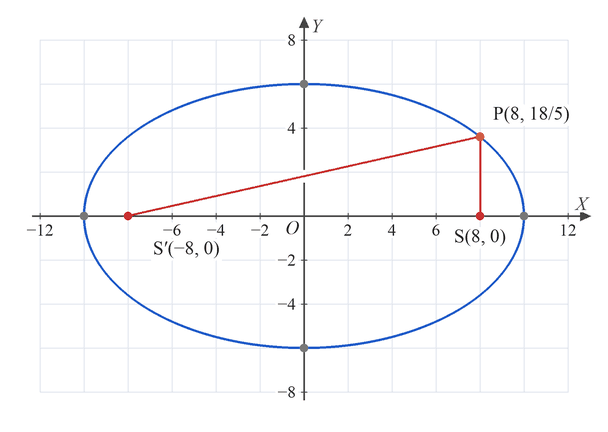
Therefore, the focal radii are and , with lengths and .