Find the equation to the ellipse with axes as the axes of coordinates.
Question 63 marksMedium
Find the equation to the ellipse with axes as the axes of coordinates.
(i) major axis =6, minor axis =4;
(ii) which passes through the points (−3,1) and (2,−2);
(iii) axes are 10 and 8 and the major axis along
(a) the axis of x,
(b) the axis of y;
(iv) major axis 29 and eccentricity 31, where the major axis is the horizontal axis;
(v) latus rectum is 5 and eccentricity 32;
(vi) foci are (±4,0) and e=31;
(vii) distance between the foci is 10 and its latus rectum is 15;
(viii) distance of the focus from the corresponding directrix is 9 and eccentricity is 54;
(ix) the minor axis is equal to the distance between the foci, and the latus rectum is 10.
Solution:
Concept: When the axes of the ellipse are the co-ordinate axes and the major axis lies along the x-axis, the equation is a2x2+b2y2=1 with a>b. Then:
the vertices are (±a,0) and the ends of the minor axis are (0,±b);
b2=a2(1−e2), where e is the eccentricity;
the foci are (±ae,0) and the directrices are x=±ea;
the latus rectum has length a2b2.
When the major axis lies along the y-axis, the equation is b2x2+a2y2=1 and every x and y above changes places.
Watch out: In parts (i), (v), (vii), (viii) and (ix) the question does not say which co-ordinate axis carries the major axis. As in part (iv), we take it along the x-axis; along the y-axis the roles of x and y in the answer are interchanged. In part (ii) no choice is needed, because the two given points fix the ellipse completely.
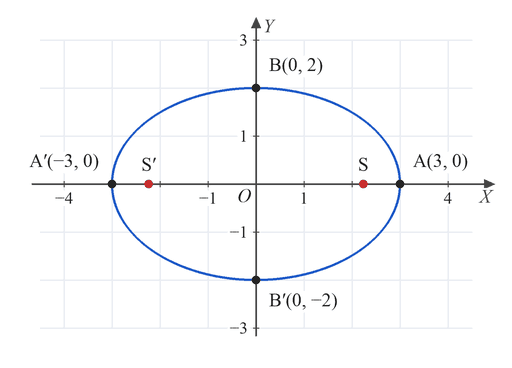
(i) Major axis =6, minor axis =4.
Step 1 — Find a and b. The major axis is 2a and the minor axis is 2b, so we halve each length:
ab=3=2
Step 2 — Write the equation. We put a2=9 and b2=4 in the standard form and multiply by 36:
9x2+4y2=14x2+9y2=36
(ii) Passing through (−3,1) and (2,−2).
Step 1 — Set up two equations. We do not know which axis is longer, so we write the equation as Ax2+By2=1 and let u=A1, v=B1. Each given point satisfies the equation:
9u+v=14u+4v=1
Step 2 — Solve for u and v. We take v=1−9u from the first equation and substitute it in the second:
4u+4−36u=1−32u=−3u=323
Then the value of v is
v=1−3227v=325
Step 3 — Write the equation. We substitute u and v back and multiply by 32:
323x2+325y2=13x2+5y2=32
Here the denominator 332 under x2 is larger than the denominator 532 under y2, so the major axis lies along the x-axis, as the figure shows.
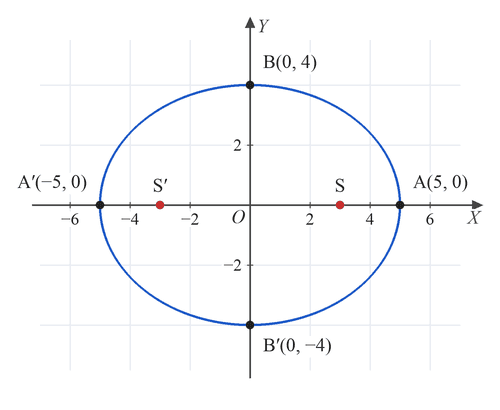
(iii) Axes 10 and 8.
Step 1 — Find a and b. The longer axis 10 is the major axis 2a and the shorter axis 8 is the minor axis 2b:
ab=5=4
Step 2 — Major axis along the x-axis, part (a). Here a2=25 stands under x2; we multiply by 400:
25x2+16y2=116x2+25y2=400
Step 3 — Major axis along the y-axis, part (b). Now a2=25 stands under y2; we multiply by 400:
16x2+25y2=125x2+16y2=400
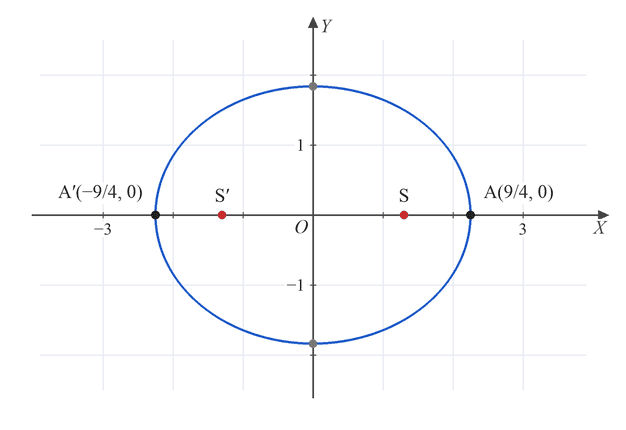
(iv) Major axis 29, eccentricity 31, major axis horizontal.
Step 1 — Find a. We halve the major axis:
a=49
Step 2 — Find b2. We use b2=a2(1−e2), where 1−e2 is 32:
b2=1681×32b2=827
Step 3 — Write the equation. We put a2=1681 and b2=827 in the standard form:
8116x2+278y2=1
We multiply both sides by 81 to clear the fractions:
16x2+24y2=81
(v) Latus rectum 5, eccentricity 32.
Step 1 — Write two expressions for b2. The latus rectum gives one expression, and the eccentricity gives another:
a2b2=5b2=25a
The relation b2=a2(1−e2), where 1−e2 is 95, gives the second one:
b2=95a2
Step 2 — Find a and b2. We equate the two expressions and divide by 5a (as a=0):
95a2=25aa=29
Then b2 follows from b2=25a:
b2=445
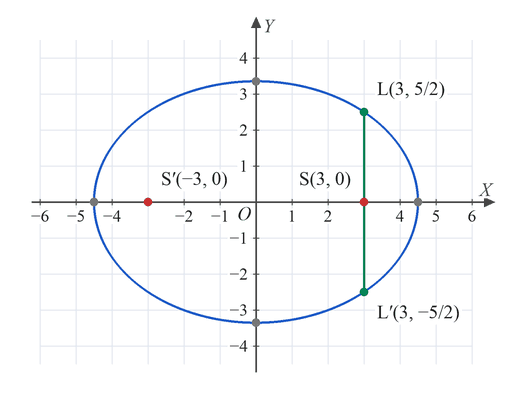
Step 3 — Write the equation. We put a2=481 and b2=445 in the standard form:
814x2+454y2=1
We multiply both sides by 405, the lowest common multiple of 81 and 45:
20x2+36y2=405
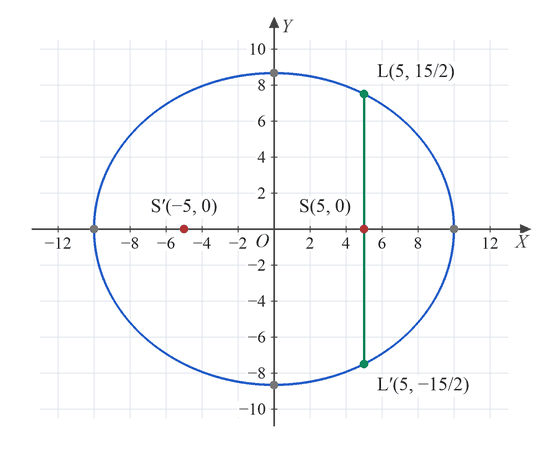
The focus is (ae,0)=(3,0), and the ends of the latus rectum are (3,±25), so the latus rectum is 5 long.
(vi) Foci (±4,0) and e=31.
Step 1 — Find a. The foci (±ae,0) are (±4,0), so
ae=4a=12
Step 2 — Find b2. We use b2=a2(1−e2):
b2=144×98b2=128
Step 3 — Write the equation. We substitute these values in the standard form and multiply by 1152 (the product 144×8):
144x2+128y2=18x2+9y2−1152=0
(vii) Distance between the foci 10, latus rectum 15.
Step 1 — Write the two conditions. The foci are 2ae apart and the latus rectum is a2b2:
ae=5b2=215a
Step 2 — Form an equation in a. We use b2=a2−a2e2, which here reads b2=a2−25:
a2−25=215a2a2−15a−50=0(a−10)(2a+5)=0
Since a>0, we keep a=10.
Step 3 — Find b2 and the equation. We substitute a=10 in the expression for b2:
b2=75
Then the standard form, multiplied by 300, becomes
100x2+75y2=13x2+4y2=300
(viii) Distance of a focus from the corresponding directrix 9, eccentricity 54.
Step 1 — Write the distance. The focus (ae,0) and the directrix x=ea lie on the same side of the centre, so their distance is the difference:
ea−ae=9
Step 2 — Find a. We put e=54:
45a−54a=9209a=9a=20
Step 3 — Find b2 and the equation. We use b2=a2(1−e2):
b2=400×259b2=144
So the equation is
400x2+144y2=1
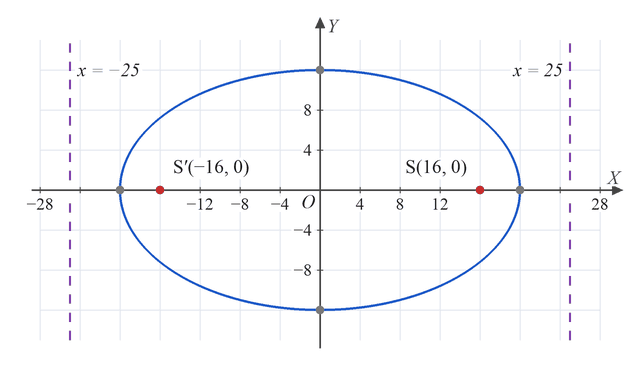
The focus S(16,0) is 9 units from the directrix x=25, as required.
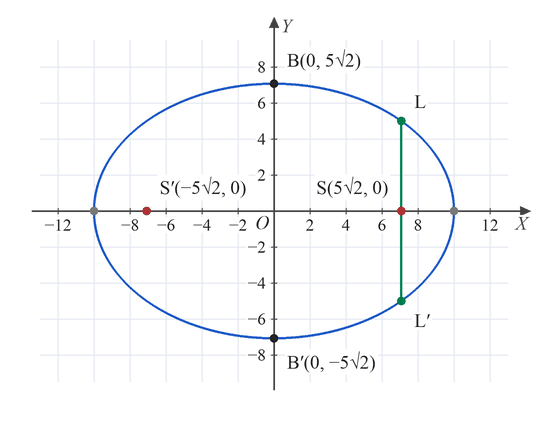
(ix) Minor axis equal to the distance between the foci, latus rectum 10.
Step 1 — Use the first condition. The minor axis 2b equals the distance 2ae between the foci:
b=aeb2=a2e2
Step 2 — Find b2 in terms of a. We also have b2=a2−a2e2. Adding the two forms gives
2b2=a2
Step 3 — Use the latus rectum. We replace 2b2 by a2 in the latus-rectum condition:
aa2=10a=10
Then half of a2 gives
b2=50
Step 4 — Write the equation. We substitute these values and multiply by 100: