
Opening your dashboard
Class 11 Chemistry Chapter 2: Structure of Atom Solutions
213 textbook questions with step-by-step answers, free to read, for ISC 2026-27.
Get talked through Ch 2, not just shown the answer
Reading a finished solution is not the same as being able to do it. The AI tutor takes one question at a time and works it with you, in your own words, until you can.
- Ask it out loud, in your own words
- It gives you the next step, not the answer
- Stuck on part (ii)? Start there
213 questions with solutions
1–5 marks · Mixed difficulty
The first 19 solutions are on this page. This chapter is a long one, so the rest open on their own page to keep this one quick to load.
- 11 mark
Question 1
Mass of one mole of electron is:
Solve with AIAnswer
(A) 0.02 mg
(B) 0.03 mg
- Correct
(C) 0.55 mg
(D) 1.00 mg
Answer: (C) 0.55 mg
Key idea: One mole of any kind of particle contains Avogadro's number of particles, . So the mass of one mole of electrons is the mass of one electron multiplied by .
Step 1 — Write down the data. The mass of one electron is kg, and one mole contains electrons.
Step 2 — Multiply the mass of one electron by Avogadro's number. One mole holds electrons, so the mass of one mole is times the mass of one electron.
Step 3 — Change kilograms into milligrams. Since 1 kg = 1000 g and 1 g = 1000 mg, 1 kg = mg. So
This rounds to 0.55 mg.
Watch out: using 1 kg = mg by mistake gives a value a thousand times too small.
Why the other options are wrong:
- (A) 0.02 mg is about 27 times smaller than the calculated 0.548 mg.
- (B) 0.03 mg is still about 18 times smaller than 0.548 mg.
- (D) 1.00 mg is nearly twice the calculated value.
Therefore, the mass of one mole of electrons is about 0.55 mg.
- 21 mark
Question 2
The energy associated with Bohr's orbit in H-atom is given by eV.
The energy associated with the orbit having a radius is equal to:
Solve with AIAnswer
(A) − 13.6 eV
(B) − 6.8 eV
- Correct
(C) − 1.51 eV
(D) zero
Answer: (C) − 1.51 eV
Key idea: In Bohr's model of the hydrogen atom the radius of the th orbit is , where is the radius of the first orbit (0.529 Å). So the radius tells us , and gives the energy.
Step 1 — Find from the radius. The orbit has radius . Comparing with :
Step 2 — Put into the energy formula. Now that we know the orbit number, we substitute it in the given formula for .
Why the other options are wrong:
- (A) − 13.6 eV is the energy of the first orbit (), whose radius is , not .
- (B) − 6.8 eV is 13.6/2; it is not for any whole number , so it is not a Bohr energy level of hydrogen.
- (D) Zero energy belongs to , an electron completely removed from the atom.
Therefore, the energy of the orbit of radius is − 1.51 eV.
- 31 mark
Question 3
The wave number of the first line in the Balmer series of H-atom is 15200 cm. The wave number of the first line in the Balmer series of ion is:
Solve with AIAnswer
(A) 15200 cm
(B) 60800 cm
(C) 76,000 cm
- Correct
(D) 136,800 cm
Answer: (D) 136,800 cm
Key idea: For a hydrogen-like species (one electron, nuclear charge ), the wave number of a line is
For the same pair of levels (, for the first Balmer line), the wave number is simply proportional to .
Step 1 — Note the values of . Hydrogen has . The ion has one electron and .
Step 2 — Write the ratio of the two wave numbers. The bracket is the same for both, so it cancels:
Step 3 — Multiply the hydrogen value by 9. Since the Li²⁺ line is 9 times the hydrogen line, we multiply the given wave number by 9.
Why the other options are wrong:
- (A) 15200 cm is the hydrogen value itself; it ignores the larger nuclear charge of .
- (B) 60800 cm is , the value for (, ), not for .
- (C) 76,000 cm is ; 5 is not the square of any whole-number , so it is not the value for any hydrogen-like ion.
Therefore, the first Balmer line of has a wave number of 136,800 cm.
- 41 mark
Question 4
The difference between the radii of 3rd and 2nd orbits in H-atom is:
Solve with AIAnswer
(A) cm
- Correct
(B) cm
(C) cm
(D) cm
Answer: (B) cm
Key idea: In Bohr's model the radius of the th orbit of the hydrogen atom is Å, and 1 Å = cm.
Step 1 — Radius of the 3rd orbit. We use the formula Å, with 3 for .
Step 2 — Radius of the 2nd orbit. In the same way we put into the formula.
Step 3 — Subtract and change to centimetres. The difference is the larger radius minus the smaller one; then we use 1 Å = cm.
This matches option (B), cm (the book rounds the Bohr radius slightly differently, 0.5292 Å).
Why the other options are wrong:
- (A) cm is the radius of the 2nd orbit itself, not the difference.
- (C) cm is the radius of the 1st orbit.
- (D) cm is Å; it would come from using instead of ().
Therefore, the difference between the radii of the 3rd and 2nd orbits is about cm.
- 51 mark
Question 5
What is degeneracy of the level of H-atom that has energy ?
Solve with AIAnswer
(A) 0
(B) 3
(C) 7
- Correct
(D) 9
Answer: (D) 9
Key idea: The energy levels of the hydrogen atom are . In hydrogen, all orbitals with the same have the same energy, so the degeneracy (number of orbitals of equal energy) of level is .
Step 1 — Find . Comparing with gives
Step 2 — Count the orbitals in level 3. For , can be 0, 1 or 2, giving one 3s, three 3p and five 3d orbitals:
This is the same as .
Why the other options are wrong:
- (A) A degeneracy of 0 would mean no orbital at all; every level has at least one orbital.
- (B) 3 is the value of (or the number of subshells, 3s, 3p, 3d), not the number of orbitals.
- (C) 7 is the number of orbitals in an f subshell, and the level has no f subshell.
Therefore, the level with energy has a degeneracy of 9.
- 61 mark
Question 6
If an electron in the ground state of H-atom is excited by monochromatic radiation of energy 12.1 eV, then the number of lines emitted, according to Bohr's theory, is equal to:
Solve with AIAnswer
(A) 1
(B) 2
- Correct
(C) 3
(D) 4
Answer: (C) 3
Key idea: An electron can absorb a photon only if the photon's energy equals the gap between two levels. When it falls back from level , it can do so directly or in steps, and the number of different spectral lines possible is .
Step 1 — Find the level reached. The energy needed to raise the electron from level 1 to level 3 is
This is about 12.1 eV, so the electron is raised to .
Step 2 — Count the possible transitions back to the ground state. From the electron can fall 3 → 1, or 3 → 2 and then 2 → 1. These are three different jumps:
Why the other options are wrong:
- (A) 1 line counts only the direct jump 3 → 1 and forgets the two-step route.
- (B) 2 lines is the most that one single atom can give (3 → 2, then 2 → 1); a sample of many atoms shows all three possible lines.
- (D) 4 lines would need the electron to reach , which needs 12.75 eV, more than the 12.1 eV supplied.
Therefore, 3 spectral lines are emitted.
- 71 mark
Question 7
The ratio of the difference between 2nd and 3rd Bohr's orbit energy to that between 3rd and 4th orbit energy is:
Solve with AIAnswer
(A) 0.35
- Correct
(B) 2.85
(C) 5.4
(D) 0.185
Answer: (B) 2.85
Key idea: In Bohr's model , where is a constant; for hydrogen eV. Any energy difference is times a difference of terms, so cancels in a ratio.
Step 1 — Difference between the 2nd and 3rd orbits. We subtract the two energies, so only the difference of the terms remains, multiplied by .
Step 2 — Difference between the 3rd and 4th orbits. We do the same subtraction for the 3rd and 4th orbits.
Step 3 — Take the ratio. We divide the first difference by the second; the constant cancels.
This is option (B), 2.85 (the book truncates 2.857).
Why the other options are wrong:
- (A) 0.35 is , the ratio taken upside down (3rd–4th gap divided by 2nd–3rd gap).
- (C) 5.4 does not equal ; the gaps shrink as rises, but not that fast.
- (D) 0.185 is less than 1, which would mean the 2nd–3rd gap is smaller than the 3rd–4th gap; in fact the energy gaps get smaller as increases.
Therefore, the required ratio is 20/7 ≈ 2.85.
- 81 mark
Question 8
The number of elliptical orbits in N-shell of an atom is:
Solve with AIAnswer
- Correct
(A) 3
(B) 4
(C) 2
(D) 1
Answer: (A) 3
Key idea: Sommerfeld extended Bohr's model by allowing elliptical orbits. For a shell with principal quantum number there are possible orbits, described by a second quantum number . Only the orbit with is a circle; the other orbits are ellipses.
Step 1 — Find for the N-shell. The shells K, L, M, N have = 1, 2, 3, 4, so the N-shell has .
Step 2 — List the orbits. For , = 1, 2, 3, 4, which gives 4 orbits. The orbit with is circular.
Step 3 — Count the elliptical ones. All orbits except the single circular one are elliptical, so we subtract 1 from the total.
Why the other options are wrong:
- (B) 4 is the total number of orbits in the N-shell, including the one circular orbit.
- (C) 2 is the number of elliptical orbits in the M-shell ().
- (D) 1 is the number of elliptical orbits in the L-shell ().
Therefore, the N-shell has 3 elliptical orbits.
- 91 mark
Question 9
The IE of is J atom. The energy of the first stationary state of is:
Solve with AIAnswer
(A) J atom
(B) J atom
(C) J atom
- Correct
(D) J atom
Answer: (D) J atom
Key idea: For a hydrogen-like species the energy of the first orbit is , where is a constant. The ionisation energy (IE) is the energy needed to remove the electron from this first orbit, so IE is the size of :
Hence is proportional to .
Step 1 — Write for . For , , and the IE is given, so
Step 2 — Use the ratio for (). Because is proportional to , the ratio of the two energies is the ratio of the squares of the nuclear charges.
Step 3 — Calculate. We multiply the He⁺ energy by this ratio to get the Li²⁺ energy.
Note: the energy of a bound state is negative, −4.41 × 10⁻¹⁷ J atom⁻¹; the printed options give only its size, and option (D) has the correct size.
Why the other options are wrong:
- (A) J is the value itself; it ignores the larger nuclear charge of .
- (B) J has the right digits but a power of ten that is one too small ( is ).
- (C) J is ten times smaller than the value, whereas the value must be larger.
Therefore, the first stationary state of has an energy of magnitude J atom.
- 101 mark
Question 10
The energy of an electron in the first Bohr orbit of H-atom is −13.6 eV. The possible energy value (s) of the excited state (s) for the electron in Bohr orbits or H-atom is (are):
Solve with AIAnswer
- Correct
(A) −3.4 eV
(B) −4.2 eV
(C) −6.8 eV
(D) +6.8 eV
Answer: (A) −3.4 eV
Key idea: The allowed energies of the electron in a hydrogen atom are eV, where can be 1, 2, 3, … Excited states are those with , and every allowed value is negative.
Step 1 — Work out the first excited state (). The first excited state is the level just above the ground state, so we put into the energy formula.
So −3.4 eV is an allowed excited-state energy.
Step 2 — Test the other values. For an allowed value, the number
must be a perfect square (1, 4, 9, …). The next levels after −3.4 eV are −1.51 eV and −0.85 eV, and all higher levels are even closer to zero.
Why the other options are wrong:
- (B) For −4.2 eV, would be 13.6/4.2, about 3.24, which is not a perfect square; the value lies between and , where no level exists.
- (C) For −6.8 eV, would be 13.6/6.8, which is 2, not a perfect square, so this is not an allowed level.
- (D) +6.8 eV is positive; a bound electron always has negative energy (zero is the energy of a free electron at rest).
Therefore, the possible excited-state energy is −3.4 eV.
- 111 mark
Question 11
What transition in H-spectrum would have the same wavelength as Balmer transition to in spectrum?
Solve with AIAnswer
(A) to
(B) to
(C) to
- Correct
(D) to
Answer: (D) to
Key idea: For a hydrogen-like species, . Two lines have the same wavelength when the products are equal.
Step 1 — Work out the bracket for (), 4 → 2. We multiply by the bracket for the given He⁺ jump, so that we can compare it with hydrogen lines.
Step 2 — Find the hydrogen transition () with the same value. For 2 → 1:
This matches, so the hydrogen line 2 → 1 (the first Lyman line) has the same wavelength.
Why the other options are wrong:
- (A) 4 → 1 gives , not .
- (B) 3 → 2 gives , not .
- (C) 3 → 1 gives , not .
Therefore, the hydrogen transition from level 2 to level 1 has the same wavelength.
- 121 mark
Question 12
How many moles of electrons weigh one kilogram (Mass of electron = Kg, Avogadro's number = ).
Solve with AIAnswer
(A)
(B)
(C)
- Correct
(D)
Answer: (D)
Key idea: Number of moles = number of particles ÷ Avogadro's number. So first find how many electrons make up 1 kg, then divide by .
Step 1 — Number of electrons in 1 kg. Dividing the total mass by the mass of one electron tells us how many electrons there are.
Step 2 — Divide by Avogadro's number. Each mole contains electrons, so we divide the number of electrons by to get moles.
This is about mol.
Why the other options are wrong:
- (A) has no link to the mass of the electron; it is not the result of dividing 1 kg by anything given.
- (B) is the number of electrons in 1 kg, not the number of moles; the step of dividing by is missing.
- (C) comes from multiplying the number of electrons by instead of dividing by it.
Therefore, 1 kg of electrons is mol.
- 131 mark
Question 13
IE of H-atom is 13.6 eV. IE of is:
Solve with AIAnswer
(A) 13.6 eV
- Correct
(B) 54.4 eV
(C) 122.4 eV
(D) zero
Answer: (B) 54.4 eV
Key idea: For a one-electron species the ionisation energy from the ground state is eV, because the electron's energy in the first orbit is eV.
Step 1 — Note for . Helium has atomic number 2, and has one electron, so it is hydrogen-like with .
Step 2 — Calculate. We put into the expression eV.
Why the other options are wrong:
- (A) 13.6 eV is the IE of hydrogen; it ignores the double nuclear charge of helium, which holds the electron more tightly.
- (C) 122.4 eV is , the IE of ().
- (D) The IE cannot be zero, because energy is always needed to remove an electron that is bound to a nucleus.
Therefore, the ionisation energy of is 54.4 eV.
- 141 mark
Question 14
What is the wavelength of the radiation emitted producing a line in the Lyman series when an electron falls to 4th stationary state in H-atom ( m)?
Solve with AIAnswer
- Correct
(A) 96.97 nm
(B) 969.7 nm
(C) 9.697 cm
(D) None
Answer: (A) 96.97 nm
Key idea: The Lyman series contains all lines produced when the electron falls to the first level (). The wavelength is given by
Step 1 — Decide which jump is meant. A Lyman line always ends on the first level. So the line meant here is the fall from the 4th stationary state to the 1st, that is, and . A fall that ends on the 4th level would belong to the Brackett series, not the Lyman series.
Step 2 — Work out the bracket. We put and into the bracket of the Rydberg formula.
Step 3 — Find . We multiply the bracket by the given value of .
Step 4 — Find and change to nanometres. The wavelength is the reciprocal of ; then we use 1 nm = m.
Note: the printed key (c) "9.697 cm" is a slip; 96.97 nm is cm, so the correct option is (A). The printed stem says "falls to 4th stationary state"; only the reading "falls from the 4th state to n = 1" gives a Lyman line.
Why the other options are wrong:
- (B) 969.7 nm is ten times too large; it is in the infrared, whereas every Lyman line is in the ultraviolet.
- (C) 9.697 cm has the right digits but the wrong unit: 96.97 nm is cm, not 9.697 cm.
- (D) "None" is wrong because option (A) gives the calculated value.
Therefore, the wavelength of the line is 96.97 nm.
- 151 mark
Question 15
Which of the following statement regarding spectral lines is incorrect?
Solve with AIAnswer
(A) The lines in the Balmer series correspond to the electronic transition from energy level having higher than 1.
(B) Paschen series appear in the infra-red region.
- Correct
(C) The lines of Lyman series appear in the visible region.
(D) Transition from higher energy levels to 5th energy level produces series which falls in the infra-red region.
Answer: (C) The lines of Lyman series appear in the visible region.
Key idea: The series of the hydrogen spectrum are named by the level on which the electron lands: Lyman (, ultraviolet), Balmer (, visible), Paschen (, infrared), Brackett (, infrared) and Pfund (, infrared).
Step 1 — Check where the Lyman series lies. Lyman lines come from falls to , the largest energy gaps in the atom. Large energy means short wavelength (122 nm and below), which is in the ultraviolet, not the visible region.
Step 2 — Conclude. Statement (C) is therefore the incorrect one.
Why the other options are not the answer (they are correct statements):
- (A) Balmer lines start from levels = 3, 4, 5, …, all of which are higher than 1, so the statement is true (they end on ).
- (B) The Paschen series () does lie in the infrared region.
- (D) Falls to the 5th level give the Pfund series, which lies in the infrared region.
Therefore, the incorrect statement is (C).
- 161 mark
Question 16
If an electron falls from to level in H-atom, then energy emitted is:
Solve with AIAnswer
(A) 10.2 eV
(B) 12.09 eV
- Correct
(C) 1.9 eV
(D) 0.65 eV
Answer: (C) 1.9 eV
Key idea: The energy given out in a jump is the difference between the two levels, with eV for hydrogen:
Step 1 — Put in and . The electron lands on level 2 and starts from level 3, so these are the values to substitute.
Step 2 — Simplify the bracket. We subtract the two fractions using the common denominator 36.
Step 3 — Multiply. Finally we multiply 13.6 eV by the value of the bracket.
This is about 1.9 eV (it is the red Balmer line at 656 nm).
Why the other options are wrong:
- (A) 10.2 eV is the energy of the jump from level 2 to level 1.
- (B) 12.09 eV is the energy of the jump from level 3 to level 1.
- (D) 0.65 eV is about the energy of the jump from level 4 to level 3 (0.66 eV).
Therefore, the energy emitted is about 1.9 eV.
- 171 mark
Question 17
If the ionisation energy of H-atom is W, then the energy of the electron in its first excited state is equal to:
Solve with AIAnswer
(A) − W
(B) − 2 W
(C) − W/2
- Correct
(D) − W/4
Answer: (D) − W/4
Key idea: The ionisation energy is the energy needed to take the electron from the ground state () right out of the atom, where its energy is zero. So the ground-state energy is , and in Bohr's model .
Step 1 — Identify the state. The first excited state is the level just above the ground state, .
Step 2 — Calculate its energy. We divide the ground-state energy by , with .
Why the other options are wrong:
- (A) − W is the energy of the ground state (), not of the first excited state.
- (B) − 2W is lower than the ground state; no level of hydrogen lies below .
- (C) − W/2 would come from dividing by instead of .
Therefore, the energy of the first excited state is − W/4.
- 181 mark
Question 18
Assuming that the energy of an electron is quantised. Which of the following statement is not true?
(A) The centrifugal force created by the electron's motion about the nucleus is counterbalanced by the electrostatic attraction between the nucleus and the electron.
(B) The radius (R) of an electron's orbit about the nucleus is equal to ( = atomic number, = size of the orbit, = principal quantum number).
(C) If the principal quantum number () of an electron is known, only the size of its orbit and energy of the electron can be calculated.
(D) As the principal quantum number increases, the difference in the energy between the levels increases.
(E) The energy () of an electron in a hydrogen-like ion is equal to ( = a constant, = atomic number of the ion, = principal quantum number).
Solve with AIWritten solution
Solution:
Key idea: In Bohr's model the electron moves in fixed circular orbits. From the principal quantum number we can calculate the radius (), the energy (), the speed of the electron () and its angular momentum (). The energy levels crowd closer together as increases.
Step 1 — Check statement (A). In a stable Bohr orbit the outward centrifugal force on the moving electron is balanced by the inward electrostatic pull of the nucleus. This is true.
Step 2 — Check statement (B). Bohr's radius formula for a hydrogen-like species is , where = 0.529 Å is the radius of the first hydrogen orbit. This is true.
Step 3 — Check statement (C). Knowing lets us calculate not only the radius and the energy but also the speed of the electron, its angular momentum and the time it takes to go round once. The word "only" makes the statement not true.
Step 4 — Check statement (D). The gaps between levels decrease as increases. For hydrogen:
So the statement that the gap increases is not true.
Step 5 — Check statement (E). Bohr's energy expression is ; for hydrogen is 13.6 eV. This is true.
Answer: the statements that are not true are (C) and (D).
Note: the book's key gives only (c), but statement (d) is also false as printed (the energy gaps get smaller as n rises), so this item has two correct options and is answered as a short-answer row naming both.
- 191 mark
Question 19
Bohr's theory for hydrogen-like atoms consists of which of the following postulates?
(A) The electron moves round the nucleus of charge + Ze in an elliptical orbit.
(B) The orbit has constant energy.
(C) Transitions between orbits generate spectral lines.
(D) The frequency of the spectral lines is given by .
Solve with AIWritten solution
Solution:
Key idea: Bohr's postulates are: the electron moves in certain fixed circular orbits (stationary states) in which its energy stays constant; it neither gains nor loses energy while in an orbit; it emits or absorbs energy only when it jumps from one orbit to another, and the frequency of the radiation is given by .
Step 1 — Check (A). Bohr's orbits are circular. Elliptical orbits were introduced later by Sommerfeld. So (A) is not a Bohr postulate.
Step 2 — Check (B). Each permitted orbit is a stationary state with a fixed energy, so the orbit has constant energy. (B) is a Bohr postulate.
Step 3 — Check (C). When the electron jumps between orbits it emits or absorbs a photon, and these photons make up the spectral lines. (C) is a Bohr postulate.
Step 4 — Check (D). The energy of the photon is , so the frequency is
The printed expression is upside down, so (D) is not correct.
Answer: the Bohr postulates are (B) and (C).
Note: the book prints both (b) and (c) as the answer, so this item is given as a short-answer row.
- 201 mark
Question 20
Bohr orbit radius of H-atom is approximately 0.53 Å. The radius for the first excited orbit is (in Å):
- 211 mark
Question 21
The electrons, identified by quantum numbers and (i) , , (ii) , , (iii) , and (iv) , can be placed in order of increasing energy, from the lowest to highest, as:
- 221 mark
Question 22
The orbital diagram in which Aufbau principle is violated is:
- 231 mark
Question 23
Which of the following statements on radial probability distribution curves is wrong?
- 241 mark
Question 24
Which one of the following statements related to radial probability distribution curves is false?
- 251 mark
Question 25
The electrons represented by the sets of quantum numbers
(i) , , ,
(ii) , , ,
(iii) , , ,
(iv) , , ,
have the decreasing order of energy as:
- 261 mark
Question 26
Which of the following sets represents 4d electron?
- 271 mark
Question 27
Which of the following statements is not correct for an electron that has the quantum numbers and ?
- 281 mark
Question 28
Ground state electronic configuration of N-atom can be represented by:
(A)
(B)
(C)
(D)
- 291 mark
Question 29
Which of the following sets of quantum numbers is (are) permitted?
(A) , , ,
(B) , , ,
(C) , , ,
(D) , , ,
- 301 mark
Question 30
The set of quantum numbers not applicable for an electron in an atom is :
- 311 mark
Question 31
The orbital angular momentum of an electron in 2s orbital is:
- 321 mark
Question 32
The magnitude of spin angular momentum of an electron is equal to:
- 331 mark
Question 33
Total spin value for unpaired electrons is equal to:
where and .
- 341 mark
Question 34
The orbital diagrams in which, both Pauli's exclusion principle and Hund's rule are violated are:
- 351 mark
Question 35
The number of nodal planes in a orbital is:
- 361 mark
Question 36
The four quantum numbers of the valence shell electron of K atom are:
- 371 mark
Question 37
Which of the following sets is not possible?
- 381 mark
Question 38
For how many orbitals the quantum numbers , and are possible?
- 391 mark
Question 39
Nineteenth electron of Cr-atom has which of the following sets of quantum numbers.
- 401 mark
Question 40
Principal, azimuthal and the magnetic quantum numbers are respectively related to
- 411 mark
Question 41
Rutherford's alpha particle scattering experiment eventually led to the conclusion that
- 421 mark
Question 42
Which of the following relates the photons both as wave motion and as a stream of particles?
- 431 mark
Question 43
Krypton (Kr) has the electronic configuration [Ar] . The 37th electron will go into which of the following subshells?
- 441 mark
Question 44
The wavelength of a spectral line for a electronic transition is inversely related to
- 451 mark
Question 45
The set of quantum numbers not applicable for an electron in an atom is
- 461 mark
Question 46
The correct set of quantum numbers for the unpaired electron of chlorine atom is
- 471 mark
Question 47
Which of the following configuration represents a noble gas?
- 481 mark
Question 48
Which of the following represents a correct set of four quantum numbers of a 4d electron?
- 491 mark
Question 49
After the emission of an α-particle from the atom of the number of neutrons in the atom will be
- 501 mark
Question 50
γ-rays are
- 511 mark
Question 51
The triad of nuclei that is isotonic is
- 521 mark
Question 52
The nuclei, which are not identical but have the same number of nucleons, represent
- 531 mark
Question 53
Which of the following does not characterise X-ray ?
- 541 mark
Question 54
The orbital angular momentum of an electron in 2s orbital is
- 551 mark
Question 55
The maximum number of 4d electrons having spin quantum numbers are
- 561 mark
Question 56
Which of the following do not have equal number of electrons, protons and neutrons?
- 571 mark
Question 57
is not isoelectronic with
- 581 mark
Question 58
Number of electrons present in is
- 591 mark
Question 59
A -orbital can accommodate
- 601 mark
Question 60
An atom has 2 electrons in K shell, 8 electrons in L shell and 6 electrons in M shell. The number of valence electrons present in that element is
- 611 mark
Question 61
The total number of neutrons in dipositive zinc () with mass number 70 is
- 621 mark
Question 62
Which of the following electronic configuration is not possible?
- 631 mark
Question 63
Magnetic quantum number specify
- 641 mark
Question 64
The line spectrum observed when electron jumps from higher level to M level is known as
- 651 mark
Question 65
The principal quantum number of an atom represents
- 661 mark
Question 66
The wavelength of which series lie towards the U.V.
- 671 mark
Question 67
Which of the following statement does not form a part of Bohr's model of hydrogen atom?
- 681 mark
Question 68
Bohr radius of hydrogen atom is
- 691 mark
Question 69
The present atomic weight scale is based on
- 701 mark
Question 70
The number of unpaired electrons in () is
- 711 mark
Question 71
The correct ground state electronic configuration of chromium atom is
- 721 mark
Question 72
Which of the following radiations is associated with largest energy?
- 731 mark
Question 73
Of the following, the electro magnetic radiation with maximum wavelength is
- 741 mark
Question 74
Wave function of electrons in atoms and molecules are called …….
- 751 mark
Question 75
The , and orbitals of atom have identical shapes but differ in their …….
- 761 mark
Question 76
Group IIIA elements have …… electrons in their outermost shell.
- 771 mark
Question 77
Group zero elements each have …… electrons in their outermost shell except …….
- 781 mark
Question 78
Nitrogen has …… electrons in the outermost shell.
- 791 mark
Question 79
The outermost electrons are also known as …… electrons.
- 801 mark
Question 80
What are the defects of Bohr's theory?
- 811 mark
Question 81
What is Heisenberg's uncertainty principle?
- 821 mark
Question 82
Describe the shapes of atomic orbitals.
- 831 mark
Question 83
What is the shape of 1s orbital?
- 841 mark
Question 84
Explain the terms: probability concept of electron.
- 851 mark
Question 85
Define atomic orbital.
- 861 mark
Question 86
What is rule?
- 871 mark
Question 87
Write Planck's equation.
- 882 marks
Question 88
Name the three important particles which constitute the atom. How were they discovered? What are their important characteristics?
- 892 marks
Question 89
What is Moseley's law? What is its importance?
- 902 marks
Question 90
Write four of the properties of the nucleus.
- 912 marks
Question 91
What is Rutherford's nuclear model of atomic structure? What are its defects?
- 922 marks
Question 92
What are electromagnetic waves? Give a practical demonstration to show how the waves are produced. Explain the following properties associated with waves:
(i) Wavelength ()
(ii) Frequency ()
(iii) Velocity
(iv) Wave number ()
Prove the relationship.
- 932 marks
Question 93
What do you understand by a photon? Write Planck's equation.
- 942 marks
Question 94
Explain the following terms:
Visible and Invisible spectra, Emission spectra, Line spectra, Absorption spectra.
What is the difference between emission spectra and absorption spectra?
- 952 marks
Question 95
What is hydrogen spectrum? How is it produced? Write the names of the spectral series into which various lines of hydrogen spectrum have been grouped.
- 962 marks
Question 96
What are the postulates of Bohr's model of atomic structure? How do these postulates explain the defects of Rutherford's model?
- 972 marks
Question 97
How will you account for hydrogen spectrum with the help of Bohr's theory?
- 982 marks
Question 98
What is de Broglie's concept regarding the atom? Write de Broglie's equation and its derivation.
- 992 marks
Question 99
How was the wave nature of electron verified by Davisson and Germer?
- 1002 marks
Question 100
Compare Bohr's theory and de Broglie's concept about the nature of electron.
- 1012 marks
Question 101
What is the difference between orbit and orbital?
- 1022 marks
Question 102
What are quantum numbers? What information are given by them?
- 1032 marks
Question 103
What are the values of , and quantum number for and electrons?
- 1042 marks
Question 104
Write correct orbital notation for each of the following set of quantum numbers.
(a) 1 0 0 (b) 2 1 −1 (c) 3 1 +1 - 1052 marks
Question 105
Give the values of all the four quantum numbers for each of the 8 electrons of oxygen atom.
- 1062 marks
Question 106
Which of the orbitals namely 1p, 2s, 3p, 3f are not possible? Give reasons.
- 1072 marks
Question 107
(a) Write down the values of , and for an electron for which .
(b) Give symbols for orbital types when the values of are 0, 2 and 3?
- 1082 marks
Question 108
How many electrons will be present in , and sub-shells of a given main shell ?
- 1092 marks
Question 109
Which of the following sets of quantum numbers for orbitals in hydrogen atom has greater energy for electrons :
(a) , ,
(b) , ,
- 1102 marks
Question 110
Define the following :
(a) Aufbau principle
(b) Hund's rule of maximum multiplicity
(c) rule
(d) Pauli's exclusion principle.
- 1112 marks
Question 111
How does Pauli's exclusion principle help in determining the maximum number of electrons that may be accommodated in an orbital, sub-shell and main shell?
- 1122 marks
Question 112
What is the rule of half-filled and completely filled orbitals? How does it help in explaining the electronic configuration of Cr, Cu, Mo atoms?
- 1132 marks
Question 113
Give the electronic configurations of the following elements in the notation :
Element : K Mn Co I La Lu Rn At. No : 19 25 27 53 57 71 86 - 1142 marks
Question 114
Which of the electronic configurations of oxygen atom (at. no. = 8) is correct ? Give reason for rejecting the other.
(a)
(b)
- 1152 marks
Question 115
Which atoms are indicated by the following configuration:
(a)
(b) .
- 1162 marks
Question 116
What are the atomic numbers of the elements with the following outermost shell configuration?
(a)
(b)
- 1172 marks
Question 117
A neutral gaseous atom possesses the following set of orbitals fully occupied.
1s, 2s, 2p, 3s, 3p, 3d, 4s, 4p
What is the name of the element?
- 1182 marks
Question 118
Will there be any difference between the energy of an electron in orbital defined by the following quantum number?
(a) , , and
(b) , ,
- 1192 marks
Question 119
Give the electronic configuration of the following ions:
(a)
(b)
(c)
(d)
- 1202 marks
Question 120
An electron is in orbital. What are the possible values of , , and for this electron?
- 1212 marks
Question 121
(i) What do you understand by the term atomic spectra? How are atomic spectra used to identify elements?
(ii) Explain how spectra of gases can be obtained.
- 1222 marks
Question 122
Show by a labelled sketch the shapes and spatial distributions of all the orbitals of principal quantum number 2.
- 1232 marks
Question 123
(a) If the electronic configuration of neon (at. no. = 10) can be written as , , , write the electronic configuration of the elements A, B and C having = 17, 18 and 19 respectively and indicate which one of them is an alkali and which one is an inert element and why?
A ( = 17) ..............
B ( = 18) ..............
C ( = 19) ..............
Alkali element .......... A, B or C
Reason ..................
Inert element ............ A, B or C
Reason ..................
(b) Calculate the atomic number of the element having the following configuration in its last orbit , .
- 1242 marks
Question 124
Explain why the electronic configuration of Cr is and not .
- 1252 marks
Question 125
Two different elements, X and Y have atomic numbers 12 and 14, respectively, write down:
(a) their electronic configurations.
(b) the groups of the periodic table to which they belong.
(c) the principal oxidation states (i.e., valencies) of these elements.
(d) the formulae of their simplest chlorides.
- 1262 marks
Question 126
Identify the species with the following compositions:
Species Protons Neutrons Electrons A 1 0 2 B 1 1 0 C 2 2 2 - 1272 marks
Question 127
(a) What particles of an atom X are responsible for its mass?
(b) Why is it that the atom X and the ion have almost the same mass?
(c) Complete the table given below:
Subshell No. of orbitals Max. number of electrons s ...... ...... p ...... ...... (d) If the value of the principal quantum number () of an atom of an element is 2. What will be the values of the other three quantum numbers namely , and ?
(e) State Pauli's exclusion principle.
- 1282 marks
Question 128
When an atom of Mg combines with another to form a compound, what electrons of Mg atom are primarily involved?
- 1292 marks
Question 129
The atom of an element has the symbol .
(i) Write down the number of protons and electrons in it.
(ii) Write down the approximate value of mass number A. Give reasons.
(iii) Write down the electronic configuration of the atom in terms of , , , .
- 1302 marks
Question 130
(a) What is the principle of detecting and identifying elements by the spectroscopic method?
(b) What are Lyman series of lines in the hydrogen spectrum?
- 1315 marks
Question 131
What are the differences between the following?
(a) Rutherford's atomic model and Bohr's atomic model
(b) Photon and quantum
(c) Atomic number and mass number
(d) Emission spectra and absorption spectra
(e) Size and shape of and orbitals
(f) orbit and orbital.
- 1325 marks
Question 132
Explain the following with proper reasons
(a) Energy of an electron in an atom is negative.
(b) A bulb emits light discontinuously but it appears emitting the light continuously.
(c) Hydrogen atom has only one electron yet its spectra contains a large number of lines.
(d) Two electrons occupy the same orbital together despite the repulsions between the two like electrostatic charges.
(e) Electronic configuration of Cu ( = 29) is and not .
(f) In Li-atom, and orbitals have considerably different energies but in H-atom these orbitals have the same energy.
(g) Outermost electronic configuration of Si-atom is
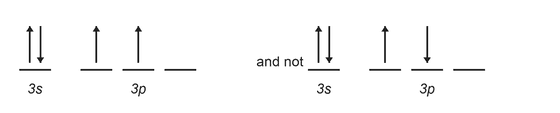
(h) Electrons in singly occupied orbitals tend to have their spins in the same direction.
(i) is more stable than .
(j) Three electrons in orbitals in N-atom are unpaired and have parallel spins.
(k) The three empty degenerate , and orbitals are first singly filled with electrons.
- 1335 marks
Question 133
(a) Write the electronic configuration of the following elements: P, Ca, Cu, Kr, Cr and U. ( for P = 15, Ca = 20, Cu = 29, Kr = 36, Cr = 24 and U = 92)
(b) Write the electronic configuration of Cr ( = 24), Sc ( = 21) and N ( = 7). Decide the possible values of the four quantum numbers for the 19th electron in Cr, 21st electron in Sc and -electrons in N.
(c) How many unpaired electrons () do Fe and have? (Atomic number of Fe = 26 and I = 53)
(d) Write the electronic configuration of the following ions in terms of , , and orbitals: , , , and ( for K, Cu, Au, Mn and I are 19, 29, 79, 25 and 53, respectively).
- 1345 marks
Question 134
Calculate the ratio of the radius of second orbit of H atom to that of third orbit.
- 1355 marks
Question 135
Choose the electronic configurations that are possible from among the following. Explain why the others are impossible?
(i)
(ii)
(iii)
(iv)
- 1365 marks
Question 136
Deduce the possible sets of four quantum numbers when = 2.
- 1375 marks
Question 137
An element has atomic number 12.
(a) Find out its electronic configuration.
(b) Name the element.
(c) Write quantum numbers for the valence-shell electrons of this element.
- 1383 marks
Question 138
Calculate the wave number for the shortest wavelength transition in the Balmer series of atomic hydrogen.
- 1393 marks
Question 139
An electron beam can undergo diffraction by crystals. Through what potential should a beam of electrons be accelerated so that its wavelength becomes equal to 1.54 Å.
- 1403 marks
Question 140
Calculate the energy required to excite one litre of hydrogen gas at 1 atm, and 298 K to the first excited state of atomic hydrogen. The energy for the dissociation of H–H bond is 436 kJ mol⁻¹.
- 1413 marks
Question 141
In H-atom, the electron falls from fifth orbit to second orbit. Calculate the frequency and wavelength of the radiation emitted in this transition. ( cm⁻¹, m s⁻¹)
- 1423 marks
Question 142
The wavelength of high energy transition of H-atoms is 91.2 nm. Calculate the corresponding wavelength of He⁺ ion.
- 1433 marks
Question 143
Calculate the frequency and wave number of radiation with wavelength 480 nm.
- 1443 marks
Question 144
A certain radio station broadcasts on a frequency of 1000 kHz. What is the wavelength of electromagnetic radiation broadcast by the radio station?
- 1453 marks
Question 145
The wavelength range of visible spectrum extends from 380 nm to 780 nm. Express the wavelength in frequencies (Hz).
- 1463 marks
Question 146
Calculate the energy associated with photon of light having a wavelength of 6000 Å. [ erg s]
- 1473 marks
Question 147
Which has a higher energy, a photon of violet light with wavelength 4000 Å or a photon of red light with wavelength 7000 Å? [ J s]
- 1483 marks
Question 148
What is the ratio between the energies of two radiations one with a wavelength of 6000 Å and the other with 2000 Å?
- 1493 marks
Question 149
Calculate the wavelength, wave number and frequency of photon having an energy equal to three electron volts. [ erg s]
- 1503 marks
Question 150
Calculate the energy in kilocalories per mole of the photons of an electromagnetic radiation of wavelength 7600 Å.
- 1513 marks
Question 151
Electromagnetic radiation of wavelength 242 nm is just sufficient to ionise the sodium atom. Calculate the ionisation energy in kJ mol⁻¹, J s.
- 1523 marks
Question 152
How many photons of light having a wavelength 4000 Å are necessary to provide 1.00 J of energy?
- 1533 marks
Question 153
Find the number of quanta of radiations of frequency s⁻¹ that must be absorbed in order to melt 5 g of ice. The energy required to melt 1 g of ice is 333 J.
- 1543 marks
Question 154
Calculate the velocity (cm/sec) of an electron placed in the third orbit of the hydrogen atom. Also calculate the number of revolutions per second that this electron makes around the nucleus.
- 1553 marks
Question 155
The ionisation energy of hydrogen atom is 13.6 eV. What will be the ionisation energy of He⁺ and Li²⁺ ions?
- 1563 marks
Question 156
According to Bohr's theory, the electronic energy of the hydrogen atom in the th Bohr's orbit is given by
Calculate the longest wavelength of light that will be needed to remove an electron from the 3rd orbit of the He⁺ ion.
- 1573 marks
Question 157
Estimate the difference in energy between the first and second Bohr orbit for hydrogen atom. At what minimum atomic number would a transition from to energy level result in the emission of X-rays with m? Which hydrogen like species does this atomic number correspond to?
- 1583 marks
Question 158
Calculate the energy emitted when electrons of 1.0 g atom of hydrogen undergo transition giving the spectral line of lowest energy in the visible region of its atomic spectrum. [ m⁻¹; m s⁻¹; J s]
- 1593 marks
Question 159
Iodine molecule dissociates into atoms after absorbing light of 4500 Å. If one quantum of radiation is absorbed by each molecule, calculate the kinetic energy of iodine atoms. [Bond energy of = 240 kJ mol⁻¹ and J sec]
- 1603 marks
Question 160
Calculate the frequency, energy and wavelength of the radiation corresponding to the spectral line of lowest frequency in Lyman series in the spectra of hydrogen atom. Also calculate the frequency for the corresponding line in the spectra of Li²⁺ ion. [ m⁻¹; m s⁻¹; J s]
- 1613 marks
Question 161
Calculate the wavelength of the radiation emitted producing a line in the Lyman series when an electron falls from fourth stationary state in hydrogen atom. [ m⁻¹]
- 1623 marks
Question 162
Calculate the wave number for the shortest wavelength transition in the Balmer series of atomic hydrogen.
- 1633 marks
Question 163
Consider the hydrogen atom to be a proton embedded in a cavity of radius (Bohr radius), whose charge is neutralised by addition of an electron to the cavity in vacuum, infinitely slowly. Estimate the average of total energy of an electron in its ground state in a hydrogen atom as the work done in the above neutralisation process. Also, if the magnitude of the average kinetic energy is half the magnitude of the average potential energy, find the average potential energy.
- 1643 marks
Question 164
Calculate the wave numbers of lines having
(a) Wavelength 5000 Å
(b) frequency Hz.
- 1653 marks
Question 165
What is the frequency of a visible radiation having a wavelength of 5000 Å?
- 1663 marks
Question 166
A photon of radiation has frequency Hz, calculate its energy ( kJ).
- 1673 marks
Question 167
A photon has wavelength 4500 Å. What is energy associated with it? ( ergs).
- 1683 marks
Question 168
Which has higher energy, a photon of violet light with wavelength 4000 Å or a photon of red light with wavelength 7000 Å? ( joule sec.)
- 1693 marks
Question 169
Calculate the frequency of radiation emitted when an electron drops from a higher energy level to a lower energy level if the difference between the energy of the two energy levels is 214.68 kJ mol⁻¹. ( kJ mole)
- 1703 marks
Question 170
Calculate the wavelength of the radiation emitted when an electron in a hydrogen atoms makes a transition from an energy level with to the level . ( J sec.)
- 1713 marks
Question 171
What will be the frequency of the line in the emission spectrum when an electron of an atom drops from third to the first energy level?
- 1723 marks
Question 172
What will be the wavelength of the spectral line when an electron in a hydrogen atom undergoes a transition from an energy level with to an energy level ?
- 1733 marks
Question 173
An electron moves with a velocity of 10³ m sec⁻¹; calculate the wavelength associated with it.
- 1743 marks
Question 174
Assuming the mass of an electron kg, and energy associated with it J, calculate its velocity and wavelength. ( Js)
- 1753 marks
Question 175
Calculate the wave length of 1000 kg rocket moving with a velocity of 300 km per hour. ( J s)
- 1763 marks
Question 176
Two particles 'X' and 'Y' are in motion. If the particle 'Y' has a momentum half of particle 'X' and the wavelength associated with 'X' is m, calculate the wavelength of particle 'Y'.
- 1773 marks
Question 177
Assuming the mass of a sub-atomic particle kg; calculate the kinetic energy and wavelength associated with it, if it is moving with a velocity of 10³ m sec⁻¹. ( J s)
- 1783 marks
Question 178
What will be the uncertainty in the position of a particle whose uncertainty in momentum is kg m sec⁻¹? ( J s)
- 1793 marks
Question 179
Assuming the mass of an electron kg, calculate the product of uncertainty of displacement and the velocity of an electron. ( Js)
- 1803 marks
Question 180
Calculate the minimum uncertainty in the velocity of a particle of mass kg if uncertainty in position is cm. ( kg m² s⁻¹)
- 1813 marks
Question 181
Calculate the uncertainty in the velocity of a cricket ball of mass 150 g, if the uncertainty in its position is of the order of 1 Å. ( kg m² sec⁻¹)
- 1823 marks
Question 182
The uncertainty in the position and velocity of a particle are m and m s⁻¹ respectively. Calculate the mass of the particle. ( Js)
- 1833 marks
Question 183
The uncertainty in the momentum of a particle is kg m s⁻¹. With what accuracy can its position be determined? (Planck's constant, J s)
- 1843 marks
Question 184
Calculate and compare the energies of two radiations, one with a wavelength of 8000 Å and the other with 4000 Å.
- 1853 marks
Question 185
Calculate the wavelength of a photon in angstroms having an energy of 1 electron volt.
(Hint: m Å)
- 1863 marks
Question 186
A photon of light with wavelength 6000 Å has an energy . Calculate the wavelength of a photon of light which corresponds to an energy equal to .
- 1873 marks
Question 187
Calculate the energy in kilocalorie per mol of the photons of an electromagnetic radiation of wavelength 5700 Å.
- 1883 marks
Question 188
Light of what frequency and wavelength is needed to ionise sodium atom. The ionisation potential of sodium is J.
- 1893 marks
Question 189
Determine the energy of 1 mole photons of radiation whose frequency is s⁻¹. ( J s)
- 1903 marks
Question 190
Calculate the wavelength of spectral line of Balmer series when (or ).
- 1913 marks
Question 191
Calculate the radius of Bohr's 2nd orbit of He⁺ ion.
- 1923 marks
Question 192
What is the velocity of an electron ( kg) in the innermost orbit of the hydrogen atom? [Bohr radius m]
- 1933 marks
Question 193
In a hydrogen atom, an electron jumps from the third orbit to the first orbit. Find out the frequency and wavelength of the spectral line. [ m⁻¹]
- 1943 marks
Question 194
The energy of the electron in the second and third Bohr orbits of hydrogen atom is erg and erg, respectively. Calculate the wavelength of the emitted radiation when the electron drops from third to second orbit.
- 1953 marks
Question 195
Calculate the wavelength in Angstroms of the photon that is emitted when an electron in Bohr orbit returns to the orbit in the hydrogen atom. The ionisation potential of the ground state of hydrogen atom is erg per atom.
(Hint: Energy of the electron in the 1st orbit = – (ionisation potential))
- 1963 marks
Question 196
Calculate the frequency in hertz and wave number of radiation with wavelength 500 nm.
- 1973 marks
Question 197
The frequency of strong yellow line in the spectrum of sodium is s⁻¹. Calculate the wavelength of the light in nanometer.
- 1983 marks
Question 198
Calculate the frequencies of visible light which range between 3800 Å and 7600 Å.
- 1993 marks
Question 199
Calculate the energy of a photon of red light having wavelength 650 nm. [ J s]
- 2003 marks
Question 200
The largest and shortest wavelengths of visible light are 700 nm and 400 nm, respectively. Calculate their frequencies and energies associated with photons. [ J s]
- 2013 marks
Question 201
Find out the wavelength of the next line in the series having lines of spectrum of hydrogen atom of wavelength 6565 Å, 4863 Å, 4342 Å and 4103 Å.
(Hint: All these lines are in visible region and thus belong to Balmer series. Next line is, therefore, from 7th orbit.)
- 2023 marks
Question 202
Calculate the ionisation energy of the hydrogen atom. How much energy will be required to ionise 1 mole of hydrogen atoms? Given that the Rydberg constant is m⁻¹.
- 2033 marks
Question 203
Calculate the wavelength of the photon which will be emitted when the electron of hydrogen atom jumps from second shell to the first shell. The ionisation energy of hydrogen is kJ mol⁻¹.
- 2043 marks
Question 204
An anion has 36 electrons and 45 neutrons. Answer the following:
(a) What is the atomic number of ?
(b) What is the mass number of ?
(c) What is the electronic configuration of ?
(d) What is the group number of ?
- 2053 marks
Question 205
Nitrogen atom has atomic number 7 and oxygen has atomic number 8. Calculate the total number of electrons in the nitrate ion.
- 2063 marks
Question 206
Given below are the sets of quantum numbers for some orbitals. Name these orbitals.
(a) , ,
(b) , ,
(c) , ,
(d) , ,
(e) , ,
- 2073 marks
Question 207
What hydrogen like ion has the wavelength difference between the first line of Balmer and Lyman series equal to 59.3 nm? cm⁻¹.
(Hint: Wavelength of 1st line in Balmer and Lyman series respectively is,
or ; Hydrogen like species is Li²⁺)
- 2083 marks
Question 208
The velocity of electron in certain Bohr orbit of H atom bears the ratio 1 : 275 to the velocity of light.
(a) What is the quantum number '' of the orbit?
(b) Calculate the wave number of the radiation when the electron jumps from state to ground state.
(Hint: (a) or or
(b) Thus, . The electron jumps from 3rd orbit to 1st orbit.)
- 2093 marks
Question 209
According to Bohr's theory, the electronic energy of hydrogen atom in the th Bohr's orbit is given by
Calculate the longest wavelength of light that will be needed to remove an electron from the 2nd orbit of Li²⁺ ion.
- 2103 marks
Question 210
Calculate the ratio of the velocity of light and the velocity of electron in the 2nd orbit of a hydrogen atom. [Given erg s; g; cm]
- 2113 marks
Question 211
The wavelength of a certain line in Lyman series is observed to be 1216 Å. To what value of '' does this correspond? cm⁻¹.
(Hint: )
- 2123 marks
Question 212
If the ionisation potential of hydrogen is 13.6 eV per atom, calculate the ionisation potential of Be³⁺.
- 2133 marks
Question 213
The ionisation energy of He⁺ is J per atom. Calculate the energy of the first energy state of Li²⁺.
What Class 11 Chemistry Ch 2 covers
The sections of the chapter, in the order the book takes them. Every question above comes from one of these.
- 01Subatomic Particles and Atomic Number, Mass Number
- 02Mass Spectrometry and Isotopes
- 03Rutherford's Nuclear Model
- 04Electromagnetic Radiation and Planck's Quantum Theory
- 05Photoelectric Effect
- 06Atomic Spectra
More ways to study this chapter
The same chapter asked three other ways. Practise it, revise it, and see what the board has set on Ch 2 before.
Class 11 Chemistry Ch 2 questions students ask
How many questions are there in Class 11 Chemistry Ch 2?
213 questions. Every one is solved step by step on this page.
Are these Class 11 Chemistry solutions free?
Yes. Every question and its full working is free to read, with no account needed.
Can I download the Class 11 Chemistry Ch 2 solutions as a PDF?
There is no PDF to download. Every solution is on this page instead, which means it is searchable, always the current syllabus, and readable on a phone. Use your browser's print option if you want it on paper.