Solution:
Key idea: each statement follows from a rule of this chapter: Bohr's energy levels, Planck's quanta, Pauli's principle, Hund's rule, the extra stability of half-filled and filled sub-shells, and shielding in many-electron atoms.
Step 1 — (a) Energy of an electron is negative. The zero of energy is taken as the energy of an electron completely removed from the atom (n=∞), at rest and free from the nucleus. When the electron comes under the attraction of the nucleus, energy is released and the electron becomes more stable, so its energy falls below zero. In Bohr's theory
En=−n22.18×10−18 J
The negative sign shows that energy must be supplied to pull the electron away; the more negative the energy, the more tightly the electron is bound.
Step 2 — (b) A bulb seems to give light continuously. By Planck's theory, light is emitted in separate packets (photons), so emission is really discontinuous. But each photon carries very little energy, so an enormous number are emitted every second, and the eye cannot detect the separate packets. Hypothetical example: a 100 W bulb giving all its energy as 600 nm light emits about 3×10²⁰ photons per second, since the energy of one photon is
E=λhc
E=600×10−96.626×10−34×3.0×108
E=3.31×10⁻¹⁹ J
and 3.31×10−19100 is about 3.0×10²⁰.
Step 3 — (c) One electron, many lines. A sample of hydrogen contains a very large number of atoms. In the discharge, different atoms are excited to different higher levels, and their electrons fall back by different jumps (3 → 2, 4 → 2, 2 → 1, 5 → 3 …). Each kind of jump gives a line of its own wavelength, so all these lines appear together in the spectrum.
Step 4 — (d) Two electrons share one orbital. By Pauli's principle two electrons can be in one orbital only if they have opposite spins. Spinning electrons behave like tiny magnets; with opposite spins their magnetic moments point opposite ways, which gives a small magnetic attraction (far weaker than the electrical repulsion). The real reason is energy: the energy needed to pair them (pairing energy) is less than the energy that would be needed to put the second electron into the next higher empty orbital, so pairing in the same orbital is the lower-energy choice.
Step 5 — (e) Cu is [Ar] 3d¹⁰ 4s¹. The 3d and 4s orbitals are very close in energy. A completely filled d sub-shell (d¹⁰) is extra stable because of its symmetrical electron distribution and larger exchange energy. So one 4s electron moves into 3d, giving 3d¹⁰ 4s¹ instead of the expected 3d⁹ 4s².
Step 6 — (f) 2s and 2p in Li and H. In the H atom there is only one electron, no electron–electron repulsion and no shielding, so the energy depends only on n; 2s and 2p (both n = 2) have the same energy. In Li the outer electron is shielded from the nucleus by the two 1s electrons. A 2s electron penetrates closer to the nucleus than a 2p electron, so it is less shielded, feels a larger nuclear attraction and has lower energy. Hence in Li, energy depends on both n and l and 2s < 2p.
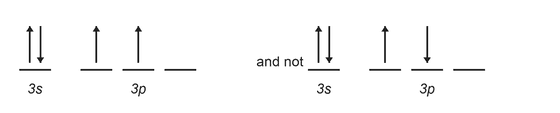
Step 7 — (g) Si has two unpaired 3p electrons with parallel spins. Si (Z = 14) has two 3p electrons. By Hund's rule they occupy two different 3p orbitals singly with parallel spins (maximum multiplicity), which gives the lowest energy because of less repulsion and greater exchange energy. The second diagram, with opposite spins in two different 3p orbitals, is not the ground state.
Step 8 — (h) Parallel spins in singly occupied orbitals. Electrons with parallel spins in degenerate orbitals can exchange places with each other; this exchange releases energy (exchange energy) and lowers the energy of the atom. Parallel spins also keep the electrons farther apart, reducing repulsion. So, by Hund's rule, single electrons in degenerate orbitals have the same spin.
Step 9 — (i) Fe³⁺ is more stable than Fe²⁺. Fe (Z = 26) is [Ar] 3d⁶ 4s². Fe²⁺ (loses the two 4s electrons) is [Ar] 3d⁶; Fe³⁺ (loses one more, from 3d) is [Ar] 3d⁵. The 3d⁵ arrangement of Fe³⁺ is exactly half-filled, which is extra stable (symmetry and maximum exchange energy). So Fe²⁺ tends to lose one more electron and change into Fe³⁺ (for example, Fe²⁺ salts are slowly oxidised by air).
Step 10 — (j) Nitrogen's three 2p electrons. N (Z = 7) is 1s² 2s² 2p³. By Hund's rule the three 2p electrons enter 2px, 2py and 2pz singly, with parallel spins. This half-filled 2p³ arrangement is the most stable: least repulsion and maximum exchange energy.
Step 11 — (k) Degenerate 2p orbitals are singly filled first. The three 2p orbitals have the same energy. Pairing two electrons in one orbital costs energy (they repel each other strongly when confined to the same region). Putting them in separate orbitals of the same energy avoids this pairing energy and allows exchange energy, so each 2p orbital first gets one electron (Hund's rule) before any pairing.
Therefore, all eleven statements follow from the rules of atomic structure: negative energy means a bound electron; photons are too many to notice; many atoms make many jumps; opposite spins and pairing energy allow two electrons in an orbital; d¹⁰ (Cu) and d⁵ (Fe³⁺) are extra stable; shielding and penetration split 2s and 2p in Li; and Hund's rule explains the parallel, single filling in Si, N and the 2p orbitals.