
Opening your dashboard
Class 11 Chemistry Chapter 2 Structure of Atom: Practice Questions
120 questions on Chapter 2, each worked through on its own page with the AI tutor. Class 11 Chemistry, ICSE 2026-27.
120 questions
1–4 marks · Mixed difficulty
- 11 mark
Question 1
The specific charge of a particle is its charge divided by its mass (). Which order of specific charge (smallest first) is correct for an electron, a proton, a neutron and an α-particle?
- 23 marks
Question 2
Heavy water is , where D is deuterium, .
(i) How many neutrons are present in 4.0 g of ?
(ii) How many neutrons are present in 3.6 g of ordinary water, (made of and )?
(iii) The two samples contain the same number of molecules. Explain why they do not contain the same number of neutrons.
(D = 2 u, H = 1 u, O = 16 u; mol⁻¹)
- 31 mark
Question 3
The charge on one electron is C. What is the size of the total charge carried by one mole of electrons? ( mol⁻¹)
- 42 marks
Question 4
Show by calculation that the electrons of a carbon-12 atom make up less than 0.03 % of the atom's mass. What does this tell you about where the mass of an atom is located?
(Mass of an electron = kg; 1 u = kg; the mass of a carbon-12 atom is exactly 12 u.)
- 51 mark
Question 5
When a boron-11 nucleus, , is struck by an α-particle, a nitrogen-14 nucleus, , and a particle X are formed. What is X?
- 63 marks
Question 6
A mass spectrometer shows that natural copper contains two isotopes, and . has an isotopic mass of 62.93 u and makes up 69.15 % of the atoms. The average atomic mass of copper is 63.55 u. Calculate the isotopic mass of .
- 71 mark
Question 7
Bromine has two isotopes, and , present in almost equal amounts. In the mass spectrum of bromine vapour, how many peaks are seen for the ion (one atom of each kind or two of the same), and in what approximate ratio of heights?
- 82 marks
Question 8
In a mass spectrometer, three ions, , and , are accelerated through the same potential and then pass through the same magnetic field. Which ion is deflected the most and which the least? Give a reason.
- 92 marks
Question 9
Living plants take in carbon dioxide containing both and the radioactive isotope , and build both into their sugars in the same way.
(i) Why do the two isotopes take part in the same chemical reactions?
(ii) State one property in which and atoms differ, and explain the difference.
- 101 mark
Question 10
In Rutherford's experiment, suppose the gold foil is replaced by an aluminium foil of the same thickness ( = 79 for gold, 13 for aluminium). What change would be observed in the scattering of the α-particles?
- 113 marks
Question 11
The radius of a nucleus of mass number is given by , where m.
(i) Calculate the radius of the nucleus of .
(ii) Taking the mass of the nucleus as kg, calculate the density of this nucleus.
(iii) Explain why the density of all nuclei comes out about the same.
- 122 marks
Question 12
In Thomson's model, the positive charge of an atom is spread evenly through the whole atom, with electrons embedded in it. Explain why this model could not account for the few α-particles that bounced back from the gold foil in Rutherford's experiment.
- 131 mark
Question 13
A microwave photon and an X-ray photon are both travelling through a vacuum. Which quantity has the same value for both?
- 143 marks
Question 14
Carbon dioxide in the atmosphere absorbs infrared radiation strongly at a wave number of 2350 cm⁻¹. For this radiation, calculate:
(i) the wavelength in micrometres (μm);
(ii) the energy of one photon;
(iii) the energy absorbed per mole of photons, in kJ mol⁻¹.
( J s; m s⁻¹; mol⁻¹)
- 151 mark
Question 15
According to Planck's quantum theory, a body emits radiation of frequency Hz. Which of the following can NOT be the total energy it emits at this frequency? ( J s)
- 162 marks
Question 16
When an iron rod is heated strongly, it first glows dull red, then orange-yellow, and at very high temperature it looks bluish-white. Use Planck's quantum theory to explain this change of colour.
- 173 marks
Question 17
In photosynthesis, chlorophyll absorbs red light of wavelength 680 nm. Assume that 8 such photons must be absorbed to release one molecule of oxygen. Calculate the minimum light energy, in kJ, needed to release one mole of .
( J s; m s⁻¹; mol⁻¹)
- 181 mark
Question 18
Ultraviolet light of wavelength 300 nm falls in turn on clean surfaces of four metals whose work functions are: sodium 2.3 eV, magnesium 3.7 eV, silver 4.3 eV and copper 4.8 eV. From which metals are electrons emitted?
( J s; m s⁻¹; 1 eV = J)
- 193 marks
Question 19
In a photoelectric experiment with a metal surface, the maximum kinetic energy of the emitted electrons was measured at two frequencies (Hypothetical data):
Frequency of light (Hz) Maximum kinetic energy (J) From these data, calculate (i) the value of Planck's constant, (ii) the threshold frequency of the metal, and (iii) its work function in eV. (1 eV = J)
- 201 mark
Question 20
Light of frequency (above the threshold frequency) ejects photoelectrons with maximum kinetic energy from a metal. If the frequency of the light is doubled to , the maximum kinetic energy of the photoelectrons becomes
- 212 marks
Question 21
Potassium has a work function of about 2.3 eV. A very bright red lamp (wavelength 700 nm) shining on potassium ejects no electrons, but a faint violet lamp (wavelength 400 nm) ejects electrons at once. Explain this observation using Einstein's theory.
( J s; m s⁻¹; 1 eV = J)
- 221 mark
Question 22
White light containing ultraviolet, visible and infrared radiation is passed through hydrogen gas at room temperature, and the transmitted light is examined with a spectroscope. The dark absorption lines that appear belong to
- 231 mark
Question 23
In a sample of hydrogen atoms, all the electrons are excited to the level . As they return to the ground state by every possible route, how many different lines of the Balmer series can appear?
- 242 marks
Question 24
A hydrogen atom has only one electron, yet the emission spectrum of hydrogen gas from a discharge tube contains many lines. Explain this, and explain why the spectrum consists of sharp lines rather than a continuous band of colours.
- 251 mark
Question 25
In which Bohr orbit of the ion () is the radius of the orbit equal to the radius of the first Bohr orbit of the hydrogen atom?
- 263 marks
Question 26
The energy of the electron in the th orbit of the hydrogen atom is J. A hydrogen atom has its electron in the orbit .
(a) How much energy is needed to remove this electron completely from the atom?
(b) Express this energy in kJ mol⁻¹ for one mole of such atoms.
(c) Find the longest wavelength of light that can remove the electron from , and name the region of the spectrum it lies in.
( J s, m s⁻¹, mol⁻¹)
- 271 mark
Question 27
According to Bohr's model, the total energy of the electron in a certain orbit of the hydrogen atom is eV. What is the potential energy of the electron in this orbit?
- 283 marks
Question 28
Using Bohr's model, J for a one-electron species of atomic number . The electron of a ion () drops from the orbit to the orbit .
(a) Calculate the energy of the photon emitted.
(b) Calculate its wavelength and say whether this light can be seen by the human eye.
( J s, m s⁻¹)
- 291 mark
Question 29
An electron and a proton are found to have exactly the same de Broglie wavelength. Which statement about them is correct?
- 303 marks
Question 30
Slow-moving ("thermal") neutrons are used to find the positions of atoms in crystals because their de Broglie wavelength is close to the spacing between atoms. A beam of neutrons has a de Broglie wavelength of 0.150 nm.
(a) Calculate the speed of the neutrons.
(b) Calculate the kinetic energy of one neutron in joules.
(c) Express this kinetic energy in electron volts.
(Mass of a neutron = kg, J s, 1 eV = J)
- 312 marks
Question 31
In a low-voltage electron microscope, the electrons in the beam move at m s⁻¹.
(a) Calculate the de Broglie wavelength of these electrons.
(b) Visible light used in an ordinary microscope has a wavelength of about 500 nm. Using your answer to (a), explain why the electron microscope can show much finer detail.
(Mass of an electron = kg, J s)
- 321 mark
Question 32
The kinetic energy of a moving electron is made four times as large. What happens to its de Broglie wavelength?
- 331 mark
Question 33
Heisenberg's uncertainty principle shows that one feature of Bohr's model of the atom cannot be correct. Which feature is it?
- 343 marks
Question 34
Early ideas suggested that electrons might exist inside the nucleus. Take the diameter of a nucleus as about m.
(a) If an electron were confined inside the nucleus, find the minimum uncertainty in its velocity.
(b) Compare this with the speed of light and state what it tells us about electrons in the nucleus.
(Mass of an electron = kg, J s, m s⁻¹)
- 353 marks
Question 35
An electron and a proton are each known to be somewhere within a region 0.10 nm wide.
(a) Calculate the minimum uncertainty in the velocity of the electron.
(b) Calculate the minimum uncertainty in the velocity of the proton.
(c) Find the ratio of the two uncertainties and explain why the uncertainty principle matters much more for electrons.
(Mass of electron = kg, mass of proton = kg, J s)
- 361 mark
Question 36
In a multi-electron atom with no external magnetic field, the energy of an electron is decided by which quantum number(s)?
- 373 marks
Question 37
Consider the shell with principal quantum number .
(a) How many subshells does it have, and what are their letters?
(b) How many orbitals does it have in all, and how many electrons could it hold at most?
(c) No known element has an electron in a 5g orbital in its ground state. Use the rule to explain why.
- 381 mark
Question 38
How many orbitals in an atom have ?
- 393 marks
Question 39
The orbitals of a certain subshell have magnetic quantum numbers .
(a) What is the azimuthal quantum number of this subshell, and what letter is used for it?
(b) What is the smallest principal quantum number for which this subshell can exist?
(c) What is the maximum number of electrons this subshell can hold?
- 401 mark
Question 40
An orbital has two lobes pointing along the +z and −z directions and a doughnut-shaped ring of electron density lying in the xy plane around the nucleus. Which orbital is it?
- 412 marks
Question 41
The shape of an orbital is usually shown by a "boundary surface diagram".
(a) What does a boundary surface diagram represent?
(b) Why is the surface drawn to enclose about 90% of the probability of finding the electron, and not 100%?
- 421 mark
Question 42
The orbital has two nodal planes, on which the probability of finding the electron is zero. These planes are
- 433 marks
Question 43
In many diagrams the two lobes of a orbital are marked "+" and "−".
(a) What do these signs stand for?
(b) Is the electron more likely to be found in the "+" lobe than in the "−" lobe? Explain.
(c) In which plane is the probability of finding a electron zero, and why?
- 442 marks
Question 44
Silicon () and sulphur () have different numbers of electrons in their 3p subshells. Show, with orbital (box) diagrams for the 3p electrons, that both atoms nevertheless have the same number of unpaired electrons in the ground state, and name the rule you used.
- 452 marks
Question 45
Among the elements with atomic numbers 1 to 20, identify the element whose ground-state atom has exactly twice as many electrons in p orbitals as in s orbitals. Show your working.
- 462 marks
Question 46
Exchange energy helps to explain the extra stability of half-filled subshells. Electrons with parallel spins in the orbitals of the same subshell can exchange their positions, and each possible exchange lowers the energy.
(a) Count the number of possible exchanges for the parallel-spin electrons in a configuration and in a configuration.
(b) Use your answer to explain why an atom may prefer to .
- 473 marks
Question 47
Give the atomic number and name of the element with the smallest atomic number whose ground-state atom has:
(a) a completely filled set of 2p orbitals;
(b) at least one electron in a 4p orbital;
(c) a completely filled set of 3d orbitals.
- 481 mark
Question 48
Which of the following electronic configurations represents an excited state (not the ground state) of a neutral atom?
- 494 marks
Question 49
Nickel has atomic number 28.
(a) Using the values of the 4s and 3d subshells, explain why 4s is filled before 3d.
(b) Write the ground-state electronic configuration of nickel.
(c) Write the electronic configuration of the ion and say which electrons are removed when it is formed.
(d) How many unpaired electrons does have? Show the 3d box diagram.
- 501 mark
Question 50
Ionisation energy of is J atom⁻¹. The energy of first stationary state () of is
- 511 mark
Question 51
The frequency of light emitted for the transition to of is equal to the transition in H-atom corresponding to which of the following?
- 521 mark
Question 52
The electrons identified by quantum numbers and :
(1) ,
(2) ,
(3) ,
(4) ,
can be placed in order of increasing energy as
- 531 mark
Question 53
The kinetic energy of an electron in the second Bohr orbit of a hydrogen atom [ is Bohr radius]
- 541 mark
Question 54
Energy of an electron is given by . Wavelength of light required to excite an electron in a hydrogen atom from level to will be ( J s and m s⁻¹)
- 551 mark
Question 55
The atomic masses of He and Ne are 4 and 20 a.m.u., respectively. The value of the de Broglie wavelength of He gas at −73°C is times that of the de Broglie wavelength of Ne at 727°C. is ______.
- 561 mark
Question 56
The correct set of four quantum numbers for the valence electrons of rubidium atom () is ______.
- 571 mark
Question 57
In an atom, the total number of electrons having quantum numbers , and is ______.
- 581 mark
Question 58
Which of the following is the energy of a possible excited state of hydrogen?
- 591 mark
Question 59
Not considering the electronic spin, the degeneracy of the second excited state () of H atom is 9, while the degeneracy of the second excited state of is ______.
- 601 mark
Question 60
A stream of electrons from a heated filament was passed between two charged plates kept at a potential difference e.s.u. If and are charge and mass of an electron respectively, then the value of (where is wavelength associated with electron wave) is given by:
- 611 mark
Question 61
The radius of the second Bohr orbit for hydrogen atom is: (Planck's constant, J s; mass of electron kg; charge of electron C; permittivity of vacuum kg⁻¹ m⁻³ A²)
- 621 mark
Question 62
What is the work function of the metal if the light of wavelength 4000 Å generates photoelectrons of velocity m s⁻¹ from it?
(Mass of electron kg
Velocity of light m s⁻¹
Planck's constant J s
Charge of electron J eV⁻¹)
- 631 mark
Question 63
The 71st electron of an element X with an atomic number of 71 enters into the orbital:
- 641 mark
Question 64
The ratio of the shortest wavelength of two spectral series of hydrogen spectrum is found to be about 9. The spectral series are:
- 651 mark
Question 65
Among the following, the energy of 2s orbital is lowest in:
- 661 mark
Question 66
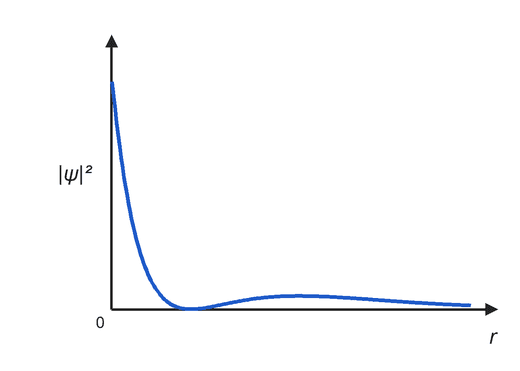
The graph between and (radial distance) is shown below. This represents:
- 671 mark
Question 67
The quantum number of four electrons are given below:
(I) , , ,
(II) , , ,
(III) , , ,
(IV) , , ,
The order of their increasing energies will be:
- 681 mark
Question 68
For any given series of spectral lines of atomic hydrogen, let be the difference in maximum and minimum frequencies in cm⁻¹. The ratio is:
- 691 mark
Question 69
The de Broglie wavelength () associated with a photoelectron varies with the frequency () of the incident radiation as, [ is threshold frequency]:
- 701 mark
Question 70
For emission line of atomic hydrogen from to , the plot of wave number () against will be (The Rydberg constant, is in wave number unit).
- 711 mark
Question 71
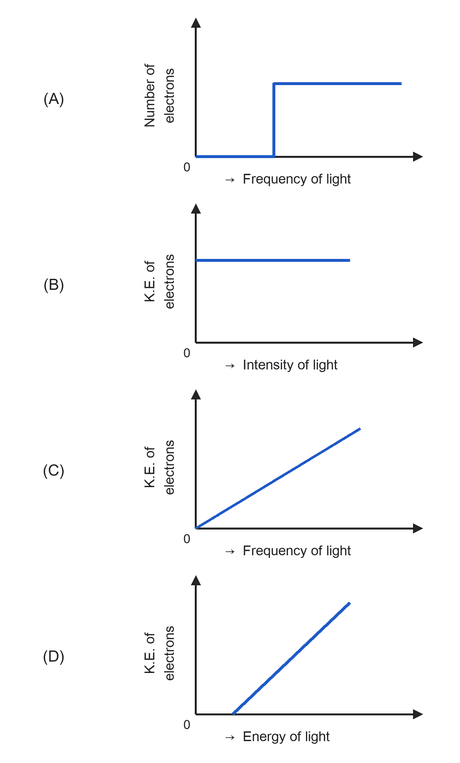
Which of the graphs shown below does not represent the relationship between incident light and the electron ejected from metal surface?
- 721 mark
Question 72
The number of orbitals associated with quantum numbers , is:
- 731 mark
Question 73
For the Balmer series in the spectrum of H atom, , the correct statements among (I) and (IV) are:
(I) As wavelength decreases, the lines in the series converge.
(II) The integer is equal to 2
(III) The lines of longest wavelength corresponds to
(IV) The ionization energy of hydrogen can be calculated from wave number of these lines
- 741 mark
Question 74
The radius of the second Bohr orbit, in terms of the Bohr radius, , in is:
- 751 mark
Question 75
The de Broglie wavelength of an electron in the 4th Bohr orbit is:
- 761 mark
Question 76
The number of subshells associated with and quantum numbers is:
- 771 mark
Question 77
The correct statement about probability density (except at infinite distance from nucleus) is:
- 781 mark
Question 78
The average molar mass of chlorine is 35.5 g mol⁻¹. The ratio of to in naturally occurring chlorine is close to:
- 791 mark
Question 79
The shortest wavelength of H atom in the Lyman series is . The longest wavelength in the Balmer series of is:
- 801 mark
Question 80
The difference between the radii of 3rd and 4th orbits of is . The difference between the radii of 3rd and 4th orbits of is . Ratio is:
- 811 mark
Question 81
The work function of sodium metal is J. If photons of wavelength 300 nm are incident on the metal, the kinetic energy of the ejected electrons will be ( J s; m/s) ______ J.
- 821 mark
Question 82
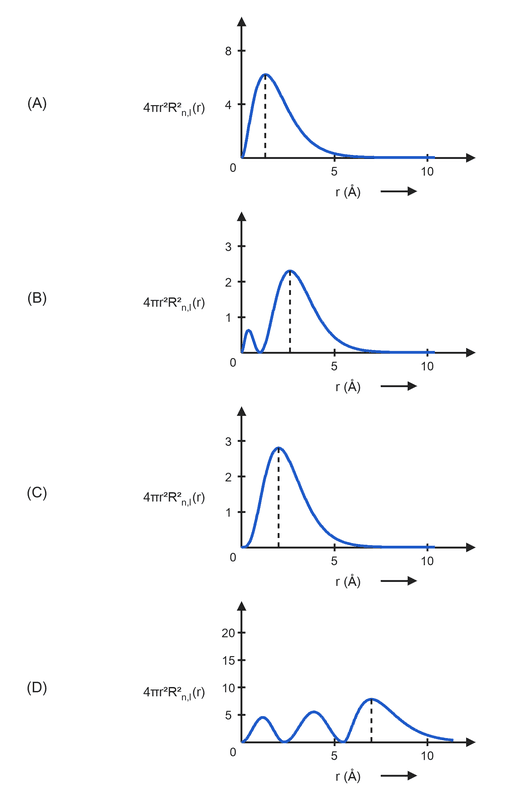
The plots of radial distribution functions for various orbitals of hydrogen atom against '' are given below. The correct plot for 3s-orbital is
- 831 mark
Question 83
The orbital having two radial as well as two angular nodes is:
- 841 mark
Question 84
A certain orbital has no angular node and two radial nodes. The orbital is
- 851 mark
Question 85
Given below are two statements:
Statement I: Bohr's theory accounts for the stability and line spectrum of ion.
Statement II: Bohr's theory was unable to explain the splitting of spectral lines in the presence of a magnetic field.
In the light of above statements, choose the most appropriate answer from the options given below:
- 861 mark
Question 86
The azimuthal quantum number for the valence electrons of ion is ______. (Atomic number of Ga = 31)
- 871 mark
Question 87
Number of electrons that vanadium () has in -orbitals is equal to ______.
- 881 mark
Question 88
The number of photons emitted by a monochromatic (single frequency) infrared range finder of power 1 mW and wavelength of 1000 nm, in 0.1 second is . The value of is ______. (Nearest integer)
- 891 mark
Question 89
A proton and a ion are accelerated by the same potential. If and denote the de Broglie wavelength of and proton, respectively, then the value of is . The value of is ______. (Rounded off to the nearest integer). [Mass of = 8.3 mass of proton]
- 901 mark
Question 90
Electromagnetic radiation of wavelength 663 nm is just sufficient to ionize the atom of metal A. The ionization energy of metal A in kJ mol⁻¹ is ______ (Rounded off to the nearest integer) [ J s, m s⁻¹, mol⁻¹]
- 911 mark
Question 91
A ball weighing 10 g is moving with a velocity of 90 m s⁻¹. If the uncertainty in its velocity is 5%, then the uncertainty in its position is ______ m. (Rounded off to the nearest integer) [Given: J s]
- 921 mark
Question 92
When light of wavelength 248 nm falls on a metal of threshold energy 3.0 eV, the de-Broglie wavelength of emitted electrons is ______ Å. (Rounded off to the nearest integer)
[Use: , J s, kg; m s⁻¹; 1 eV J]
- 931 mark
Question 93
The number of orbitals with , is ______. (Rounded off to the nearest integer).
- 941 mark
Question 94
A certain orbital has and . The number of radial nodes in this orbital is ______. (Rounded off to the nearest integer)
- 951 mark
Question 95
is the probability of finding the 1s electron of hydrogen atom in a spherical shell of infinitesimal thickness , at a distance from the nucleus. The volume of this shell is . The qualitative sketch of the dependence of on is?

- 961 mark
Question 96
The wave function, is a mathematical function whose value depends upon spherical polar coordinates of the electron and characterized by the quantum numbers , and . Here, is distance from nucleus, is colatitude and is azimuth. In the mathematical functions given in the table, is atomic number and is Bohr radius.
Using this information which is available in three columns of the table, answer the following questions:
Column 1 Column 2 Column 3 (I) 1s orbital (i) (P) the graph of against shown below the table (II) 2s orbital (ii) One radial node (Q) Probability density at nucleus (III) orbital (iii) (R) Probability density is maximum at nucleus. (IV) orbital (iv) -plane is a nodal plane (S) Energy needed to excite electron from state to state is times the energy needed to excite electron from state to state Graph (P):

Which of the following options has the correct combination considering List-I and List-II?
(a) (III), (S)
(b) (IV), (Q)
(c) (III), (P)
(d) (IV), (U)
- 971 mark
Question 97
The wave function, is a mathematical function whose value depends upon spherical polar coordinates of the electron and characterized by the quantum numbers , and . Here, is distance from nucleus, is colatitude and is azimuth. In the mathematical functions given in the table, is atomic number and is Bohr radius.
Using this information which is available in three columns of the table, answer the following questions:
Column 1 Column 2 Column 3 (I) 1s orbital (i) (P) the graph of against shown below the table (II) 2s orbital (ii) One radial node (Q) Probability density at nucleus (III) orbital (iii) (R) Probability density is maximum at nucleus. (IV) orbital (iv) -plane is a nodal plane (S) Energy needed to excite electron from state to state is times the energy needed to excite electron from state to state Graph (P):
Which of the following options has the correct combination considering List-I and List-II?
(a) (II), (R)
(b) (II), (Q)
(c) (I), (P)
(d) (I), (T)
- 981 mark
Question 98
For answering questions 49 and 50 use the information given below:
The critical wavelength for producing the photoelectric effect in a metal is 2450 Å. The energy of a quantum at this wavelength is J. The wavelength that would be necessary to produce photoelectrons from metal having twice the kinetic energy of those produced at 2000 Å is Å.
The value of is ______.
- 991 mark
Question 99
For answering questions 49 and 50 use the information given below:
The critical wavelength for producing the photoelectric effect in a metal is 2450 Å. The energy of a quantum at this wavelength is J. The wavelength that would be necessary to produce photoelectrons from metal having twice the kinetic energy of those produced at 2000 Å is Å.
The value of is ______.
- 1001 mark
Question 100
Consider a helium (He) atom that absorbs a photon of wavelength 330 nm. The change in the velocity (in cm s⁻¹) of the He atom after the photon absorption is ______.
(Assume: Momentum is conserved when the photon is absorbed. Use: Planck constant J s, Avogadro number mol⁻¹, Molar mass of He g mol⁻¹)
- 1011 mark
Question 101
The energies and of two radiations are 25 eV and 50 eV, respectively. The relation between their wavelengths i.e., and will be
- 1021 mark
Question 102
If , the correct sequence for filling of electrons will be
- 1031 mark
Question 103
Maximum number of electrons in a subshell with and is
- 1041 mark
Question 104
The correct set of four quantum numbers for the valence electron of rubidium atom () is
- 1051 mark
Question 105
What is the maximum number of electrons that can be associated with the following set of quantum numbers?
, and
- 1061 mark
Question 106
Based on equation , certain conclusions are written. Which of them is not correct?
- 1071 mark
Question 107
The value of Planck's constant is J s. The speed of light is nm s. Which value is closest to the wavelength in nanometer of a quantum of light with frequency of s?
- 1081 mark
Question 108
What is the maximum number of orbitals that can be identified with the following quantum numbers?
, ,
- 1091 mark
Question 109
Calculate the energy in joule corresponding to light of wavelength 45 nm.
(Planck's constant, J s, speed of light, m s)
- 1101 mark
Question 110
The angular momentum of electron in '' orbitals is equal to?
- 1111 mark
Question 111
Which is the correct order of increasing energy of the listed orbitals in the atom of titanium?
(At. no. = 22)
- 1121 mark
Question 112
The number of -electrons in () is not equal to the number of electrons in which one of the following?
- 1131 mark
Question 113
The electrons occupying the same orbital are distinguished by
- 1141 mark
Question 114
How many electrons can fit in the orbital for which and ?
- 1151 mark
Question 115
Which of the following pairs of -orbitals will have electron density along the axis?
- 1161 mark
Question 116
Which one is the wrong statement?
(A) The uncertainty principle is
(B) Half-filled and fully filled orbitals have greater stability due to greater exchange energy, greater symmetry and more balanced arrangement.
(C) The energy of 2-orbital is less than the energy of 2-orbital in case of hydrogen like atoms.
(D) de-Broglie's wavelength is given by , where = mass of the particle, = velocity of the particle.
- 1171 mark
Question 117
Which one is a wrong statement?
- 1181 mark
Question 118
4, 5, 5 and 6 orbitals are arranged in the order of decreasing energy. The correct option is
- 1191 mark
Question 119
Which of the following series of transitions in the spectrum of hydrogen atom falls in visible region?
- 1201 mark
Question 120
A particular station of All India Radio, New Delhi, broadcasts on a frequency of 1,368 kHz (kilohertz). The wavelength of the electromagnetic radiation emitted by the transmitter is:
[speed of light m s]