
Opening your dashboard
Class 11 Biology Chapter 2: Five Kingdom Classification Solutions
41 textbook questions with step-by-step answers, free to read, for ISC 2026-27.
Get talked through Ch 2, not just shown the answer
Reading a finished solution is not the same as being able to do it. The AI tutor takes one question at a time and works it with you, in your own words, until you can.
- Ask it out loud, in your own words
- It gives you the next step, not the answer
- Stuck on part (ii)? Start there
41 questions with solutions
1–5 marks · Mixed difficulty
- 11 mark
Question 1
Who gave the five kingdom classification?
Solve with AIWritten solution
Solution:
Concept: The five kingdom classification (Monera, Protista, Fungi, Plantae and Animalia) replaced the older two kingdom system of Linnaeus, which could not place organisms such as bacteria, fungi and Euglena properly.
Step 1 — Recall the scientist. The five kingdom system was proposed by Robert H. Whittaker, an American ecologist.
Step 2 — Recall the year. He published it in 1969.
Therefore, the five kingdom classification was given by Robert H. Whittaker in 1969.
- 21 mark
Question 2
Which kingdoms did Whittaker add in three kingdom classification?
Solve with AIWritten solution
Solution:
Concept: Ernst Haeckel (1866) proposed a three kingdom classification: Protista, Plantae and Animalia. Whittaker's five kingdom system (1969) kept these three and added two more.
Step 1 — Find the first new kingdom. Whittaker separated all prokaryotes (bacteria and cyanobacteria) into a kingdom of their own, Monera, because their cell structure differs basically from that of all eukaryotes.
Step 2 — Find the second new kingdom. He took the fungi out of Plantae into a kingdom of their own, Fungi, because they have no chlorophyll, have chitin cell walls and absorb their food.
Note: The idea of separate kingdoms for prokaryotes and for fungi had been suggested earlier, but Whittaker's 1969 system brought the five kingdoms together.
Therefore, Whittaker added Kingdom Monera and Kingdom Fungi to the three kingdom classification.
- 31 mark
Question 3
Name five kingdoms of the Whittaker classification.
Solve with AIWritten solution
Solution:
Concept: R.H. Whittaker (1969) divided living organisms into five kingdoms, using cell structure, body organisation, mode of nutrition, reproduction and evolutionary relationships.
Step 1 — Name the prokaryotic kingdom. Monera contains the prokaryotes, such as bacteria.
Step 2 — Name the unicellular eukaryotic kingdom. Protista contains the single-celled eukaryotes, such as Euglena and Amoeba.
Step 3 — Name the three multicellular eukaryotic kingdoms. Fungi are heterotrophs that absorb their food, Plantae are photosynthetic, and Animalia are heterotrophs that take in their food.
Therefore, the five kingdoms are Monera, Protista, Fungi, Plantae and Animalia.
- 41 mark
Question 4
What kind of organisms are included in Kingdom Fungi?
Solve with AIWritten solution
Solution:
Concept: Kingdom Fungi contains eukaryotic heterotrophs that digest food outside their body and absorb it. Their body is usually a network of thread-like hyphae (a mycelium), and their cell walls are made of chitin.
Step 1 — Describe the cell type. Fungi have a true nucleus, so they are eukaryotic.
Step 2 — Describe the body. Most fungi are multicellular (hyphae forming a mycelium), but yeasts are unicellular.
Step 3 — Describe their nutrition. Fungi have no chlorophyll, so they are heterotrophs. Most are saprophytes on dead organic matter; some are parasites, and some live in partnerships, as in lichens and mycorrhiza.
Therefore, Kingdom Fungi includes unicellular or multicellular eukaryotic organisms without chlorophyll, with chitin cell walls, which are mainly saprophytic in nutrition.
- 51 mark
Question 5
To which group do the following belong to?
(i) Unicellular prokaryotes
(ii) Unicellular eukaryotes
Solve with AIWritten solution
Solution:
Concept: In the five kingdom system, single-celled organisms are placed by their cell type: prokaryotes, with no nuclear membrane, go to Monera, and eukaryotes, with a membrane-bound nucleus, go to Protista.
Step 1 — Place part (i). Unicellular prokaryotes, such as bacteria and cyanobacteria, belong to Kingdom Monera.
Step 2 — Place part (ii). Unicellular eukaryotes, such as Amoeba, Euglena and diatoms, belong to Kingdom Protista.
Therefore, (i) unicellular prokaryotes belong to Kingdom Monera and (ii) unicellular eukaryotes belong to Kingdom Protista.
- 61 mark
Question 6
Which group contains bacteria?
Solve with AIWritten solution
Solution:
Concept: Bacteria are prokaryotes: their cells have no nuclear membrane and no membrane-bound organelles. In the five kingdom system all prokaryotes are placed in Kingdom Monera.
Step 1 — Identify the cell type of bacteria. Bacteria are prokaryotic.
Step 2 — Place them. Prokaryotes belong to Kingdom Monera, so bacteria are placed in Monera.
Note: In the modern three-domain system, bacteria form the domain Bacteria.
Therefore, bacteria belong to Kingdom Monera.
- 71 mark
Question 7
What are Archaebacteria?
Solve with AIWritten solution
Solution:
Concept: Archaebacteria are prokaryotes placed in Kingdom Monera in the five kingdom system. They differ from the true bacteria (eubacteria) in the make-up of their cell walls and cell membranes, and many of them live in extreme habitats.
Step 1 — Describe their cells. Archaebacteria have prokaryotic cells. Their cell walls contain no peptidoglycan, and their cell membranes are built from unusual ether-linked lipids.
Step 2 — Name their main groups. Halophiles live in extremely salty areas, thermoacidophiles in hot acidic springs, and methanogens in marshes and in the gut of ruminants such as cows, where they produce methane (biogas).
Step 3 — Explain their place today. Carl Woese showed, by comparing their ribosomal RNA, that they are very different from the bacteria. In the three-domain system (1990) they form a separate domain, Archaea, which is in some ways closer to the eukaryotes than to the bacteria.
Note: The name 'archaebacteria' means 'ancient bacteria'. It was given because their extreme habitats were thought to resemble those of the early Earth; it does not mean they have been shown to be older than the bacteria.
Therefore, archaebacteria are prokaryotes, often of extreme habitats, whose cell walls lack peptidoglycan and whose membranes have unusual lipids; today they form the separate domain Archaea.
- 81 mark
Question 8
Mention two important groups of Eubacteria.
Solve with AIWritten solution
Solution:
Concept: Eubacteria are the 'true bacteria'. Most of them have peptidoglycan in their cell walls, which archaebacteria lack. The chapter divides them into two groups.
Step 1 — Name the first group. Cyanobacteria (blue-green algae) are photosynthetic eubacteria with chlorophyll a that release oxygen; some, such as Nostoc and Anabaena, also fix nitrogen.
Step 2 — Name the second group. The other true bacteria are mostly heterotrophs (decomposers and parasites); a few make their own food, either by a kind of photosynthesis that releases no oxygen or by chemosynthesis.
Therefore, the two important groups of eubacteria are (i) cyanobacteria and (ii) bacteria.
- 91 mark
Question 9
What are mycoplasmas?
Solve with AIWritten solution
Solution:
Concept: Mycoplasmas are bacteria of Kingdom Monera that have no cell wall. They are among the smallest known cells able to grow and multiply on their own (about 0.2–0.3 µm across).
Step 1 — Place them. Mycoplasmas are prokaryotes, so they belong to Kingdom Monera.
Step 2 — Give their special feature. They have no cell wall, only a cell membrane, so they have no fixed shape; most can live with or without oxygen.
Step 3 — Give their importance. Many are parasites that cause diseases in plants and animals, including a type of pneumonia in humans.
Therefore, mycoplasmas are among the smallest known prokaryotes, and they have no cell wall.
- 101 mark
Question 10
Name important groups of Kingdom Protista?
Solve with AIWritten solution
Solution:
Concept: Kingdom Protista holds the unicellular eukaryotes. In this textbook they are sorted into groups by their mode of nutrition: those that make food by photosynthesis, those that feed on dead matter, and the animal-like forms that eat other organisms.
Step 1 — Find the plant-like group. Protists that have chlorophyll and make their own food are the photosynthetic protista (protistan algae): chrysophytes such as diatoms, dinoflagellates and euglenoids.
Step 2 — Find the fungus-like group. Protists that live on dead and decaying matter are the saprophytic protista, the slime moulds.
Step 3 — Find the animal-like group. Protists that capture or take in food like animals, or live as parasites, are the protozoans (amoeboid, flagellated, ciliated and sporozoans).
Note: Counted group by group, the same organisms form five groups: chrysophytes, dinoflagellates, euglenoids, slime moulds and protozoans. Protista is a convenient grouping, not a natural one; its members belong to several separate evolutionary lines.
Therefore, the important groups of Kingdom Protista are the photosynthetic protista, the saprophytic protista (slime moulds) and the protozoans.
- 111 mark
Question 11
Name four major groups of protozoans.
Solve with AIWritten solution
Solution:
Concept: Protozoans are unicellular, eukaryotic, heterotrophic protists with no cell wall. They are divided into groups mainly by how they move (their locomotory structures).
Step 1 — Group those that move by pseudopodia. Protozoans that move and catch food with false feet (pseudopodia) are the amoeboid protozoans, e.g. Amoeba and Entamoeba.
Step 2 — Group those that move by flagella. Protozoans that swim with one or more whip-like flagella are the flagellated protozoans, e.g. Trypanosoma.
Step 3 — Group those that move by cilia. Protozoans covered with many short cilia are the ciliated protozoans, e.g. Paramecium.
Step 4 — Group those with no locomotory organs. Protozoans that are parasites, with no pseudopodia, flagella or cilia and with an infectious spore-like stage in their life cycle, are the sporozoans, e.g. Plasmodium.
Therefore, the four major groups of protozoans are amoeboid protozoans, flagellated protozoans, ciliated protozoans and sporozoans.
- 121 mark
Question 12
Give three important features of Kingdom Fungi.
Solve with AIWritten solution
Solution:
Concept: Kingdom Fungi is a separate kingdom in Whittaker's system because fungi are eukaryotes that lack chlorophyll and feed by absorbing food, unlike plants (which photosynthesise) and animals (which ingest food).
Step 1 — State the cell type. Fungi are eukaryotic: their cells have a true nucleus and membrane-bound organelles, and the walls are rigid and made of chitin and other polysaccharides.
Step 2 — State the mode of nutrition. Fungi have no chlorophyll, so they are heterotrophic; they absorb food that has already been made by other organisms.
Step 3 — State the main way they get food. Most fungi are saprophytic: they grow on dead and decaying organic matter, digest it outside the body and absorb it. A few are parasites, and some live in symbiosis (lichens, mycorrhizae).
Therefore, three important features of fungi are that they are eukaryotic (with chitin cell walls), heterotrophic, and mainly saprophytic.
- 131 mark
Question 13
To which kingdom do the following belong?
(i) Amoeba
(ii) Mushroom
(iii) Bacteria
(iv) Slime mould
Solve with AIWritten solution
Solution:
Concept: In Whittaker's five kingdom system, prokaryotes go to Monera, unicellular eukaryotes to Protista, and multicellular eukaryotes to Fungi (absorb food, no chlorophyll), Plantae (photosynthetic) or Animalia (ingest food, no cell wall).
Step 1 — Place Amoeba. Amoeba is a single eukaryotic cell that moves by pseudopodia and engulfs food, so it is an amoeboid protozoan in Kingdom Protista.
Step 2 — Place the mushroom. A mushroom has a body of hyphae with chitin walls, no chlorophyll, and absorbs food from decaying matter, so it belongs to Kingdom Fungi.
Step 3 — Place bacteria. Bacteria are prokaryotes with no nuclear membrane, so they belong to Kingdom Monera.
Step 4 — Place the slime mould. Slime moulds are eukaryotes with no cell wall in the feeding stage and feed on decaying matter, so they are the saprophytic protists of Kingdom Protista.
Note: Whittaker's original 1969 scheme kept slime moulds with the fungi; today they are known to be close relatives of amoebae (the group Amoebozoa), which supports keeping them among the protists.
Therefore, Amoeba belongs to Protista, the mushroom to Fungi, bacteria to Monera and the slime mould to Protista.
- 141 mark
Question 14
The metazoans without cell walls with eukaryote cells are placed in which kingdom?
Solve with AIWritten solution
Solution:
Concept: Metazoans are multicellular animals. Whittaker separated the multicellular eukaryotes by cell wall and nutrition: plants have cellulose walls, fungi have chitin walls, and animals have no cell wall at all.
Step 1 — Read the clues. The organisms are eukaryotic, multicellular (metazoans) and their cells have no cell walls.
Step 2 — Match the clues to a kingdom. Plantae and Fungi both have cell walls, so they are ruled out. Multicellular eukaryotes without cell walls, which take in food by ingestion, are animals.
Therefore, such organisms are placed in Kingdom Animalia.
- 151 mark
Question 15
Which group is known as decomposers and mineralisers in the biosphere?
Solve with AIWritten solution
Solution:
Concept: Decomposers break down dead plants and animals; mineralisers turn the organic matter into simple inorganic minerals (ammonia, nitrates, phosphates, sulphates) that plants can absorb again.
Step 1 — Name the group. Most heterotrophic bacteria are saprophytes, so bacteria (Kingdom Monera) are the major decomposers in nature.
Step 2 — Explain why they are also called mineralisers. As bacteria break down dead matter they release its nitrogen, sulphur and phosphorus as simple minerals, so the nutrients are recycled for plants.
Note: Fungi are the other major decomposers, especially of wood and leaf litter; the phrase "decomposers and mineralisers of the biosphere" is used for the bacteria.
Therefore, the bacteria of Kingdom Monera are known as the decomposers and mineralisers of the biosphere.
- 161 mark
Question 16
State economically important uses of methanogens.
Solve with AIWritten solution
Solution:
Concept: Methanogens are archaebacteria that live where there is no oxygen. They make methane (CH₄) from simple compounds such as carbon dioxide and hydrogen, or acetic acid, that other microbes release when they break down organic matter.
Step 1 — Say where they live. Methanogens live in marshes, paddy fields, sewage sludge and the rumen (gut) of cattle and buffaloes, so cattle dung is rich in them.
Step 2 — Give the main use. In a biogas (gobar gas) plant, cattle dung is fed into a closed tank without air. Other bacteria break the dung down, and the methanogens turn the products into methane-rich biogas, used as fuel for cooking and lighting.
Step 3 — Give the second use. The slurry left after biogas production is a good manure for fields, and the same methane-forming process is used to treat sewage in sludge digesters.
Watch out: Methanogens do not digest cellulose themselves. In the rumen, cellulose is broken down by other bacteria, protozoa and fungi; the methanogens use the hydrogen and carbon dioxide those microbes release.
Therefore, methanogens are used to produce biogas (methane fuel) from cattle dung, with manure as a by-product, and in sewage treatment.
- 171 mark
Question 17
What is the nature of cell walls in diatoms?
Solve with AIWritten solution
Solution:
Concept: Diatoms are chrysophytes (photosynthetic protists). Their wall, called a frustule, is made largely of silica, the material of glass.
Step 1 — State what the wall is made of. The cell wall is embedded with glass-like silica, so it is hard and almost indestructible.
Step 2 — State the shape of the wall. The wall is in two thin overlapping halves (the larger epitheca and the smaller hypotheca) that fit together like a soap box and its lid.
Step 3 — Say why this matters. Because the silica walls do not decay, dead diatoms pile up on the sea floor over millions of years as diatomaceous earth, used in polishing, filtration of oils and syrups, and as an insulating material.
Therefore, diatom cell walls are made of silica and are in two overlapping halves that fit like a soap box, which makes them almost indestructible.
- 181 mark
Question 18
Find out what do the terms 'algal bloom' signify.
Solve with AIWritten solution
Solution:
Concept: An algal bloom is a sudden, very rapid growth of algae or cyanobacteria (blue-green algae, which are really bacteria) in a water body, so that the water turns green or another colour and is covered with a scum.
Step 1 — State the cause. Blooms form when water receives large amounts of nutrients, mainly nitrates and phosphates from sewage, detergents and fertiliser run-off. This enrichment is called eutrophication. Cyanobacteria such as Microcystis, Anabaena and Nostoc then multiply very fast.
Step 2 — State the effects. The thick layer cuts off light from plants below. When the bloom dies, bacteria decompose it and use up the dissolved oxygen, so fish and other animals die. Some cyanobacteria also release toxins that harm animals and people.
Step 3 — State what a bloom signifies. A bloom is a sign that the water is polluted with nutrients and that its quality is falling.
Therefore, an algal bloom signifies nutrient pollution (eutrophication) of a water body, which lowers its oxygen and can make it toxic.
- 191 mark
Question 19
What is red tide?
Solve with AIWritten solution
Solution:
Concept: Dinoflagellates are mostly marine, photosynthetic protists. Some red-coloured kinds can multiply so fast that they change the colour of the sea.
Step 1 — State what happens. Under warm, nutrient-rich conditions, red dinoflagellates such as Gonyaulax (and the related Alexandrium) undergo rapid multiplication; the water contains so many of them that the sea appears red.
Step 2 — State why it is harmful. These dinoflagellates release toxins, which may kill fish and other marine animals. Shellfish that feed on them store the toxin, and people who eat such shellfish can be poisoned.
Therefore, a red tide is a bloom of red dinoflagellates such as Gonyaulax that colours the sea red and releases toxins harmful to marine life.
- 202 marks
Question 20
Why can not Euglena be placed into kingdom plantae?
Solve with AIWritten solution
Solution:
Concept: Kingdom Plantae contains multicellular, eukaryotic, photosynthetic organisms with a rigid cellulose cell wall that cannot move about. An organism that lacks these features cannot be placed there.
Step 1 — Compare the body and the wall. Euglena is unicellular and has no cell wall; instead it has a flexible, protein-rich pellicle. Plants are multicellular and have a rigid cellulose wall.
Step 2 — Compare movement. Euglena swims actively with a flagellum, whereas plants are fixed and cannot move from place to place.
Step 3 — Compare nutrition. Euglena has chlorophyll and photosynthesises in light, but in the dark it becomes heterotrophic and takes organic food from its surroundings, like an animal. Plants are autotrophic throughout.
Step 4 — Place it. Because it has features of both plants and animals and is a single eukaryotic cell, it is placed among the euglenoids in Kingdom Protista.
Therefore, Euglena is not placed in Plantae because it is unicellular, has no cell wall, moves by a flagellum and can be heterotrophic; it is placed in Protista.
- 212 marks
Question 21
Give disadvantages of the two kingdom classification.
Solve with AIWritten solution
Solution:
Concept: The two kingdom classification (Linnaeus, 18th century) sorted all living things into Plantae and Animalia using only simple features such as movement and the presence of a cell wall.
Step 1 — Give the first disadvantage. It did not separate prokaryotes from eukaryotes. Bacteria and blue-green algae (cyanobacteria), which have no true nucleus, were put in Plantae with eukaryotic plants.
Step 2 — Give the second disadvantage. It did not separate organisms by mode of nutrition or wall type. Non-photosynthetic fungi with chitin walls were grouped with photosynthetic green plants with cellulose walls.
Step 3 — Give a third disadvantage. Unicellular and multicellular organisms were put in the same kingdom, and organisms such as Euglena and slime moulds fitted neither kingdom.
Therefore, the two kingdom system wrongly grouped prokaryotes with eukaryotes, fungi with green plants, and unicellular with multicellular organisms.
- 222 marks
Question 22
Give two shortcomings of two kingdom classification.
Solve with AIWritten solution
Solution:
Concept: A good classification must use features that show real differences, such as cell structure, body organisation, mode of nutrition, reproduction and evolutionary relationships. The two kingdom system used only simple features such as movement and the cell wall.
Step 1 — Give the first shortcoming. It was based on simple outward features only and ignored cell structure, the nature of the cell wall and the mode of nutrition. As a result prokaryotes and eukaryotes were placed together, and heterotrophic fungi were placed with autotrophic green plants.
Step 2 — Give the second shortcoming. Many organisms did not fit either kingdom. Euglena has plant features (chlorophyll) and animal features (movement, heterotrophy in the dark); slime moulds have no cell wall while feeding but form walled spores; lichens are a partnership of a fungus and an alga.
Therefore, the two kingdom system ignored cell structure and nutrition, and many organisms such as Euglena, slime moulds and lichens could not be placed in either kingdom.
- 233 marks
Question 23
Name major important groups of kingdom monera with one example of each group.
Solve with AIWritten solution
Solution:
Concept: Kingdom Monera holds all prokaryotes: single cells with no nuclear membrane. In this textbook it is divided into archaebacteria and eubacteria (true bacteria), and the eubacteria include the cyanobacteria.
Step 1 — Name the first group. Archaebacteria live in extreme places such as very salty water, hot springs and oxygen-free marshes. Example: methanogens, which produce methane in marshes and in the rumen of cattle (others are halophiles and thermoacidophiles).
Step 2 — Name the second group. Cyanobacteria (blue-green algae) are photosynthetic eubacteria with chlorophyll a. Example: Nostoc.
Step 3 — Name the third group. The other eubacteria (true bacteria) are non-photosynthetic, and may be saprophytes, parasites or symbionts. Example: Rhizobium, which fixes nitrogen in the root nodules of leguminous plants.
Note: The name "archaebacteria" (ancient bacteria) comes from an early guess that they are the oldest life; today they are placed in a separate domain, Archaea. Archaea and Bacteria both go back to the same common ancestor, and Archaea are in some ways closer to eukaryotes.
Therefore, the groups are archaebacteria (methanogens), cyanobacteria (Nostoc) and true bacteria (Rhizobium).
- 243 marks
Question 24
Give four important groups of kingdom monera.
Solve with AIWritten solution
Solution:
Concept: Kingdom Monera includes all prokaryotes, cells with no true nucleus and no membrane-bound organelles. They differ in their walls, habitats and nutrition.
Step 1 — Describe archaebacteria. Archaebacteria live in extreme habitats: halophiles in very salty water, thermoacidophiles in hot acidic springs and methanogens in oxygen-free marshes. Their wall has no murein (it is made of other polysaccharides and proteins), and their membrane lipids are of a special kind that helps them survive.
Step 2 — Describe cyanobacteria. Cyanobacteria (blue-green algae) are photosynthetic eubacteria with chlorophyll a. Some fix nitrogen in special cells called heterocysts, e.g. Nostoc and Anabaena.
Step 3 — Describe true bacteria. True bacteria (eubacteria) have a cell wall of murein (peptidoglycan). They may be autotrophs (chemosynthetic) or heterotrophs (saprophytes, symbionts, parasites), e.g. Rhizobium.
Step 4 — Describe mycoplasmas. Mycoplasmas (PPLO) have no cell wall, so they change shape easily. They are among the smallest known cells (about 0.1–0.3 µm) and can live without oxygen; some cause diseases in plants and animals.
Note: Archaebacteria were named "ancient bacteria" on an early guess; they are now a separate domain, Archaea, and both Archaea and Bacteria go back to the same common ancestor.
Therefore, the four important groups of Monera are archaebacteria, cyanobacteria, true bacteria (eubacteria) and mycoplasmas.
- 253 marks
Question 25
Why are fungi called saprophytes?
Solve with AIWritten solution
Solution:
Concept: A saprophyte is an organism that obtains its food from dead and decaying organic matter by digesting it outside its body and absorbing the products.
Step 1 — Show that fungi cannot make food. Fungi have no chlorophyll, so they cannot photosynthesise; they must get ready-made food, which makes them heterotrophic.
Step 2 — Show where most fungi get food. Most fungi grow on dead organic matter such as stale bread, rotten fruit, fallen leaves, wood and leather. Their hyphae release enzymes into it, break it down and absorb the simple nutrients.
Step 3 — Link this to the name. Since this is the main way fungi feed, they are called saprophytes. In doing so they act as major decomposers, returning minerals to the soil. A smaller number are parasites or symbionts.
Therefore, fungi are called saprophytes because, lacking chlorophyll, most of them live on dead and decaying organic matter and absorb food from it.
- 263 marks
Question 26
Why are deuteromycetes called 'imperfect fungi'?
Solve with AIWritten solution
Solution:
Concept: In fungi the sexual stage is called the perfect stage and the asexual stage the imperfect stage. Fungi were classified into classes mainly by the kind of sexual spores they form.
Step 1 — State what is missing. In deuteromycetes, only the asexual (vegetative) phase is known; their sexual stage has not been observed.
Step 2 — State how they reproduce. They reproduce only by asexual spores called conidia. Their mycelium is septate and branched.
Step 3 — Explain the name. Because the perfect (sexual) stage is unknown, they are called imperfect fungi. When the sexual stage of a member is discovered, it is moved to the Ascomycetes or Basidiomycetes. Examples: Alternaria, Colletotrichum, Trichoderma.
Note: Today DNA comparison is used to place these fungi even without a sexual stage; most of them turn out to be Ascomycetes, so Deuteromycetes is a convenient group, not a natural class.
Therefore, deuteromycetes are called imperfect fungi because only their asexual stage is known and no sexual (perfect) stage has been seen.
- 272 marks
Question 27
Differentiate between: Two kingdom and five kingdom classification
Solve with AIWritten solution
Solution:
Concept: A classification is judged by the criteria it uses. The two kingdom system used only simple visible features; Whittaker's five kingdom system added cell structure, body organisation and mode of nutrition.
Step 1 — Compare who proposed them and how many kingdoms there are. The two kingdom system goes back to Carolus Linnaeus (Systema Naturae, 10th edition 1758) and has only Plantae and Animalia. The five kingdom system was proposed by R.H. Whittaker in 1969 and has Monera, Protista, Fungi, Plantae and Animalia.
Step 2 — Compare the basis and the results. The table sets the two systems side by side.
Feature Two kingdom classification Five kingdom classification Proposed by Carolus Linnaeus (18th century) R.H. Whittaker (1969) Number of kingdoms Two: Plantae and Animalia Five: Monera, Protista, Fungi, Plantae, Animalia Basis Simple features such as movement, mode of feeding and presence of a cell wall Complexity of cell (prokaryotic or eukaryotic), complexity of body (unicellular or multicellular) and mode of nutrition Prokaryotes Bacteria and blue-green algae placed with plants Placed in a separate kingdom, Monera Fungi Placed with green plants Placed in a separate kingdom, Fungi Unicellular eukaryotes Split between plants and animals; Euglena fits neither Grouped together in Protista Therefore, the two kingdom system used simple features and had only Plantae and Animalia, while Whittaker's five kingdom system used cell structure, body organisation and nutrition to form five kingdoms.
- 282 marks
Question 28
Differentiate between: Archaebacteria and Eubacteria
Solve with AIWritten solution
Solution:
Concept: Both groups are prokaryotes (no nuclear membrane), but they differ in their cell wall, membrane lipids and habitats, so they are placed in separate groups.
Step 1 — Note what the names mean. "Archaebacteria" means ancient bacteria, a name given when they were thought to be the oldest life. Today they are a separate domain, Archaea; both Archaea and Bacteria go back to the same common ancestor. "Eubacteria" means true bacteria.
Step 2 — Compare them feature by feature. The table shows the main differences.
Feature Archaebacteria Eubacteria Habitat Many live in extreme conditions: very salty water (halophiles), hot acidic springs (thermoacidophiles), oxygen-free marshes (methanogens) Found almost everywhere: soil, water, air and inside other organisms Cell wall No murein; made of other polysaccharides and proteins Contains murein (peptidoglycan) Membrane lipids Special branched lipids joined by ether links, which stay stable in heat and salt Ordinary lipids joined by ester links, as in eukaryotes Nutrition Many are chemosynthetic (methanogens make methane) Photosynthetic, chemosynthetic or heterotrophic Examples Halophiles, methanogens, thermoacidophiles Cyanobacteria (Nostoc), true bacteria (Rhizobium) Therefore, archaebacteria differ from eubacteria in lacking murein in the wall, in their special membrane lipids and in living mostly in extreme habitats.
- 292 marks
Question 29
Differentiate between: Chrysophytes and Dinoflagellates
Solve with AIWritten solution
Solution:
Concept: Chrysophytes and dinoflagellates are both photosynthetic protists (protistan algae), but they differ in habitat, wall and movement.
Step 1 — Identify the members. Chrysophytes include the diatoms and golden-brown algae. Dinoflagellates are mostly marine forms that may be yellow, green, brown, blue or red.
Step 2 — Compare them feature by feature. The table shows the differences.
Feature Chrysophytes Dinoflagellates Habitat Fresh water as well as the sea Mostly marine Cell wall Diatom walls are two thin overlapping halves rich in silica, fitting like a soap box A stiff wall of cellulose plates (armour) on the outer surface Movement Most float passively in water currents as plankton Two flagella: one runs lengthwise and the other lies across the cell in a groove Special features Silica walls pile up as diatomaceous earth; diatoms are the chief producers of the oceans Some are bioluminescent; red forms cause red tides Examples Triceratium, Chrysosphaerella Gonyaulax, Glenodinium Therefore, chrysophytes have silica-rich walls and mostly float passively in fresh water or the sea, while dinoflagellates are mostly marine, have cellulose-plate walls and swim with two flagella.
- 302 marks
Question 30
Differentiate between: Amoeboid and Ciliated protozoans
Solve with AIWritten solution
Solution:
Concept: Protozoans are grouped by their locomotory structures. Amoeboid forms move by pseudopodia; ciliated forms move by many short cilia.
Step 1 — Recall the two groups. Amoeboid protozoans (such as Amoeba) have no fixed shape. Ciliated protozoans (such as Paramecium) have a definite shape and are covered with cilia.
Step 2 — Compare them feature by feature. The table shows the differences.
Feature Amoeboid protozoans Ciliated protozoans Locomotion Pseudopodia (false feet) Cilia, short hair-like threads covering the body Shape No definite shape Definite, characteristic shape Habitat Fresh water, sea water or moist soil; some are parasites Aquatic, actively moving Feeding Engulf food by surrounding it with pseudopodia Beating cilia drive water with food through the oral groove into the gullet Examples Amoeba, Entamoeba Paramecium, Vorticella Therefore, amoeboid protozoans move and feed by pseudopodia and have no fixed shape, while ciliated protozoans move by cilia, have a definite shape and feed through a gullet.
- 312 marks
Question 31
Differentiate between: Ascomycetes and Basidiomycetes
Solve with AIWritten solution
Solution:
Concept: Ascomycetes and basidiomycetes are fungi with septate, branched hyphae. They are told apart by where their sexual spores form: inside a sac (ascus) or outside on a club (basidium).
Step 1 — Recall the common names. Ascomycetes are the sac fungi; basidiomycetes are the club fungi.
Step 2 — Compare them feature by feature. The table shows the differences.
Feature Ascomycetes Basidiomycetes Common name Sac fungi Club fungi Asexual reproduction By conidia formed outside (exogenously) on conidiophores; yeast buds Asexual spores generally not found; mainly by fragmentation (rusts are an exception: they form asexual spores) Sexual spores Ascospores, formed inside sac-like asci Basidiospores, formed outside on club-shaped basidia Fruiting body Ascocarp Basidiocarp (for example a mushroom) Examples Yeast, Penicillium, Aspergillus, Claviceps Agaricus, Ustilago (smut), Puccinia (rust) Therefore, ascomycetes form ascospores inside asci and reproduce asexually by conidia, while basidiomycetes form basidiospores outside on basidia and mostly multiply asexually by fragmentation.
- 325 marks
Question 32
List major disputes in placements of groups in two kingdom classification.
Solve with AIWritten solution
Solution:
Concept: In the two kingdom system every organism had to be a plant or an animal. A group whose features are partly plant-like and partly animal-like, or neither, causes a dispute over where it belongs.
Step 1 — Describe the dispute over Euglena. Single-celled organisms such as Euglena have chlorophyll and make food like plants in light, but they swim with a flagellum, have no cell wall and become heterotrophic in the dark, like animals. They could not be fitted into either kingdom.
Step 2 — Describe the dispute over slime moulds. Slime moulds have no cell wall in their feeding stage and move about engulfing food like animals, but they form walled spores in fruiting bodies like plants or fungi.
Step 3 — Describe the dispute over fungi. Fungi lack chlorophyll and absorb food from dead matter, and their walls are made of chitin, not cellulose. Yet they were placed with green plants only because they have a cell wall and do not move.
Step 4 — Describe the dispute over lichens. Lichens grow on rocks and tree bark and look like crusts. Each lichen is a partnership of a fungus and an alga (or a cyanobacterium), so it is two organisms, not one plant.
Step 5 — Describe the dispute over bacteria. Bacteria, first described by Antonie van Leeuwenhoek in 1676, are prokaryotes. They were later put in the plant kingdom with eukaryotic plants, although their cell structure is completely different.
Step 6 — State the outcome. These disputes showed that cell structure, wall material, mode of nutrition and evolutionary relationships must also be used, which led to Whittaker's five kingdom classification.
Therefore, the major disputes concerned Euglena, slime moulds, fungi, lichens and bacteria, none of which fitted properly into plants or animals.
- 335 marks
Question 33
What is the basis of five kingdom classification?
Solve with AIWritten solution
Solution:
Concept: R.H. Whittaker (1969) sorted organisms into five kingdoms using three main criteria: complexity of the cell, complexity of the body and mode of nutrition. Reproduction and evolutionary (phylogenetic) relationships were also considered.
Step 1 — Apply the first criterion, cell structure. Cells are either prokaryotic (no nuclear membrane) or eukaryotic (true nucleus). All prokaryotes are put in Monera.
Step 2 — Apply the second criterion, body organisation. Eukaryotes are either unicellular or multicellular. Unicellular eukaryotes are put in Protista.
Step 3 — Apply the third criterion, mode of nutrition. Multicellular eukaryotes are split by how they get food. Those that photosynthesise are Plantae (producers). Those that absorb food made by others are Fungi (decomposers). Those that ingest food are Animalia (consumers).
Step 4 — List the resulting kingdoms. The table summarises the result.
Kingdom Cell type Body Nutrition Ecological role Monera Prokaryotic Unicellular Autotrophic or heterotrophic Producers and decomposers Protista Eukaryotic Unicellular Photosynthetic, absorptive or ingestive All three roles Fungi Eukaryotic Mostly multicellular (yeast unicellular) Absorptive heterotrophs Decomposers Plantae Eukaryotic Multicellular Photosynthetic autotrophs Producers Animalia Eukaryotic Multicellular Ingestive heterotrophs Consumers Step 5 — Picture the arrangement. Whittaker drew Monera at the base, Protista above it, and three branches rising from the protists: Plantae, Fungi and Animalia, with unicellular forms lower and multicellular forms higher.

Note: The system has limits: viruses and lichens are not placed in it, and Protista is a mixed group. Since 1990, Carl Woese's three domain system (Bacteria, Archaea, Eukarya), based on ribosomal RNA, has split the old Monera into two domains.
Therefore, the five kingdom classification is based on cell structure (prokaryotic or eukaryotic), body organisation (unicellular or multicellular) and mode of nutrition (photosynthesis, absorption or ingestion).
- 345 marks
Question 34
Explain nutrition in Kingdom Monera.
Solve with AIWritten solution
Solution:
Concept: Members of Kingdom Monera (bacteria) show the widest range of nutrition of any kingdom: some make their own food using light or chemical energy, and most take food from other organisms.
Step 1 — Describe photoautotrophs. Photoautotrophic bacteria make food using light energy. Cyanobacteria have chlorophyll a like green plants and carry out photosynthesis that releases oxygen, e.g. Nostoc, Anabaena, Spirulina.
Step 2 — Describe chemoautotrophs. Chemoautotrophic (chemosynthetic) bacteria make food using energy released by oxidising inorganic substances such as ammonia, nitrites, hydrogen sulphide and ferrous iron; they use this energy to make ATP. Nitrifying bacteria (ammonia → nitrite → nitrate) help recycle nitrogen, and others recycle sulphur and iron. Methanogens (archaebacteria) also make their food this way, using hydrogen and carbon dioxide and giving out methane.
Step 3 — Describe saprophytes. Most heterotrophic bacteria are saprophytes: they feed on dead organic matter and are the major decomposers, so bacteria are called the decomposers and mineralisers of the biosphere.
Step 4 — Describe symbionts. Some bacteria live in symbiosis with other organisms; e.g. Rhizobium in the root nodules of leguminous plants such as pea fixes atmospheric nitrogen for the plant and gets food from it.
Step 5 — Describe parasites. Some bacteria are parasites that live on living hosts; many are pathogens causing diseases of human beings (cholera, typhoid, tuberculosis), crops (citrus canker), farm animals and pets.
Therefore, nutrition in Monera is photoautotrophic, chemoautotrophic or heterotrophic, and the heterotrophs are saprophytes, symbionts or parasites.
- 355 marks
Question 35
What are cyanobacteria? Give their important features.
Solve with AIWritten solution
Solution:
Concept: Cyanobacteria (blue-green algae) are photosynthetic prokaryotes. Although once called algae, they are bacteria: a distinct group of eubacteria in Kingdom Monera.
Step 1 — State their place in history. They are thought to be the earliest organisms to carry out oxygen-releasing photosynthesis; their oxygen changed the early atmosphere.
Step 2 — State their pigments and nutrition. They have chlorophyll a like green plants, together with blue (phycocyanin) and red pigments, and they are photosynthetic autotrophs.
Step 3 — State their body form and habitat. They are unicellular, colonial or filamentous, and live in fresh water, the sea and on damp soil. Colonies are usually covered by a gelatinous (mucilaginous) sheath.
Step 4 — State their special cells. Some, such as Nostoc and Anabaena, fix atmospheric nitrogen in large, thick-walled cells called heterocysts.
Step 5 — State how they move and grow in polluted water. They have no flagella; some show gliding movements. In water polluted with nutrients they multiply fast and form blooms.
Step 6 — State their importance. Nostoc and Anabaena are used as biofertilisers in rice fields, and Spirulina is grown as a protein-rich food.
Step 7 — Picture a typical form. Nostoc is a beaded chain of cells inside a mucilaginous sheath, with larger, thick-walled heterocysts at intervals along the chain.
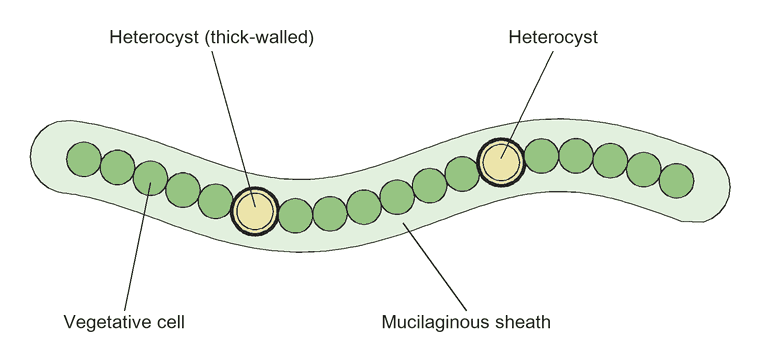
Therefore, cyanobacteria are photosynthetic prokaryotes with chlorophyll a, no flagella and a mucilaginous sheath, and some fix nitrogen in heterocysts.
- 365 marks
Question 36
Give a basic framework of classification of Kingdom Protista.
Solve with AIWritten solution
Solution:
Concept: Kingdom Protista contains the unicellular eukaryotes. They are grouped by their mode of nutrition into plant-like, fungus-like and animal-like protists.
Step 1 — List the photosynthetic protists. The photosynthetic protista (protistan algae) make their own food and form three groups.
- Chrysophytes: diatoms and golden-brown algae, with silica in their walls; the chief producers of the oceans, e.g. Chrysosphaerella, Triceratium.
- Dinoflagellates: mostly marine, with a wall of cellulose plates and two flagella, e.g. Gonyaulax.
- Euglenoids: mostly freshwater, with a protein-rich pellicle instead of a cell wall, and chlorophyll, e.g. Euglena.
Step 2 — List the saprophytic protists. The saprophytic protista are the fungus-like decomposers.
- Slime moulds: in favourable conditions they form a large creeping plasmodium; in unfavourable conditions they form fruiting bodies bearing walled spores, e.g. Physarum (plasmodial slime mould) and Dictyostelium (cellular slime mould, whose separate amoeba-like cells gather into a slug).
Step 3 — List the protozoans. The protozoans are animal-like heterotrophs, living as predators or parasites.
- Amoeboid protozoans move by pseudopodia, e.g. Amoeba.
- Flagellated protozoans move by flagella, e.g. Trypanosoma.
- Ciliated protozoans move by cilia and have a gullet, e.g. Paramecium.
- Sporozoans are parasites with an infectious spore-like stage, e.g. Plasmodium.
Therefore, Protista is divided into photosynthetic protists (chrysophytes, dinoflagellates, euglenoids), saprophytic protists (slime moulds) and protozoans (amoeboid, flagellated, ciliated and sporozoans).
- 375 marks
Question 37
What kind of organisms are placed in Kingdom Fungi? Give at least 5-6 important features.
Solve with AIWritten solution
Solution:
Concept: Kingdom Fungi contains eukaryotic, heterotrophic organisms that lack chlorophyll, have walls of chitin and feed by absorbing food. Examples are moulds on bread and oranges, yeasts, mushrooms and puffballs.
Step 1 — State their nutrition. Fungi have no chlorophyll, so they cannot prepare their own food; they are heterotrophs.
Step 2 — State their range of form. They vary greatly in size and form, from microscopic yeast to mushrooms, bracket fungi and large puffballs.
Step 3 — State their body plan. The body is multicellular except in yeast, which is unicellular. It is made of thin threads called hyphae, which form a network called the mycelium. Hyphae may be coenocytic (no cross walls, many nuclei) or septate (with cross walls).
Step 4 — State their cell wall. Their cells have rigid walls made of chitin and other polysaccharides.
Step 5 — State their ways of feeding. Most are saprophytes on dead matter; some are parasites on plants and animals; some are symbionts, as in lichens (with algae) and mycorrhizae (with the roots of higher plants).
Step 6 — State their distribution. They are cosmopolitan, found in air, water and soil and on plants and animals, and grow best in warm and humid places.
Step 7 — State their reproduction. They reproduce vegetatively (fragmentation, fission, budding), asexually (conidia, sporangiospores, zoospores) and sexually (oospores, ascospores, basidiospores). Sexual reproduction involves fusion of cytoplasm (plasmogamy), fusion of nuclei (karyogamy) and meiosis.
Therefore, fungi are eukaryotic heterotrophs without chlorophyll, with a body of hyphae and chitin walls, mainly saprophytic, and reproduce by vegetative, asexual and sexual means; examples are yeast, Penicillium, Rhizopus and Agaricus.
- 385 marks
Question 38
What kind of nutrition and life cycle is found in Kingdom Plantae?
Solve with AIWritten solution
Solution:
Concept: Kingdom Plantae contains eukaryotic, mostly multicellular organisms with chlorophyll and cellulose cell walls. Nearly all make their own food, and their life cycle has two alternating generations.
Step 1 — Describe the main mode of nutrition. Plants are autotrophic: they make food by photosynthesis using chlorophyll, light, carbon dioxide and water. They are the main producers on land and in shallow water.
Step 2 — Describe partial heterotrophs. A few plants depend partly or wholly on other organisms for food.
- Parasites: Cuscuta (dodder) has little or no chlorophyll and takes food from its host through suckers (haustoria).
- Insectivorous plants: the pitcher plant and Drosera still photosynthesise, but they trap and digest insects to get nitrogen, which is scarce in their soil.
Step 3 — Describe the symbiotic plants. Leguminous plants such as pea live in symbiosis with nitrogen-fixing Rhizobium in their root nodules. They remain fully autotrophic: the bacteria supply nitrogen compounds and the plant supplies food, so both benefit.
Step 4 — Describe the life cycle. The plant life cycle shows alternation of generations: a diploid sporophyte forms haploid spores by meiosis, and each spore grows into a haploid gametophyte that forms gametes; the gametes fuse to give the zygote, which grows into the next sporophyte.
Step 5 — Describe how it varies. Which generation is larger, free-living or dependent differs between groups: the gametophyte is dominant in bryophytes, while the sporophyte is dominant in pteridophytes, gymnosperms and angiosperms.
Therefore, plants are mostly autotrophic (a few are parasitic or partly heterotrophic like insectivorous plants), and their life cycle shows alternation of a diploid sporophytic and a haploid gametophytic generation.
- 395 marks
Question 39
Explain the kind of nutrition found in Fungi.
Solve with AIWritten solution
Solution:
Concept: Fungi have no chlorophyll, so they are heterotrophs. They release digestive enzymes into their food and absorb the dissolved products through their hyphae.
Step 1 — Describe saprophytic nutrition. Most fungi are saprophytes: they live on dead and decaying organic matter, break it down and absorb the nutrients, so they are major decomposers. Some grow on dung (coprophilous fungi), and many deuteromycetes decompose leaf litter and help recycle minerals.
Step 2 — Describe parasitic nutrition. Some fungi are parasites that take food from living plants and animals, e.g. Ustilago (smut) and Puccinia (rust) on cereals, Claviceps (ergot) on rye, and the fungi that cause ringworm and athlete's foot in humans. Albugo (white rust of mustard) is studied with the fungi, but it is now known to be an oomycete (water mould), a relative of brown algae and diatoms.
Step 3 — Describe symbiotic nutrition. Some fungi live in symbiosis, where both partners benefit.
- Lichens: a fungus and an alga live together; the alga makes food and the fungus gives shelter and absorbs water and minerals.
- Mycorrhizae: a fungus lives with the roots of higher plants and helps them absorb water and minerals, especially phosphorus.
Step 4 — Describe the conditions they need. Fungi grow best in warm and humid places with organic matter, such as stale bread, rotten fruit, wet leather, wood and soil.
Therefore, fungi are absorptive heterotrophs whose nutrition is mainly saprophytic, with some parasitic and some symbiotic forms (lichens and mycorrhizae).
- 405 marks
Question 40
Explain the mode of nutrition in Kingdom Protista.
Solve with AIWritten solution
Solution:
Concept: Protists show almost every mode of nutrition, so they fill all three roles in an ecosystem: producers, consumers and decomposers.
Step 1 — Describe photosynthetic nutrition. The protistan algae (chrysophytes such as diatoms, dinoflagellates and euglenoids) have chlorophyll and make their own food. As phytoplankton they are the chief producers in the seas and in fresh water. Diatoms and dinoflagellates have walls; euglenoids have a pellicle instead.
Step 2 — Describe holozoic nutrition. Protozoans and other zooplankton have no cell wall and take in solid food. Amoeba surrounds its prey with pseudopodia, and Paramecium sweeps food into its gullet with cilia; the food is digested inside food vacuoles.
Step 3 — Describe saprophytic nutrition. Slime moulds creep over decaying twigs and leaves, engulfing the organic material and bacteria on them; they act as decomposers.
Step 4 — Describe parasitic nutrition. Some protists are parasites in other organisms, e.g. Plasmodium (malaria), Trypanosoma (sleeping sickness) and Entamoeba (amoebic dysentery).
Step 5 — Describe symbiotic nutrition. Some flagellates live in the gut of termites and wood-eating cockroaches, where they digest cellulose for their hosts and get food and shelter in return.
Step 6 — Describe mixed nutrition. Euglena photosynthesises in sunlight; in the dark it becomes heterotrophic and takes in organic food from its surroundings. Organisms like this, which use both modes, are called mixotrophs.
Therefore, protists may be photosynthetic, holozoic, saprophytic, parasitic, symbiotic or mixotrophic, and so they act as producers, consumers and decomposers.
- 415 marks
Question 41
Give the characteristic features of Kingdom Plantae and Kingdom Animalia.
Solve with AIWritten solution
Solution:
Concept: In Whittaker's system the multicellular eukaryotes that make their own food form Kingdom Plantae, and those that ingest food and have no cell wall form Kingdom Animalia.
Step 1 — State the cell and body features of plants. Plants are eukaryotic, mostly multicellular, and contain chlorophyll; they live on land and in water (sea, lakes and streams). Their cells have a rigid cellulose cell wall.
Step 2 — State the movement and nutrition of plants. Plants are mostly fixed in one place with no organs of locomotion. They are mostly autotrophic and are the main producers. A few are parasites (Cuscuta) or partly heterotrophic (insectivorous plants such as the pitcher plant), while legumes live in symbiosis with nitrogen-fixing bacteria but still make their own food.
Step 3 — State the life cycle of plants. The life cycle shows alternation of generations between a diploid sporophyte and a haploid gametophyte. The main groups are algae, bryophytes, pteridophytes, gymnosperms and angiosperms.
Step 4 — State the cell and body features of animals. Animals are eukaryotic, multicellular and have no chlorophyll; they are called metazoans. Their cells have no cell wall.
Step 5 — State the movement and nutrition of animals. Most animals can move from place to place using muscles controlled by a nervous system; sponges, corals and some others are fixed. They are heterotrophic: most are holozoic, taking food in through the mouth and digesting it in an internal cavity, and they store reserve food as glycogen or fat. Some are parasites. They are the consumers of food chains.
Step 6 — State the growth and reproduction of animals. Animals follow a definite growth pattern and stop growing on reaching adult size. They reproduce mainly by sexual reproduction (fusion of male and female gametes), followed by embryonic development.
Therefore, plants are eukaryotic, photosynthetic producers with cellulose walls and alternation of generations, while animals are multicellular, wall-less, heterotrophic consumers with a definite growth pattern.
What Class 11 Biology Ch 2 covers
The sections of the chapter, in the order the book takes them. Every question above comes from one of these.
- 01Two Kingdom Classification
- 02Kingdom Monera
- 03Kingdom Protista
- 04Kingdom Fungi
- 05Kingdom Plantae
- 06Kingdom Animalia
More ways to study this chapter
The same chapter asked three other ways. Practise it, revise it, and see what the board has set on Ch 2 before.
Class 11 Biology Ch 2 questions students ask
How many questions are there in Class 11 Biology Ch 2?
41 questions. Every one is solved step by step on this page.
Are these Class 11 Biology solutions free?
Yes. Every question and its full working is free to read, with no account needed.
Can I download the Class 11 Biology Ch 2 solutions as a PDF?
There is no PDF to download. Every solution is on this page instead, which means it is searchable, always the current syllabus, and readable on a phone. Use your browser's print option if you want it on paper.