
Opening your dashboard
Class 11 Biology Chapter 2 Five Kingdom Classification: Practice Questions
95 questions on Chapter 2, each worked through on its own page with the AI tutor. Class 11 Biology, ICSE 2026-27.
95 questions
1–5 marks · Mixed difficulty
- 11 mark
Question 1
In Linnaeus's two kingdom system, which of the following groups was placed in Kingdom Animalia?
- 21 mark
Question 2
A student records these characters of an organism:
- Cell type: eukaryotic
- Cell wall: present in some members of its group
- Body organisation: unicellular
In which kingdom of Whittaker's system does it belong?
- 34 marks
Question 3
Three organisms are studied: a mushroom, a bacterium and Paramecium.
(i) Under the two kingdom classification, which two of them were placed in the same kingdom? Name that kingdom.
(ii) Name the kingdom of each organism in Whittaker's five kingdom classification.
- 43 marks
Question 4
In Whittaker's scheme, each of the three multicellular kingdoms has a main mode of nutrition and a major ecological role. Copy and complete the table.
Kingdom Mode of nutrition Major ecological role Plantae ? ? Fungi ? ? Animalia ? ? - 53 marks
Question 5
Whittaker's five kingdom classification uses three criteria: complexity of cell structure, complexity of the organism's body, and mode of obtaining nutrition.
Which one criterion separates each pair of kingdoms below? Give the contrasting conditions.
(i) Monera and Protista
(ii) Protista and Plantae
(iii) Plantae and Fungi
- 61 mark
Question 6
A taxonomist objects that one group in Linnaeus's Kingdom Plantae cannot make its own food and has chitin, not cellulose, in its cell walls. Which group is she objecting to?
- 71 mark
Question 7
A laboratory report describes a bacterium as "comma shaped". To which shape group does it belong?
- 84 marks
Question 8
The diagram shows a bacterial cell as seen under the electron microscope.
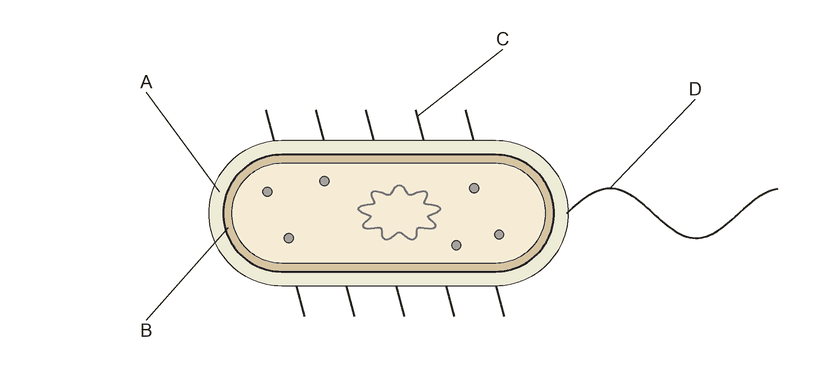
(i) Name the parts labelled A, B, C and D.
(ii) Name the material in the cell wall that protects the cell against chemical and mechanical injury.
- 93 marks
Question 9
Students collect three samples, each containing one kind of archaebacteria. (Hypothetical data.)
Sample Source P Brine from a salt pan, a very strong salt solution Q Water from a hot sulphur spring at about 90 °C with very low pH R Contents of the gut of a buffalo Name the group of archaebacteria most likely present in each sample, and give the feature of the habitat that points to it.
- 101 mark
Question 10
Some soil bacteria oxidise ammonia and nitrites and use the energy released to make ATP. These bacteria are
- 112 marks
Question 11
Rhizobium lives in the roots of pea plants, while some other bacteria live in crop plants and damage them. Both are heterotrophic bacteria.
How does the relationship of each with its host differ?
- 121 mark
Question 12
A moneran cell seen under the microscope is large, has no flagella, shows gliding movements and contains chlorophyll a. It is most likely
- 133 marks
Question 13
A bacterial culture in a dish is growing well. Later the dish dries out, and some days afterwards it is moistened again. (Hypothetical situation.)
(i) By which method do the bacteria multiply while conditions are good?
(ii) How do they survive the dry period?
(iii) What happens when the dish is moistened again?
- 142 marks
Question 14
A teaspoonful of curd contains millions of bacteria. Use this fact to state two features of the members of Kingdom Monera.
- 151 mark
Question 15
The nucleoid of a bacterial cell is a region of the cytoplasm that contains
- 161 mark
Question 16
Some protists live in the gut of termites and wood-eating cockroaches. How do they help these insects?
- 173 marks
Question 17
Give reasons:
(i) Euglena can change its shape.
(ii) Euglena appears green in colour.
(iii) Euglena survives when its pond dries up.
- 183 marks
Question 18
A sugar factory filters its syrup through a white, gritty powder dug from old sea-bed deposits.
(i) Name this powder and the protists that formed it.
(ii) Why did the walls of these protists not decay after they died?
(iii) Why is the powder useful for filtering syrup?
- 191 mark
Question 19
Which organism is correctly matched with its group?
- 204 marks
Question 20
On a damp forest floor, a slimy mass with thousands of nuclei is seen spreading slowly over dead leaves. Weeks later, in dry weather, small stalked structures appear in its place.
(i) What is the slimy mass called?
(ii) How does it obtain its food?
(iii) What are the stalked structures, and what do they bear?
(iv) How does the organism reach new sites?
- 211 mark
Question 21
A protozoan is mainly parasitic, simple in structure because of its parasitic life, and has an infectious spore-like stage in its life cycle. To which group does it belong?
- 223 marks
Question 22
Describe, step by step, how Paramecium takes in food from the surrounding water and gets rid of what it cannot digest.
- 232 marks
Question 23
Amoeba and the radiolarians are both amoeboid protozoans (rhizopods). Give one similarity and one difference between them.
- 243 marks
Question 24
Draw a labelled diagram of Trypanosoma. Name the disease it causes in man.
- 254 marks
Question 25
Kingdom Protista is said to form a link with Plantae, Animalia and Fungi, and its boundaries are not well defined.
Explain this statement, naming one group of protists that resembles each of these three kingdoms and saying how it resembles it.
- 261 mark
Question 26
On a farm, one crop shows a rust disease caused by Puccinia and another shows a smut disease caused by Ustilago. To which class of fungi do both these parasites belong?
- 272 marks
Question 27
Draw labelled diagrams to show the difference between a coenocytic hypha and a septate hypha.
- 281 mark
Question 28
Which sequence correctly shows the three steps of the sexual cycle in fungi?
- 293 marks
Question 29
A cell taken from the mycelium of a mushroom-forming fungus contains two separate haploid nuclei (n + n).
(i) What is this condition called?
(ii) How did the cell come to have two nuclei?
(iii) How does this mycelium finally give rise to spores? Name the spores.
- 301 mark
Question 30
Which pair correctly matches a fungal spore with the way it is produced?
- 313 marks
Question 31
Kingdom Fungi is divided into classes on the basis of (i) the morphology of the mycelium, (ii) the mode of spore formation and (iii) the kind of fruiting bodies or sexual spores formed.
Use each basis in turn to show how Phycomycetes differ from Ascomycetes.
- 321 mark
Question 32
Suppose a fungus causing ringworm was placed in Deuteromycetes because only its conidia had been seen. Years later, ascospores formed in asci are found in it. What will taxonomists now do?
- 332 marks
Question 33
On a school field trip, students find (i) a crusty growth on a rock formed by a fungus living together with an alga, and (ii) fungal threads living in close association with the roots of a tree.
Name each association and the mode of life the fungus shows in them.
- 343 marks
Question 34
Give reasons:
(i) Basidiomycetes are called club fungi.
(ii) Phycomycetes are also called zygomycetes.
(iii) A mushroom seen growing on a log is only a small part of the whole fungus.
- 354 marks
Question 35
A laboratory records these observations on four fungi, P, Q, R and S. (Hypothetical data.)
Fungus Mycelium Asexual spores Sexual spores P No cross walls, many nuclei Formed inside a sporangium A thick-walled diploid resting spore Q Septate, branched Conidia on conidiophores Formed inside sac-like structures R Septate, branched Generally not formed Four, borne on a club-shaped structure S Septate, branched Conidia only Never observed Name the class of each fungus and give one example of that class.
- 361 mark
Question 36
Which organism is correctly matched with its description?
- 373 marks
Question 37
The diagram shows a mushroom, Agaricus.

(i) Name the parts labelled A, B, C and D.
(ii) To which class of fungi does Agaricus belong? Name the spores it forms in sexual reproduction.
- 381 mark
Question 38
Plant cells cannot contract or relax in the way animal cells can. Which feature of plant cells explains this?
- 393 marks
Question 39
Most plants make their food by photosynthesis, but some obtain nutrition in other ways. Name the mode of nutrition of each plant below and say how it gets its nutrition.
(i) Cuscuta
(ii) Pitcher plant
(iii) A leguminous plant living with nitrogen-fixing bacteria
- 401 mark
Question 40
The life cycle of plants shows alternation of generation. Which pairing of a phase with its chromosome condition is correct?
- 412 marks
Question 41
A student writes: "In every plant group, the gametophyte is the free-living phase and the sporophyte depends on it."
Explain why this statement is not correct.
- 423 marks
Question 42
A herbarium has three specimens: (i) a red seaweed, (ii) a liverwort and (iii) a seed plant that bears no flowers.
Name the major group of Kingdom Plantae to which each specimen belongs.
- 431 mark
Question 43
Which feature separates Kingdom Plantae from Kingdom Animalia but does NOT separate it from Kingdom Fungi?
- 441 mark
Question 44
Sponges are placed in Kingdom Animalia, yet they are an exception to one general feature of the kingdom. Which one?
- 453 marks
Question 45
The steps of holozoic nutrition in a free-living animal are listed out of order:
absorption, egestion, ingestion, assimilation, digestion
(i) Arrange them in the correct order.
(ii) Where in the body does digestion take place?
(iii) In what form do animals store their food reserves?
- 461 mark
Question 46
A few animals live in close association with photosynthetic protists. Such animals are described as
- 472 marks
Question 47
Give reasons:
(i) Animals are called the basic consumers on earth.
(ii) Even an animal that eats only other animals depends on plants for its food.
- 482 marks
Question 48
Most animals can move from place to place, but plants are fixed at one place.
(i) Which body systems make movement possible in animals?
(ii) What do the higher animals have in addition?
- 491 mark
Question 49
Which statement about growth and reproduction in Kingdom Animalia is correct?
- 504 marks
Question 50
A newly found organism is multicellular, eukaryotic and heterotrophic. A student concludes at once that it belongs to Kingdom Animalia.
(i) Explain why these three features alone are not enough to place it in Kingdom Animalia.
(ii) State three observations that would confirm it belongs to Kingdom Animalia rather than Kingdom Fungi.
- 511 mark
Question 51
Two kingdom classification was given by
- 521 mark
Question 52
Cyanobacteria belong to kingdom
- 531 mark
Question 53
The bacteria that can survive in extreme salty areas are called
- 541 mark
Question 54
Heterocyst is found in
- 551 mark
Question 55
'Diatoms' the chief producers in the oceans belong to group
- 561 mark
Question 56
Bacteria have been put in the kingdom Monera because they are
- 571 mark
Question 57
Five kingdom classification was given by
- 581 mark
Question 58
Euglena belongs to kingdom
- 591 mark
Question 59
Ferns are
- 601 mark
Question 60
Mode of nutrition in kingdom Fungi is mainly
- 611 mark
Question 61
Which of the following is a smallest living organism?
- 621 mark
Question 62
Holozoic kind of nutrition is found in
- 631 mark
Question 63
The multicellular decomposers belong to kingdom
- 641 mark
Question 64
Who wrote "Species Plantarum" and provided a basis for classification of plants?
- 651 mark
Question 65
Five kingdom classification of living organisms was proposed by
- 661 mark
Question 66
In Five kingdom system of Whittaker, how many kingdoms contain eukaryotes?
- 671 mark
Question 67
Which of the following is not the locomotory organ of Group protozoa?
- 681 mark
Question 68
The thalloid body of a slime mould (myxomycetes) is known as
- 691 mark
Question 69
What is common about Trypanosoma, Noctiluca, Monocystis and Giardia?
- 701 mark
Question 70
Kingdom Monera has _____, _____ type of organisms.
- 711 mark
Question 71
Cyanobacteria are also known as _____, as they have chlorophyll.
- 721 mark
Question 72
Mycoplasmas are smallest known _____ and lack a _____.
- 731 mark
Question 73
Diatomaceous earth is due to _____ deposits of diatoms on ocean floor.
- 741 mark
Question 74
Slime moulds form aggregation containing thousands of nuclei called _____ during favourable conditions.
- 751 mark
Question 75
All protists are unicellular.
- 761 mark
Question 76
Some monerans are prokaryotic.
- 771 mark
Question 77
Viroids have saprophytic mode of nutrition.
- 781 mark
Question 78
Yeasts are an exception in Kingdom Fungi because they are unicellular.
- 791 mark
Question 79
Sponges are grouped in Kingdom Animalia.
- 801 mark
Question 80
Kingdom Monera has unicellular eukaryotic organisms like bacteria.
- 811 mark
Question 81
Cyanobacteria also known as blue-green algae have chlorophyll similar to green plants.
- 821 mark
Question 82
Mycoplasmas lack a cell wall and can survive without oxygen.
- 831 mark
Question 83
Diatoms are microscopic phytoplanktons having silica deposits in their cell walls.
- 841 mark
Question 84
Slime moulds are saprophytic protists.
- 855 marks
Question 85
Match the following:
Column A Column B 1. Unicellular, eukaryotic, marine and photosynthetic. (a) Fungi 2. Prokaryotic, unicellular microscopic organisms (b) Amoeboid protozoans 3. Unicellular/multicellular, body made of hyphae, mainly saprophytic. (c) Halophiles 4. Eukaryotic, unicellular, locomotion by pseudopodia. (d) Dinoflagellates 5. Unicellular, prokaryotic, can survive in extreme salty areas. (e) Bacteria - 861 mark
Question 86
Who gave the five kingdom classification?
- 871 mark
Question 87
Name the group that contains prokaryotic organisms.
- 881 mark
Question 88
Name the group that has eukaryotic, saprophytic organisms having chitinous cell walls.
- 891 mark
Question 89
Organisms responsible for red tides in seas.
- 901 mark
Question 90
Gametes that are similar in morphology.
- 911 mark
Question 91
Assertion (A): Kingdom Monera includes all unicellular and prokaryotic organisms.
Reason (R): Prokaryotic organisms are the smallest, microscopic and most plentiful organisms on earth.
- 921 mark
Question 92
Assertion (A): Archaebacteria are able to survive in harsh habitats like extreme salty areas and hot springs.
Reason (R): Archaebacteria survive in extreme conditions due to the presence of peptidoglycan in their cell wall.
- 931 mark
Question 93
Assertion (A): Cyanobacteria like Nostoc can fix atmospheric nitrogen.
Reason (R): Nostoc is a blue-green alga which can photosynthesise.
- 941 mark
Question 94
Assertion (A): Chrysophytes belong to Kingdom Monera. They are the chemosynthetic producers in oceans.
Reason (R): Chrysophytes are bio-luminescent and have two unequal flagella.
- 951 mark
Question 95
Assertion (A): Basidiomycetes are called sac fungi.
Reason (R): They have sac-like basidium that produce spores.