
Question 355 marksMedium
What are cyanobacteria? Give their important features.
Confirming your payment
Sign up now and get 250 free tokens.
Five Kingdom Classification · Question 35 of 41
What are cyanobacteria? Give their important features.
Solution:
Concept: Cyanobacteria (blue-green algae) are photosynthetic prokaryotes. Although once called algae, they are bacteria: a distinct group of eubacteria in Kingdom Monera.
Step 1 — State their place in history. They are thought to be the earliest organisms to carry out oxygen-releasing photosynthesis; their oxygen changed the early atmosphere.
Step 2 — State their pigments and nutrition. They have chlorophyll a like green plants, together with blue (phycocyanin) and red pigments, and they are photosynthetic autotrophs.
Step 3 — State their body form and habitat. They are unicellular, colonial or filamentous, and live in fresh water, the sea and on damp soil. Colonies are usually covered by a gelatinous (mucilaginous) sheath.
Step 4 — State their special cells. Some, such as Nostoc and Anabaena, fix atmospheric nitrogen in large, thick-walled cells called heterocysts.
Step 5 — State how they move and grow in polluted water. They have no flagella; some show gliding movements. In water polluted with nutrients they multiply fast and form blooms.
Step 6 — State their importance. Nostoc and Anabaena are used as biofertilisers in rice fields, and Spirulina is grown as a protein-rich food.
Step 7 — Picture a typical form. Nostoc is a beaded chain of cells inside a mucilaginous sheath, with larger, thick-walled heterocysts at intervals along the chain.
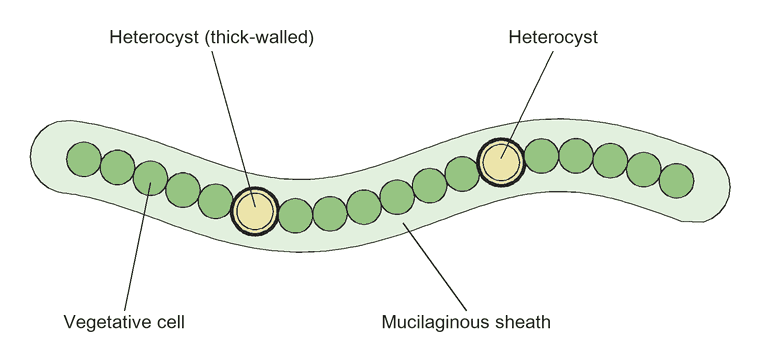
Therefore, cyanobacteria are photosynthetic prokaryotes with chlorophyll a, no flagella and a mucilaginous sheath, and some fix nitrogen in heterocysts.