
Opening your dashboard
Class 11 Biology Chapter 19: Respiration in Plants Solutions
54 textbook questions with step-by-step answers, free to read, for ISC 2026-27.
Get talked through Ch 19, not just shown the answer
Reading a finished solution is not the same as being able to do it. The AI tutor takes one question at a time and works it with you, in your own words, until you can.
- Ask it out loud, in your own words
- It gives you the next step, not the answer
- Stuck on part (ii)? Start there
54 questions with solutions
1–5 marks · Mixed difficulty
- 11 mark
Question 1
Which is a basic energy–rich molecule in the cells?
Solve with AIWritten solution
Solution:
Concept: Cells store the energy released in respiration in a form they can use at once.
Step 1 — What is asked: We need the molecule that acts as the energy currency of every cell.
Step 2 — The fact: ATP (adenosine triphosphate) holds energy in its two terminal phosphate bonds; when it is split to ADP, energy is released for cell work, and ATP is remade from ADP during respiration.
Therefore, ATP (adenosine triphosphate) is the basic energy-rich molecule of cells.
- 21 mark
Question 2
What is the full form of ATP?
Solve with AIWritten solution
Solution:
Concept: An ATP molecule is made of adenine, the sugar ribose and three phosphate groups.
Step 1 — What is asked: We need the expanded name of ATP.
Step 2 — The name: The base adenine joined to ribose forms adenosine, and three phosphate groups make it a triphosphate.
Therefore, ATP stands for adenosine triphosphate.
- 31 mark
Question 3
What is the full form of NAD?
Solve with AIWritten solution
Solution:
Concept: NAD is the coenzyme that accepts hydrogen (electrons) during the oxidation steps of respiration.
Step 1 — What is asked: We need the expanded name of NAD.
Step 2 — The name: It is made of two nucleotides joined together (a dinucleotide), one carrying nicotinamide and the other adenine; its oxidised form is NAD⁺ and its reduced form is NADH.
Therefore, NAD stands for nicotinamide adenine dinucleotide.
- 41 mark
Question 4
How much energy is released by ATP when it gets converted to ADP?
Solve with AIWritten solution
Solution:
Concept: Hydrolysis of the terminal phosphate bond of ATP releases energy.
Step 1 — What is asked: We need the energy released when ATP loses one phosphate and becomes ADP.
Step 2 — The value: The reaction is ATP + H₂O → ADP + Pi + energy, and it releases about 30.6 kJ for every mole of ATP (about 7.3 kcal) under standard conditions.
Therefore, about 30.6 kJ of energy is released per mole of ATP converted to ADP.
- 51 mark
Question 5
Name the pathway common to both aerobic and anaerobic pathways.
Solve with AIWritten solution
Solution:
Concept: Both kinds of respiration begin by breaking glucose into pyruvic acid, a step that needs no oxygen.
Step 1 — What is asked: We need the first pathway shared by aerobic and anaerobic respiration.
Step 2 — The fact: Glycolysis (EMP pathway) splits glucose into two pyruvic acid molecules in the cytoplasm; only after this do the two kinds of respiration take different routes.
Therefore, glycolysis is the pathway common to aerobic and anaerobic respiration.
- 61 mark
Question 6
Where does glycolysis take place in cells?
Solve with AIWritten solution
Solution:
Concept: The enzymes of glycolysis are dissolved in the fluid part of the cytoplasm.
Step 1 — What is asked: We need the site of glycolysis in the cell.
Step 2 — The fact: Glycolysis takes place in the cytoplasm (cytosol), outside the mitochondria, and does not need oxygen.
Therefore, glycolysis takes place in the cytoplasm of the cell.
- 71 mark
Question 7
What is the end product of glycolysis?
Solve with AIWritten solution
Solution:
Concept: Glycolysis is the partial oxidation of one glucose molecule (6C).
Step 1 — What is asked: We need the final organic product of glycolysis.
Step 2 — The fact: One glucose (6 carbons) is broken into two molecules of pyruvic acid (3 carbons each), with a net gain of 2 ATP and 2 NADH.
Therefore, the end product of glycolysis is two molecules of pyruvic acid.
- 81 mark
Question 8
What happens to the end product of glycolysis in anaerobic respiration?
Solve with AIWritten solution
Solution:
Concept: Without oxygen, pyruvic acid is not oxidised further; it is reduced so that NAD⁺ is made again.
Step 1 — In yeast and plants: Pyruvic acid is broken down to ethyl alcohol and CO₂ (alcoholic fermentation).
Step 2 — In animal muscle: Pyruvic acid is reduced to lactic acid, and no CO₂ is released (lactic acid fermentation).
Therefore, in anaerobic respiration pyruvic acid becomes ethyl alcohol and CO₂ in plants and yeast, and lactic acid in animal muscles.
- 91 mark
Question 9
How many molecules are released in anaerobic respiration from one glucose molecule?
Solve with AIWritten solution
Solution:
Concept: In anaerobic respiration the only ATP made comes from glycolysis.
Step 1 — What is asked: We need the number of ATP molecules gained per glucose without oxygen.
Step 2 — The count: Glycolysis makes 4 ATP but uses 2, so the net gain is 2 ATP; the later fermentation step only remakes NAD⁺ and gives no extra ATP.
Therefore, 2 ATP molecules are gained from one glucose molecule in anaerobic respiration.
- 101 mark
Question 10
Where does anaerobic respiration occur in animals?
Solve with AIWritten solution
Solution:
Concept: Animal cells respire anaerobically only when oxygen supply falls short of demand.
Step 1 — What is asked: We need the animal tissue that respires without oxygen.
Step 2 — The fact: During continuous vigorous exercise, skeletal muscle cells get too little oxygen, so they break glucose down to lactic acid for a short time.
Therefore, in animals anaerobic respiration occurs in skeletal muscles during vigorous exercise.
- 111 mark
Question 11
Name the organelle where aerobic respiration occurs in the cells.
Solve with AIWritten solution
Solution:
Concept: After glycolysis, the oxygen-requiring stages of respiration need a special organelle.
Step 1 — What is asked: We need the organelle of aerobic respiration.
Step 2 — The fact: The link reaction and the Krebs cycle occur in the matrix, and the ETS on the inner membrane, of the mitochondria.
Therefore, aerobic respiration occurs in the mitochondria.
- 121 mark
Question 12
How many molecules are produced in aerobic respiration from one glucose molecule?
Solve with AIWritten solution
Solution:
Concept: The ATP made in all stages of aerobic respiration is added up in the respiratory balance sheet.
Step 1 — What is asked: We need the total ATP gain from complete oxidation of one glucose.
Step 2 — The count: Glycolysis gives 8 ATP, the link reaction 6 ATP and the Krebs cycle 24 ATP, so the total is 38 ATP (36 in cells such as skeletal muscle and brain, where the 2 NADH of glycolysis pass their electrons into the mitochondria through the glycerol-phosphate shuttle and so give only 2 ATP each instead of 3).
Note: The 38-ATP count assumes 3 ATP per NADH and 2 ATP per FADH₂. Current measurements give about 2.5 and 1.5, so one glucose really yields about 30–32 ATP; ISC answers use the book's values.
Therefore, 38 ATP molecules are produced from one glucose molecule in aerobic respiration.
- 131 mark
Question 13
Name the cycle that occurs in mitochondria.
Solve with AIWritten solution
Solution:
Concept: The acetyl CoA formed from pyruvic acid is oxidised in a cycle of reactions in the mitochondrial matrix.
Step 1 — What is asked: We need the name of the cyclic pathway in mitochondria.
Step 2 — The fact: It is the Krebs cycle, also called the citric acid cycle or tricarboxylic acid (TCA) cycle.
Therefore, the Krebs cycle (citric acid cycle) occurs in mitochondria.
- 141 mark
Question 14
How many molecules of ATP does one NADH generate?
Solve with AIWritten solution
Solution:
Concept: NADH gives its electrons to the ETS, and the energy released is used to make ATP by oxidative phosphorylation.
Step 1 — What is asked: We need the ATP yield of one NADH.
Step 2 — The value: On the book's basis, one NADH oxidised through the ETS gives 3 ATP.
Note: Current measurements give about 2.5 ATP per NADH; 3 is the classic textbook value.
Therefore, one NADH generates 3 ATP molecules.
- 151 mark
Question 15
Name the molecule that is transported from cytoplasm to mitochondria for oxidation.
Solve with AIWritten solution
Solution:
Concept: Glycolysis ends in the cytoplasm, while further oxidation happens inside mitochondria.
Step 1 — What is asked: We need the product of glycolysis that moves into the mitochondrion.
Step 2 — The fact: Pyruvic acid (pyruvate) is carried into the mitochondrial matrix, where it is oxidised to acetyl CoA.
Therefore, pyruvic acid (pyruvate) is transported into the mitochondria for oxidation.
- 161 mark
Question 16
Name the first molecule pyruvic acid is converted to by a dehydrogenase enzyme.
Solve with AIWritten solution
Solution:
Concept: Pyruvate dehydrogenase removes one carbon of pyruvic acid as CO₂ and oxidises the rest (oxidative decarboxylation).
Step 1 — What is asked: We need the product of pyruvate dehydrogenase.
Step 2 — The fact: The remaining two-carbon acetyl group joins coenzyme A, so the product is acetyl CoA; CO₂ and NADH are also formed.
Therefore, pyruvic acid is converted to acetyl CoA (an acetyl group carried by coenzyme A).
- 171 mark
Question 17
Which is the first molecule formed during Krebs cycle?
Solve with AIWritten solution
Solution:
Concept: The Krebs cycle starts when acetyl CoA (2C) joins oxaloacetic acid (4C).
Step 1 — What is asked: We need the first product of the Krebs cycle.
Step 2 — The fact: The enzyme citrate synthase joins the 2-carbon acetyl group to 4-carbon oxaloacetic acid, forming the 6-carbon citric acid, and CoA is released.
Therefore, citric acid is the first molecule formed in the Krebs cycle.
- 181 mark
Question 18
Why is Krebs cycle also called as Tricarboxylic acid cycle?
Solve with AIWritten solution
Solution:
Concept: A carboxyl group is –COOH; a tricarboxylic acid has three of them.
Step 1 — What is asked: We need the reason for the name TCA cycle.
Step 2 — The reason: The cycle begins with citric acid, which has three carboxyl (–COOH) groups, so it is a tricarboxylic acid.
Therefore, it is called the tricarboxylic acid cycle because its first product, citric acid, has three carboxyl groups.
- 191 mark
Question 19
Where does ETS take place?
Solve with AIWritten solution
Solution:
Concept: The carriers of the electron transport system are embedded in a membrane.
Step 1 — What is asked: We need the site of the electron transport system.
Step 2 — The fact: The ETS carriers sit in the inner mitochondrial membrane (including its folds, the cristae).
Therefore, ETS takes place in the inner mitochondrial membrane.
- 201 mark
Question 20
Name the 3 electron-carrier complexes present in ETS.
Solve with AIWritten solution
Solution:
Concept: The ETS has two mobile carriers (ubiquinone and cytochrome c) and fixed protein complexes in the inner membrane.
Step 1 — What is asked: We need the three large electron-carrier complexes.
Step 2 — The complexes: They are (i) NADH dehydrogenase (complex I), (ii) cytochrome bc₁ complex (complex III) and (iii) cytochrome oxidase complex (complex IV), which has cytochromes a and a₃ and two copper centres.
Note: A fourth complex, succinate dehydrogenase (complex II), passes electrons from FADH₂ to ubiquinone; the three named here are the ones that pump protons.
Therefore, the three complexes are NADH dehydrogenase, cytochrome bc₁ complex and cytochrome oxidase complex.
- 211 mark
Question 21
What is oxidative phosphorylation?
Solve with AIWritten solution
Solution:
Concept: Phosphorylation means adding a phosphate group, here to ADP to make ATP.
Step 1 — What is asked: We need the meaning of oxidative phosphorylation.
Step 2 — The meaning: It is the synthesis of ATP from ADP and Pi using the energy released when NADH and FADH₂ are oxidised in the electron transport system; the energy builds a proton gradient that drives ATP synthase.
Therefore, oxidative phosphorylation is the formation of ATP using the energy released during electron transport.
- 221 mark
Question 22
How many ATPs are released in glycolysis and how many during Krebs cycle?
Solve with AIWritten solution
Solution:
Concept: Each NADH oxidised in the ETS gives 3 ATP and each FADH₂ gives 2 ATP (book basis).
Step 1 — Glycolysis: It gives a net 2 ATP directly plus 2 NADH, which give 6 ATP, so the total is 8 ATP.
Step 2 — Mitochondrial stage: The Krebs cycle itself gives 2 ATP (GTP in animal cells) + 6 NADH (18 ATP) + 2 FADH₂ (4 ATP), which is 24 ATP; with the 2 NADH (6 ATP) of the link reaction the mitochondrial total is 30 ATP.
Note: The 38-ATP count assumes 3 ATP per NADH and 2 ATP per FADH₂. Current measurements give about 2.5 and 1.5, so one glucose really yields about 30–32 ATP; ISC answers use the book's values.
Therefore, glycolysis yields 8 ATP and the Krebs cycle stage yields 30 ATP (24 from the cycle and 6 from the link reaction).
- 231 mark
Question 23
Does electron transport chain occur during fermentation?
Solve with AIWritten solution
Solution:
Concept: In fermentation there is no oxygen to act as the final electron acceptor.
Step 1 — What is asked: We need to know whether NADH is oxidised through the ETS in fermentation.
Step 2 — The fact: No; in fermentation NADH gives its hydrogen to pyruvic acid or acetaldehyde in the cytoplasm, so NAD⁺ is regenerated without electron transport and without extra ATP.
Therefore, no, the electron transport chain does not occur during fermentation.
- 241 mark
Question 24
How many ATP molecules are released from one FADH₂ molecule?
Solve with AIWritten solution
Solution:
Concept: FADH₂ gives its electrons to ubiquinone, so they skip complex I and less energy is captured than from NADH.
Step 1 — What is asked: We need the ATP yield of one FADH₂.
Step 2 — The value: On the book's basis one FADH₂ gives 2 ATP.
Note: Current measurements give about 1.5 ATP per FADH₂; 2 is the classic textbook value.
Therefore, one FADH₂ molecule releases 2 ATP.
- 251 mark
Question 25
How many FADH₂ molecule are formed during Krebs cycle?
Solve with AIWritten solution
Solution:
Concept: FADH₂ is formed when succinic acid is oxidised to fumaric acid, once in every turn of the cycle.
Step 1 — Per turn: One turn of the Krebs cycle (one acetyl CoA) forms 1 FADH₂.
Step 2 — Per glucose: One glucose gives two pyruvic acid and so two acetyl CoA, so the cycle turns twice and forms 2 FADH₂.
Therefore, 2 FADH₂ molecules are formed in the Krebs cycle per glucose molecule (1 per turn).
- 262 marks
Question 26
Which organisms show anaerobic respiration? What is fermentation?
Solve with AIWritten solution
Solution:
Concept: Anaerobic respiration is the incomplete breakdown of food without oxygen.
Step 1 — Organisms: It occurs in yeast, many bacteria and some fungi, in some parasites such as the tapeworm, and for short periods in higher plants and in animal skeletal muscles when oxygen is short.
Step 2 — Fermentation: Fermentation is the anaerobic breakdown of glucose by microbes or plant/animal cells into ethyl alcohol and CO₂ or lactic acid, with a net gain of only 2 ATP; the extra reactions after glycolysis regenerate NAD⁺.
Therefore, yeast, many bacteria, parasites and muscle cells respire anaerobically, and fermentation is the anaerobic conversion of glucose into alcohol and CO₂ or lactic acid.
- 272 marks
Question 27
What is the net gain of ATP molecules during glycolysis and Krebs cycle?
Solve with AIWritten solution
Solution:
Concept: ATP is made directly (substrate-level) and indirectly when NADH and FADH₂ pass electrons to the ETS (book basis: NADH 3 ATP, FADH₂ 2 ATP).
Step 1 — Glycolysis: Glycolysis makes 4 ATP and uses 2, a net 2 ATP directly; its 2 NADH give 6 ATP, so the net gain is 8 ATP per glucose.
Step 2 — Krebs cycle: For two turns (one glucose) the cycle gives 2 ATP (GTP in animal cells) directly, plus 6 NADH (18 ATP) and 2 FADH₂ (4 ATP), a net 24 ATP; adding the 6 ATP from the 2 NADH of the link reaction gives 30 ATP.
Note: The 38-ATP count assumes 3 ATP per NADH and 2 ATP per FADH₂. Current measurements give about 2.5 and 1.5, so one glucose really yields about 30–32 ATP; ISC answers use the book's values.
Therefore, the net gain is 8 ATP in glycolysis and 24 ATP in the Krebs cycle (30 including the link reaction).
- 282 marks
Question 28
Explain the common metabolic pathway of aerobic and anaerobic respiration.
Solve with AIWritten solution
Solution:
Concept: Glycolysis (EMP pathway) is the first stage of both aerobic and anaerobic respiration.
Step 1 — Where and how: Glycolysis takes place in the cytoplasm and does not need oxygen; one glucose (6C) is phosphorylated twice (using 2 ATP), split into two 3-carbon sugar phosphates, and these are oxidised to two pyruvic acid molecules.
Step 2 — What it yields: It makes 4 ATP (net 2 ATP) and 2 NADH. The pyruvic acid then goes to the mitochondria if oxygen is present, or is turned into ethanol or lactic acid if it is not.
Therefore, glycolysis, which converts glucose into two pyruvic acid in the cytoplasm, is the pathway common to aerobic and anaerobic respiration.
- 292 marks
Question 29
Give the end products of glycolysis, lactic acid and alcoholic fermentation.
Solve with AIWritten solution
Solution:
Concept: Glycolysis is followed by different reactions in different cells when oxygen is absent.
Step 1 — Glycolysis: Its end products are 2 pyruvic acid, 2 ATP (net) and 2 NADH per glucose.
Step 2 — Lactic acid fermentation: Its end product is lactic acid (2 per glucose); no CO₂ is released.
Step 3 — Alcoholic fermentation: Its end products are ethyl alcohol (ethanol) and CO₂ (2 of each per glucose).
Therefore, glycolysis gives pyruvic acid, lactic acid fermentation gives lactic acid, and alcoholic fermentation gives ethanol and CO₂.
- 302 marks
Question 30
Give the full forms of ETC and TCA cycle.
Solve with AIWritten solution
Solution:
Concept: Both are stages of aerobic respiration in mitochondria.
Step 1 — ETC: ETC stands for electron transport chain, the series of electron carriers in the inner mitochondrial membrane.
Step 2 — TCA cycle: TCA cycle stands for tricarboxylic acid cycle (Krebs cycle), named after citric acid, its first product, which has three carboxyl groups.
Therefore, ETC is the electron transport chain and TCA cycle is the tricarboxylic acid cycle.
- 312 marks
Question 31
Where does the electron transport system operate in a cell? Name various electron carriers involved in ETC through which the electrons pass.
Solve with AIWritten solution
Solution:
Concept: The ETS passes electrons from NADH and FADH₂ to oxygen through a fixed sequence of carriers.
Step 1 — Site: It operates in the inner mitochondrial membrane.
Step 2 — Carriers in order: Electrons pass from NADH to NADH dehydrogenase (complex I) → ubiquinone (Q, which also receives electrons from FADH₂ through succinate dehydrogenase) → cytochrome bc₁ complex → cytochrome c → cytochrome oxidase complex (cytochromes a and a₃ with copper centres) → oxygen, the final acceptor, which forms water.
Therefore, the ETS works in the inner mitochondrial membrane, and electrons pass through NADH dehydrogenase, ubiquinone, cytochrome bc₁, cytochrome c and cytochrome oxidase to oxygen.
- 322 marks
Question 32
What is oxidative phosphorylation? Give one example.
Solve with AIWritten solution
Solution:
Concept: Phosphorylation is the addition of phosphate to ADP to form ATP.
Step 1 — Meaning: Oxidative phosphorylation is the synthesis of ATP using the energy released when NADH and FADH₂ are oxidised through the ETS; the energy pumps protons out of the matrix, and their flow back through ATP synthase (F₀–F₁) makes ATP.
Step 2 — Example: When one NADH formed in the Krebs cycle is oxidised in the mitochondrion and its electrons reach oxygen, the energy released makes 3 ATP (book basis) from ADP and Pi.
Therefore, oxidative phosphorylation is ATP synthesis driven by electron transport, for example 3 ATP made when one NADH is oxidised in the mitochondrion.
- 332 marks
Question 33
What is the net gain of ATP molecules from (i) one NADPH and (ii) one FADH molecule?
Solve with AIWritten solution
Solution:
Concept: In respiration the reduced coenzymes NADH and FADH₂ are oxidised in the ETS to make ATP.
Step 1 — Reading the stem: In respiration the coenzymes are NADH and FADH₂, so the printed "NADPH" and "FADH" are read as NADH and FADH₂.
Step 2 — Part (i): One NADH gives 3 ATP, because its electrons enter at complex I and pass all three proton-pumping complexes.
Step 3 — Part (ii): One FADH₂ gives 2 ATP, because its electrons enter later, at ubiquinone, and skip complex I.
Note: Current measurements give about 2.5 and 1.5 ATP; 3 and 2 are the book's values.
Therefore, (i) one NADH gives 3 ATP and (ii) one FADH₂ gives 2 ATP.
- 342 marks
Question 34
Name two mobile carrier proteins that transfer the electrons.
Solve with AIWritten solution
Solution:
Concept: The ETS has three fixed complexes and two mobile carriers that shuttle electrons between them.
Step 1 — First carrier: Ubiquinone (Q) moves within the inner membrane and carries electrons from complex I (and from FADH₂ via complex II) to the cytochrome bc₁ complex.
Step 2 — Second carrier: Cytochrome c is a small protein on the outer surface of the inner membrane; it carries electrons from cytochrome bc₁ to cytochrome oxidase.
Note: Strictly, only cytochrome c is a protein; ubiquinone is a small lipid-soluble quinone.
Therefore, the two mobile electron carriers are ubiquinone and cytochrome c.
- 352 marks
Question 35
What is meant by RQ? Why does its value differ for different substrates?
Solve with AIWritten solution
Solution:
Concept: The respiratory quotient compares the CO₂ given out with the O₂ taken in during respiration.
Step 1 — Meaning: RQ is the ratio of the volume of CO₂ evolved to the volume of O₂ consumed in respiration.
Step 2 — Why it differs: Substrates contain different proportions of oxygen. Carbohydrates need as much O₂ as the CO₂ they give (RQ = 1); fats and proteins are poor in oxygen, so they need more O₂ (RQ about 0.7 and 0.9); organic acids are rich in oxygen, so they need less O₂ (RQ more than 1).
Therefore, RQ is CO₂ evolved ÷ O₂ consumed, and it differs because substrates differ in their oxygen content.
- 363 marks
Question 36
What is anaerobic respiration? In which organisms does it occur? Why is anaerobic respiration considered inefficient?
Solve with AIWritten solution
Solution:
Concept: Respiration may be aerobic (with oxygen) or anaerobic (without oxygen); both start with glycolysis.
Step 1 — Meaning: Anaerobic respiration is the incomplete breakdown of glucose without oxygen, by enzymes of the cytoplasm, into ethyl alcohol and CO₂ or into lactic acid, releasing a small amount of energy.
Step 2 — Organisms: It occurs in yeast, many bacteria and some fungi, in parasites such as the tapeworm, and for short periods in higher plants and in skeletal muscles during vigorous exercise.
Step 3 — Why inefficient: Only 2 ATP are gained per glucose against 38 in aerobic respiration, because much energy stays locked in ethanol or lactic acid, and the NADH is reoxidised by pyruvic acid or acetaldehyde instead of the ETS, so it yields no ATP.
Note: The 38-ATP count assumes 3 ATP per NADH and 2 ATP per FADH₂. Current measurements give about 2.5 and 1.5, so one glucose really yields about 30–32 ATP; ISC answers use the book's values.
Therefore, anaerobic respiration is the incomplete oxidation of glucose without oxygen in yeast, bacteria, parasites and muscles, and it is inefficient because it gives only 2 ATP per glucose.
- 373 marks
Question 37
How many net ATP molecules are formed during (i) citric acid cycle, (ii) aerobic respiration, (iii) aerobic respiration?
Solve with AIWritten solution
Solution:
Concept: The ATP count per glucose adds substrate-level ATP to the ATP made from NADH (3 each) and FADH₂ (2 each).
Step 1 — Reading the stem: Parts (ii) and (iii) print the same words; part (ii) is read as anaerobic respiration, the likely intended word, and part (iii) as aerobic respiration.
Step 2 — Part (i): Two turns of the citric acid cycle give 2 ATP (GTP in animal cells) + 6 NADH (18 ATP) + 2 FADH₂ (4 ATP), a net of 24 ATP per glucose.
Step 3 — Part (ii): Anaerobic respiration gives only the net 2 ATP of glycolysis.
Step 4 — Part (iii): Aerobic respiration gives glycolysis 8 + link reaction 6 + Krebs cycle 24, a net of 38 ATP per glucose (36 in cells such as skeletal muscle and brain, where the 2 NADH of glycolysis pass their electrons into the mitochondria through the glycerol-phosphate shuttle and so give only 2 ATP each instead of 3).
Note: The 38-ATP count assumes 3 ATP per NADH and 2 ATP per FADH₂. Current measurements give about 2.5 and 1.5, so one glucose really yields about 30–32 ATP; ISC answers use the book's values.
Therefore, the net gain is (i) 24 ATP in the citric acid cycle, (ii) 2 ATP in anaerobic respiration and (iii) 38 ATP in aerobic respiration.
- 383 marks
Question 38
What is the role of enzymes (i) invertase, (ii) lactate dehydrogenase (iii) alcohol dehydrogenase?
Solve with AIWritten solution
Solution:
Concept: Each step of respiration is controlled by a specific enzyme.
Step 1 — Invertase: It hydrolyses sucrose into glucose and fructose, so that the sucrose made in photosynthesis can enter glycolysis.
Step 2 — Lactate dehydrogenase: In muscle cells without enough oxygen, it reduces pyruvic acid to lactic acid using NADH, which is reoxidised to NAD⁺ so glycolysis can continue.
Step 3 — Alcohol dehydrogenase: In yeast, it reduces acetaldehyde to ethyl alcohol using NADH, again regenerating NAD⁺ (acetaldehyde is first formed from pyruvic acid by pyruvate decarboxylase, with release of CO₂).
Therefore, invertase splits sucrose into glucose and fructose, lactate dehydrogenase makes lactic acid from pyruvic acid, and alcohol dehydrogenase makes ethanol from acetaldehyde.
- 393 marks
Question 39
What is the role of ATP synthase? Where does it take place in a cell?
Solve with AIWritten solution
Solution:
Concept: ATP synthase is the enzyme complex of oxidative phosphorylation.
Step 1 — Structure: It has two parts: F₀, an integral protein in the inner membrane that forms a channel for protons, and F₁, a head piece on the matrix side that contains the site of ATP synthesis.
Step 2 — Role: Electron transport pumps protons into the intermembrane space; they flow back into the matrix through F₀, and this energy is used by F₁ to join ADP and Pi into ATP (chemiosmosis).
Step 3 — Site: It is located in the inner mitochondrial membrane, with F₁ facing the matrix.
Therefore, ATP synthase (F₀–F₁) uses the flow of protons to make ATP from ADP and Pi, and it lies in the inner mitochondrial membrane.
- 403 marks
Question 40
Where do the oxidation–reduction reactions take place in a cell. Explain the term oxidation with respect to electrons and hydrogen. What is the importance of these reactions?
Solve with AIWritten solution
Solution:
Concept: Respiration is a chain of oxidation–reduction reactions in which food is oxidised step by step.
Step 1 — Where: They take place in the cytoplasm (glycolysis), the mitochondrial matrix (link reaction, Krebs cycle) and the inner mitochondrial membrane (electron transport system).
Step 2 — Oxidation: Oxidation is the removal of electrons or of hydrogen from a compound (for example, NADH → NAD⁺); reduction is the addition of electrons or hydrogen (NAD⁺ → NADH), and the two always occur together.
Step 3 — Importance: Food is oxidised in small steps, and the energy released is captured in NADH and FADH₂ and finally in ATP, instead of being lost as heat; in the ETS each carrier is alternately reduced and oxidised, which releases energy to pump protons for ATP synthesis.
Therefore, redox reactions occur in the cytoplasm and mitochondria, oxidation is loss of electrons or hydrogen, and these reactions let the cell trap food energy as ATP step by step.
- 413 marks
Question 41
Give the reaction that connects glycolysis with Krebs cycle. What is an electron transport system? Where does it occur in a cell?
Solve with AIWritten solution
Solution:
Concept: Pyruvic acid from glycolysis must be changed to acetyl CoA before it can enter the Krebs cycle.
Step 1 — Link reaction: In the mitochondrial matrix, pyruvate dehydrogenase removes CO₂ from pyruvic acid and oxidises it (oxidative decarboxylation); the acetyl group joins coenzyme A.
Step 2 — Electron transport system: It is a series of electron carriers (NADH dehydrogenase, ubiquinone, cytochrome bc₁, cytochrome c, cytochrome oxidase) that pass electrons from NADH and FADH₂ to oxygen; the energy released is used to make ATP.
Step 3 — Site: It occurs in the inner mitochondrial membrane.
Therefore, the link reaction (pyruvic acid → acetyl CoA) joins glycolysis to the Krebs cycle, and the ETS is the chain of electron carriers in the inner mitochondrial membrane.
- 422 marks
Question 42
Differentiate between: Cellular respiration and Combustion
Solve with AIWritten solution
Solution:
Concept: Both release energy by oxidising organic matter, but in very different ways.
Step 1 — What is compared: We compare cellular respiration with combustion, feature by feature.
Step 2 — The differences: The main points of difference are given in the table below.
Feature Cellular respiration Combustion Nature A biochemical process in living cells A physicochemical process Energy release Gradual, in many small enzyme-controlled steps Sudden burst of energy at one time Form of energy Mostly trapped in ATP; a little lost as heat Mostly released as heat (and light) Temperature and enzymes Occurs at the normal temperature of the cell, with no sharp rise; enzymes needed Temperature rises sharply; no enzymes needed Therefore, cellular respiration and combustion differ in nature, energy release, form of energy and temperature and enzymes.
- 432 marks
Question 43
Differentiate between: Aerobic respiration and Anaerobic respiration
Solve with AIWritten solution
Solution:
Concept: The two kinds of respiration differ in their need for oxygen and in how far glucose is broken down.
Step 1 — What is compared: We compare aerobic respiration with anaerobic respiration, feature by feature.
Step 2 — The differences: The main points of difference are given in the table below.
Feature Aerobic respiration Anaerobic respiration Oxygen Needed Not needed Breakdown of glucose Complete, to CO₂ and H₂O Incomplete, to ethanol and CO₂ or lactic acid Site Cytoplasm and mitochondria Cytoplasm only ATP per glucose 38 ATP (book basis) 2 ATP Note: The 38-ATP count assumes 3 ATP per NADH and 2 ATP per FADH₂. Current measurements give about 2.5 and 1.5, so one glucose really yields about 30–32 ATP; ISC answers use the book's values.
Therefore, aerobic respiration and anaerobic respiration differ in oxygen, breakdown of glucose, site and ATP per glucose.
- 442 marks
Question 44
Differentiate between: Alcoholic fermentation and Lactic acid fermentation
Solve with AIWritten solution
Solution:
Concept: Both regenerate NAD⁺ after glycolysis without oxygen, but they make different products.
Step 1 — What is compared: We compare alcoholic fermentation with lactic acid fermentation, feature by feature.
Step 2 — The differences: The main points of difference are given in the table below.
Feature Alcoholic fermentation Lactic acid fermentation End product Ethyl alcohol (ethanol) and CO₂ Lactic acid CO₂ released Yes No Enzymes after glycolysis Pyruvate decarboxylase and alcohol dehydrogenase Lactate dehydrogenase Where it occurs Yeast, some bacteria, plant tissues Skeletal muscles in heavy exercise, lactic acid bacteria Therefore, alcoholic fermentation and lactic acid fermentation differ in end product, CO₂ released, enzymes after glycolysis and where it occurs.
- 452 marks
Question 45
Differentiate between: Glycolysis and Citric acid cycle
Solve with AIWritten solution
Solution:
Concept: Glycolysis is the first stage of respiration; the citric acid cycle is the second stage of aerobic respiration.
Step 1 — What is compared: We compare glycolysis with citric acid cycle, feature by feature.
Step 2 — The differences: The main points of difference are given in the table below.
Feature Glycolysis Citric acid cycle Site Cytoplasm Mitochondrial matrix Pathway and oxygen Linear; common to aerobic and anaerobic respiration Cyclic; works only in aerobic respiration Substrate and products Glucose → 2 pyruvic acid (partial oxidation) Acetyl CoA → CO₂ (complete oxidation of the acetyl group) ATP per glucose (book basis) 8 ATP (2 ATP + 2 NADH) 24 ATP (2 ATP + 6 NADH + 2 FADH₂) Therefore, glycolysis and citric acid cycle differ in site, pathway and oxygen, substrate and products and ATP per glucose (book basis).
- 462 marks
Question 46
Differentiate between: Glycolysis and Alcoholic fermentation
Solve with AIWritten solution
Solution:
Concept: Glycolysis splits glucose; alcoholic fermentation is glycolysis followed by the conversion of pyruvic acid to ethanol without oxygen.
Step 1 — What is compared: We compare glycolysis with alcoholic fermentation, feature by feature.
Step 2 — The differences: The main points of difference are given in the table below.
Feature Glycolysis Alcoholic fermentation What it is First stage of both aerobic and anaerobic respiration A kind of anaerobic respiration End products 2 pyruvic acid 2 ethyl alcohol and 2 CO₂ NADH Produces 2 NADH per glucose Uses up the NADH of glycolysis (reoxidised to NAD⁺) CO₂ Not released Released (by pyruvate decarboxylase) Therefore, glycolysis and alcoholic fermentation differ in what each is, end products, NADH and CO₂.
- 475 marks
Question 47
Why does anaerobic respiration produce less energy than aerobic respiration? Give a summary of various pathways of anaerobic respiration.
Solve with AIWritten solution
Solution:
Concept: Aerobic respiration oxidises glucose completely to CO₂ and H₂O, while anaerobic respiration stops after glycolysis and one or two more steps.
Step 1 — Incomplete oxidation: In anaerobic respiration glucose is only partly broken down; most of its energy remains locked in the products, ethanol or lactic acid.
Step 2 — No electron transport: Without oxygen there is no final electron acceptor, so the NADH of glycolysis is reoxidised by pyruvic acid or acetaldehyde, which gives no ATP; in aerobic respiration each NADH gives 3 ATP.
Step 3 — The result: Anaerobic respiration gains only 2 ATP per glucose, while aerobic respiration gains 38 ATP, so about 36 more ATP are made when oxygen is present.
Step 4 — Common first stage: Both pathways start with glycolysis in the cytoplasm: glucose → 2 pyruvic acid + 2 ATP + 2 NADH.
Step 5 — Lactic acid fermentation: In skeletal muscles (heavy exercise) and lactic acid bacteria, lactate dehydrogenase reduces pyruvic acid to lactic acid; no CO₂ is released.
Step 6 — Alcoholic fermentation: In yeast, some bacteria and plant tissues, pyruvate decarboxylase removes CO₂ to give acetaldehyde, which alcohol dehydrogenase reduces to ethyl alcohol.
Step 7 — Summary diagram: The flow chart shows glycolysis and both fermentation branches with their enzymes.

Note: The 38-ATP count assumes 3 ATP per NADH and 2 ATP per FADH₂. Current measurements give about 2.5 and 1.5, so one glucose really yields about 30–32 ATP; ISC answers use the book's values.
Therefore, anaerobic respiration gives less energy (2 ATP) because glucose is only partly oxidised and NADH is not passed to the ETS; its pathways are glycolysis followed by lactic acid or alcoholic fermentation.
- 485 marks
Question 48
What is respiratory quotient? How does it differ for different substrates? Explain with examples.
Solve with AIWritten solution
Solution:
Concept: The respiratory quotient (RQ) depends on how much oxygen a substrate already contains.
Step 1 — Definition: RQ is the ratio of the volume of CO₂ evolved to the volume of O₂ consumed in respiration; since equal volumes of gases have equal numbers of molecules, it is also the ratio of their molecules.
Step 2 — Carbohydrates (RQ = 1): Glucose is completely oxidised, using 6 O₂ and giving 6 CO₂.
Step 3 — Fats (RQ about 0.7): Fats contain much less oxygen than carbohydrates, so much more O₂ is needed; for tripalmitin:
Step 4 — Proteins (RQ about 0.9): Proteins also contain less oxygen than carbohydrates, so their RQ is a little less than 1, about 0.9.
Step 5 — Organic acids (RQ more than 1): Organic acids such as oxalic acid and malic acid are rich in oxygen, so they need little O₂; for oxalic acid:
Step 6 — Anaerobic respiration (RQ infinite): In alcoholic fermentation CO₂ is given out but no O₂ is used, so RQ is infinite.
Therefore, RQ is CO₂ evolved ÷ O₂ consumed: about 1 for carbohydrates, 0.7 for fats, 0.9 for proteins, more than 1 for organic acids and infinite in anaerobic respiration.
- 495 marks
Question 49
Explain the process of glycolysis. List various steps involved in the formation of lactic acid and ethyl alcohol from pyruvic acid.
Solve with AIWritten solution
Solution:
Concept: Glycolysis (EMP pathway) is the breakdown of one glucose into two pyruvic acid in the cytoplasm, without oxygen.
Step 1 — Phosphorylation: Glucose is phosphorylated to glucose 6-phosphate by hexokinase (1 ATP used), isomerised to fructose 6-phosphate by phosphoglucoisomerase, and phosphorylated again to fructose 1,6-bisphosphate by phosphofructokinase (1 more ATP used).
Step 2 — Splitting: Aldolase splits fructose 1,6-bisphosphate (6C) into two 3-carbon molecules, 3-phosphoglyceraldehyde (PGAL) and dihydroxyacetone phosphate, which are interconvertible, so two PGAL go on.
Step 3 — Energy harvesting: Each PGAL is oxidised to 1,3-bisphosphoglycerate (NAD⁺ → NADH), which gives 3-phosphoglycerate and 1 ATP; this changes to 2-phosphoglycerate, loses water to form phosphoenolpyruvate (PEP), and PEP gives pyruvic acid and 1 more ATP.
Step 4 — Net result: Per glucose 4 ATP are made and 2 used, so the net gain is 2 ATP and 2 NADH.
Step 5 — Lactic acid formation: Without oxygen in muscle, lactate dehydrogenase transfers hydrogen from NADH to pyruvic acid, forming lactic acid and regenerating NAD⁺.
Step 6 — Ethyl alcohol formation: In yeast, pyruvate decarboxylase first removes CO₂ from pyruvic acid to form acetaldehyde; then alcohol dehydrogenase reduces acetaldehyde with NADH to ethyl alcohol.
Step 7 — Flow chart: The steps, enzymes and carbon numbers are shown below.
Therefore, glycolysis converts glucose into 2 pyruvic acid with a net gain of 2 ATP and 2 NADH, and pyruvic acid is reduced to lactic acid (lactate dehydrogenase) or decarboxylated and reduced to ethanol (pyruvate decarboxylase, alcohol dehydrogenase).
- 505 marks
Question 50
What is alcoholic fermentation? Describe briefly only the important steps involved.
Solve with AIWritten solution
Solution:
Concept: Fermentation is anaerobic respiration in which the reactions after glycolysis only regenerate NAD⁺.
Step 1 — Meaning: Alcoholic fermentation is the anaerobic breakdown of glucose into ethyl alcohol and CO₂, with a net gain of 2 ATP; it occurs in yeast, some bacteria and plant tissues.
Step 2 — Glycolysis: In the cytoplasm, one glucose is broken into 2 pyruvic acid, with a net gain of 2 ATP and 2 NADH.
Step 3 — Decarboxylation: Pyruvate decarboxylase removes one carbon from each pyruvic acid as CO₂, forming acetaldehyde (2C).
Step 4 — Reduction: Alcohol dehydrogenase transfers hydrogen from NADH to acetaldehyde, forming ethyl alcohol; NAD⁺ is regenerated so that glycolysis can continue.
Step 5 — Importance and limit: It is used in making beers and wines; when alcohol reaches about 13 %, it kills the yeast cells, so fermentation stops.
Step 6 — Flow chart: The right-hand branch of this chart shows the steps.
Therefore, alcoholic fermentation turns glucose into ethanol and CO₂ by glycolysis, decarboxylation of pyruvic acid to acetaldehyde, and reduction of acetaldehyde to ethanol.
- 515 marks
Question 51
How is acetyl CoA formed? What is its role in citric acid cycle? Describe the process and role of citric acid cycle in living organisms.
Solve with AIWritten solution
Solution:
Concept: Acetyl CoA links glycolysis (cytoplasm) to the citric acid cycle (mitochondrial matrix).
Step 1 — Formation of acetyl CoA: Pyruvic acid enters the mitochondrial matrix; pyruvate dehydrogenase removes one carbon as CO₂ and oxidises the rest (NAD⁺ → NADH), and the acetyl group (2C) joins coenzyme A.
Step 2 — Its role: Acetyl CoA brings the 2-carbon acetyl group into the cycle: it combines with oxaloacetic acid (4C) to form citric acid (6C), releasing CoA.
Step 3 — Process (1): Citric acid is isomerised to isocitric acid (6C); this is oxidatively decarboxylated to α-ketoglutaric acid (5C) (NADH, CO₂), which gives succinyl CoA (4C) (NADH, CO₂).
Step 4 — Process (2): Succinyl CoA gives succinic acid, making 1 ATP (GTP in animal cells); succinic acid is oxidised to fumaric acid (FADH₂), which takes up water to form malic acid, and malic acid is oxidised to oxaloacetic acid (NADH), so the cycle starts again.
Step 5 — Yield: Each turn releases 2 CO₂ and forms 3 NADH, 1 FADH₂ and 1 ATP (GTP in animal cells); one glucose gives two turns, worth 24 ATP (book basis).
Step 6 — Role in living organisms: It completes the oxidation of food to CO₂, supplies NADH and FADH₂ for ATP production in the ETS, and its intermediates (α-ketoglutaric acid, oxaloacetic acid, succinyl CoA) are used to make amino acids, chlorophyll and other molecules, so it is amphibolic.
Step 7 — Diagram: The cycle with carbon numbers and outputs is shown below.
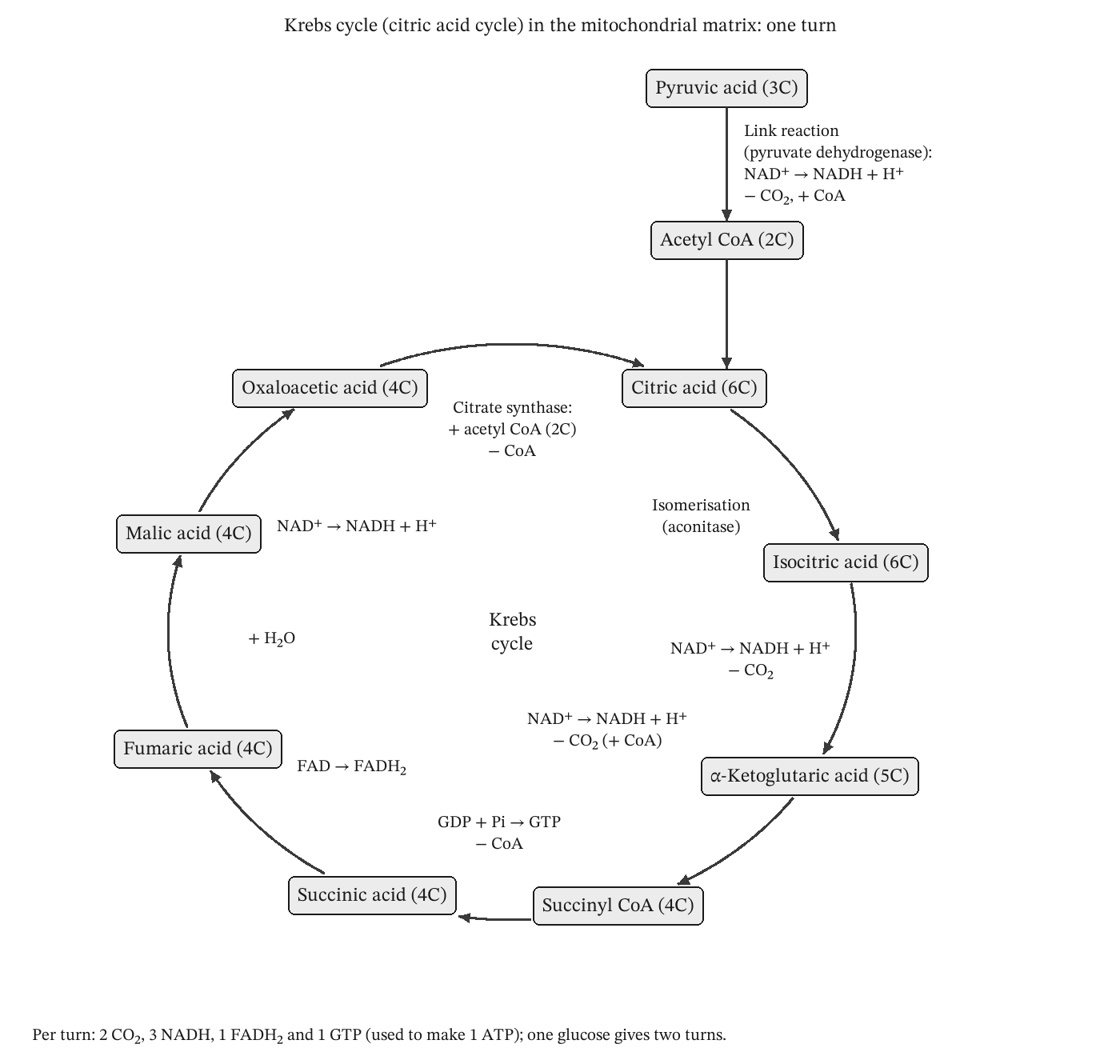
Therefore, acetyl CoA is formed from pyruvic acid by oxidative decarboxylation and feeds its acetyl group into the citric acid cycle, which oxidises it to CO₂, yields NADH, FADH₂ and ATP (GTP in animal cells), and supplies carbon skeletons.
- 525 marks
Question 52
Illustrate the mechanism of electron transport system. How is energy released during ETS utilised in synthesising ATP molecules? What is oxidative phosphorylation?
Solve with AIWritten solution
Solution:
Concept: The ETS is a chain of electron carriers in the inner mitochondrial membrane that passes electrons from NADH and FADH₂ to oxygen.
Step 1 — Electron flow: NADH gives electrons to NADH dehydrogenase (complex I); they pass to ubiquinone, which also receives electrons from FADH₂ via succinate dehydrogenase (complex II).
Step 2 — Further carriers: Ubiquinone passes them to the cytochrome bc₁ complex, then to the mobile carrier cytochrome c, and then to the cytochrome oxidase complex (cytochromes a and a₃ with copper centres).
Step 3 — Final acceptor: Cytochrome oxidase gives the electrons to oxygen, which combines with protons to form water; without oxygen the whole chain stops.
Step 4 — Proton gradient: As electrons fall to lower energy, complexes I, III and IV use the energy to pump protons (H⁺) from the matrix into the intermembrane space, building a high H⁺ concentration there.
Step 5 — ATP synthesis: Protons flow back into the matrix through the F₀ channel of ATP synthase, and the F₁ head uses this energy to make ATP from ADP and Pi (chemiosmosis); on the book's basis one NADH gives 3 ATP and one FADH₂ gives 2 ATP.
Step 6 — Oxidative phosphorylation: This coupling of electron transport (oxidation) to ATP formation (phosphorylation) is called oxidative phosphorylation.
Step 7 — Diagram: The diagram shows the carriers, the proton pumping and ATP synthase.

Note: Current measurements give about 2.5 ATP per NADH and 1.5 ATP per FADH₂; 3 and 2 are the book's values.
Therefore, electrons pass from NADH and FADH₂ through complexes I, III and IV, ubiquinone and cytochrome c to oxygen; the energy pumps protons whose return through ATP synthase makes ATP, a process called oxidative phosphorylation.
- 535 marks
Question 53
Explain major steps involved in complete oxidation of one glucose molecule.
Solve with AIWritten solution
Solution:
Concept: Complete (aerobic) oxidation of glucose gives CO₂, water and ATP in five stages. The overall reaction is shown in Step 1.
Step 1 — Overall reaction: One glucose uses 6 O₂ and gives 6 CO₂, 6 H₂O and energy.
Step 2 — Glycolysis: In the cytoplasm, glucose is split into 2 pyruvic acid, with a net gain of 2 ATP and 2 NADH (8 ATP in all).
Step 3 — Link reaction: In the mitochondrial matrix, each pyruvic acid is oxidatively decarboxylated to acetyl CoA, giving 2 CO₂ and 2 NADH (6 ATP) per glucose.
Step 4 — Krebs cycle: In the matrix, each acetyl CoA joins oxaloacetic acid to form citric acid, and the cycle releases 4 CO₂, 6 NADH, 2 FADH₂ and 2 ATP (GTP in animal cells) per glucose (24 ATP).
Step 5 — Electron transport: On the inner mitochondrial membrane, NADH and FADH₂ pass electrons through the carriers to oxygen, forming water and pumping protons.
Step 6 — Oxidative phosphorylation: Protons return through ATP synthase, which makes ATP; altogether one glucose gives 38 ATP (36 in cells such as skeletal muscle and brain, where the 2 NADH of glycolysis pass their electrons into the mitochondria through the glycerol-phosphate shuttle and so give only 2 ATP each instead of 3).
Note: The 38-ATP count assumes 3 ATP per NADH and 2 ATP per FADH₂. Current measurements give about 2.5 and 1.5, so one glucose really yields about 30–32 ATP; ISC answers use the book's values.
Therefore, glucose is completely oxidised by glycolysis, the link reaction, the Krebs cycle, electron transport and oxidative phosphorylation, giving 6 CO₂, 6 H₂O and 38 ATP.
- 545 marks
Question 54
How are glycolysis, Krebs cycle and ETS linked?
Solve with AIWritten solution
Solution:
Concept: The three stages are joined by the molecules one stage hands to the next.
Step 1 — Glycolysis to Krebs cycle: Glycolysis in the cytoplasm forms pyruvic acid, which enters the mitochondrion and becomes acetyl CoA in the link reaction; acetyl CoA is the fuel of the Krebs cycle.
Step 2 — Krebs cycle: Acetyl CoA joins oxaloacetic acid to form citric acid; the cycle oxidises the acetyl group to CO₂ and stores the hydrogen as NADH and FADH₂.
Step 3 — To the ETS: The NADH from glycolysis, the link reaction and the Krebs cycle, and the FADH₂ from the Krebs cycle, give their electrons to the ETS in the inner mitochondrial membrane.
Step 4 — ETS back to the cycles: The ETS reoxidises them to NAD⁺ and FAD, which return to glycolysis and the Krebs cycle; so these stages can keep running only while the ETS works, that is, while oxygen is present.
Step 5 — Energy: The electron flow drives ATP synthase, giving most of the 38 ATP (book basis); glycolysis and the Krebs cycle make only 4 ATP directly.
Note: The 38-ATP count assumes 3 ATP per NADH and 2 ATP per FADH₂. Current measurements give about 2.5 and 1.5, so one glucose really yields about 30–32 ATP; ISC answers use the book's values.
Therefore, pyruvic acid (as acetyl CoA) links glycolysis to the Krebs cycle, and NADH/FADH₂ link both to the ETS, which regenerates NAD⁺/FAD and makes most of the ATP.
What Class 11 Biology Ch 19 covers
The sections of the chapter, in the order the book takes them. Every question above comes from one of these.
- 01ATP - The Energy Source of Cells
- 02Types of Respiration
- 03Glycolysis
- 04Fermentation
- 05Aerobic Respiration
More ways to study this chapter
The same chapter asked three other ways. Practise it, revise it, and see what the board has set on Ch 19 before.
Class 11 Biology Ch 19 questions students ask
How many questions are there in Class 11 Biology Ch 19?
54 questions. Every one is solved step by step on this page.
Are these Class 11 Biology solutions free?
Yes. Every question and its full working is free to read, with no account needed.
Can I download the Class 11 Biology Ch 19 solutions as a PDF?
There is no PDF to download. Every solution is on this page instead, which means it is searchable, always the current syllabus, and readable on a phone. Use your browser's print option if you want it on paper.