
Opening your dashboard
Class 11 Biology Chapter 19 Respiration in Plants: Practice Questions
119 questions on Chapter 19, each worked through on its own page with the AI tutor. Class 11 Biology, ICSE 2026-27.
119 questions
1–4 marks · Mixed difficulty
- 11 mark
Question 1
In a test tube, an enzyme removes the terminal phosphate group from ATP. A second enzyme then removes one more phosphate group from the product. Which adenine-containing molecule is left at the end?
- 22 marks
Question 2
(Hypothetical data.) A 1 g sample of actively growing root tissue hydrolyses about mol of ATP to ADP every second. Take the energy released as 30.6 kJ for each mole of ATP changed to ADP, as in the chapter.
(a) Calculate the energy released by this hydrolysis in one second, in joules.
(b) Calculate the energy released in one hour.
- 31 mark
Question 3
A cell needs energy many times a second, in small amounts, for jobs such as active transport and building proteins. Which property of ATP best suits it to this role?
- 43 marks
Question 4
(Hypothetical data.) A root-tip cell contains about molecules of ATP at any moment. The chapter states that a working cell uses and regenerates its entire pool of ATP about once every minute.
(a) Estimate how many ATP molecules this cell regenerates in one hour.
(b) Suggest why the cell keeps only a small stock of ATP instead of a large one.
(c) Name the process in the cell that supplies the energy to regenerate ATP from ADP.
- 52 marks
Question 5
A plant cell is well supplied with glucose, but a poison stops it from regenerating ATP from ADP. The cell's activities, such as active uptake of ions, continue for a short time.
(a) Predict what happens to the amounts of ATP and ADP in the cell.
(b) Predict what happens to its active uptake of ions within a few minutes, and give a reason.
- 61 mark
Question 6
Apples stored for many weeks in a sealed box with very little oxygen developed an alcoholic smell. Which statement correctly describes the respiration of the fruit cells in the box?
- 72 marks
Question 7
(Hypothetical data.) Two flasks each hold 100 mL of the same dilute glucose solution and the same small number of yeast cells at 30 °C. Air is bubbled through flask X; flask Y is sealed so that no oxygen can enter. After 6 hours, flask X contains about four times as many yeast cells as flask Y, and only flask Y smells of alcohol.
(a) Explain why the yeast multiplied much more in flask X.
(b) Explain why only flask Y smells of alcohol.
- 81 mark
Question 8
Which single observation shows that a plant tissue is respiring aerobically rather than by any kind of fermentation?
- 93 marks
Question 9
(Hypothetical data.) A group of active cells needs ATP molecules every minute. Take 38 ATP per glucose for aerobic respiration and 2 ATP per glucose for anaerobic respiration, as in the chapter.
(a) How many glucose molecules per minute would the cells use if they respired aerobically?
(b) How many would they use if they respired anaerobically?
(c) Use your answers to explain why large, active organisms cannot depend on anaerobic respiration for long.
- 101 mark
Question 10
Which sequence shows the correct order of the stages in the complete aerobic respiration of glucose in a plant cell?
- 112 marks
Question 11
The roots of many crop plants can respire without oxygen, yet these plants often die when a field stays waterlogged for many days. Give two reasons.
- 123 marks
Question 12
(Hypothetical data.) A plant cell breaks down 5 molecules of glucose by glycolysis.
(a) How many molecules of fructose 1,6-bisphosphate are split, and how many molecules of glyceraldehyde 3-phosphate finally pass on to the energy-harvesting steps?
(b) How many molecules of pyruvic acid are formed, and how many carbon atoms do they contain in total?
(c) Use your answer to (b) to say whether glycolysis releases any carbon dioxide.
- 132 marks
Question 13
(Hypothetical data.) A cell breaks down 3 molecules of glucose to pyruvic acid by glycolysis.
(a) How many ATP molecules are used, and how many are formed?
(b) What is the net gain of ATP and how many NADH molecules are formed?
- 141 mark
Question 14
A drug is added to yeast cells that blocks only the enzyme phosphofructokinase. Which compound will build up immediately before the blocked step?
- 152 marks
Question 15
When fructose 1,6-bisphosphate splits, only glyceraldehyde 3-phosphate is used directly by the next step of glycolysis, yet both three-carbon halves of glucose end up as pyruvic acid.
(a) Explain how this happens.
(b) State how this affects the number of ATP and NADH formed in the energy-harvesting steps from one glucose.
- 164 marks
Question 16
The figure shows the steps of glycolysis. Four of the steps are marked P, Q, R and S.

(a) At which two lettered steps is ATP used, and at which two is ATP formed?
(b) Name the enzyme that catalyses each of the steps P, Q, R and S.
- 171 mark
Question 17
The four ATP molecules formed in glycolysis itself (before any NADH is used) are made by which process?
- 183 marks
Question 18
In a leaf cell, sucrose is the usual starting molecule for respiration.
(a) Name the enzyme that first acts on sucrose, and the two products formed.
(b) How many ATP molecules are used to convert one molecule of sucrose into two molecules of fructose 1,6-bisphosphate?
(c) What is the net gain of ATP, and how many NADH are formed, when one sucrose is broken down to pyruvic acid by glycolysis?
- 191 mark
Question 19
Which step of glycolysis is an oxidation, in which NAD⁺ is reduced to NADH?
- 202 marks
Question 20
In alcoholic fermentation, yeast converts acetaldehyde into ethanol, and in lactic acid fermentation a muscle cell converts pyruvic acid into lactic acid. Neither of these final steps produces any ATP. Explain why the cells still carry them out.
- 213 marks
Question 21
(Hypothetical data.) Three equal pieces of dough were made from flour, water and a little sugar, and left for 1 hour.
Dough Contents Temperature Volume at start (cm³) Volume after 1 h (cm³) A with yeast 35 °C 200 380 B no yeast 35 °C 200 200 C with yeast 4 °C 200 215 (a) Name the gas that made dough A rise, and the process that produced it.
(b) Calculate the percentage increase in the volume of dough A.
(c) Explain why dough C rose so little.
- 221 mark
Question 22
(Hypothetical data.) Grape juice with yeast was left to ferment in a closed vat fitted with an outlet for gas. The alcohol content rose to about 13% and then stopped rising, although some sugar was still left. Which is the best explanation?
- 233 marks
Question 23
(Hypothetical data.) Yeast fermenting glucose in a sealed flask released molecules of carbon dioxide.
(a) Write the balanced overall equation for alcoholic fermentation of glucose.
(b) Calculate how many glucose molecules were fermented and how many ethanol molecules were formed.
(c) Calculate the net number of ATP molecules the yeast gained.
- 241 mark
Question 24
When one glucose molecule undergoes lactic acid fermentation in a muscle cell, where do its six carbon atoms end up?
- 253 marks
Question 25
Ethanol produced by the fermentation of sugarcane juice is blended into petrol and burnt as a fuel.
(a) What does the use of ethanol as a fuel tell us about how much of the energy of glucose is released in alcoholic fermentation?
(b) Explain why the NADH formed in glycolysis gives the yeast no extra ATP during fermentation.
(c) Hence state the net ATP the yeast gains per glucose.
- 261 mark
Question 26
Cyanide binds to the cytochrome oxidase complex (complex IV) of the electron transport system and stops it from passing electrons to oxygen. Which change follows soon after cyanide reaches the mitochondria of a respiring root cell?
- 273 marks
Question 27
(Hypothetical data.) Four molecules of pyruvic acid enter a mitochondrion and are completely oxidised.
(a) How many molecules of CO₂ are released when they are converted to acetyl CoA?
(b) How many turns of the Krebs cycle take place, and how many molecules of CO₂ are released in the cycle?
(c) Show that the total CO₂ released accounts for every carbon atom in the four pyruvic acid molecules.
- 281 mark
Question 28
(Hypothetical data.) Three molecules of pyruvic acid are completely oxidised inside a mitochondrion: each is first converted to acetyl CoA, which is then oxidised in the Krebs cycle. How many molecules of NADH are formed in all?
- 294 marks
Question 29
The figure shows a section of a mitochondrion. W, X, Y and Z mark different parts.
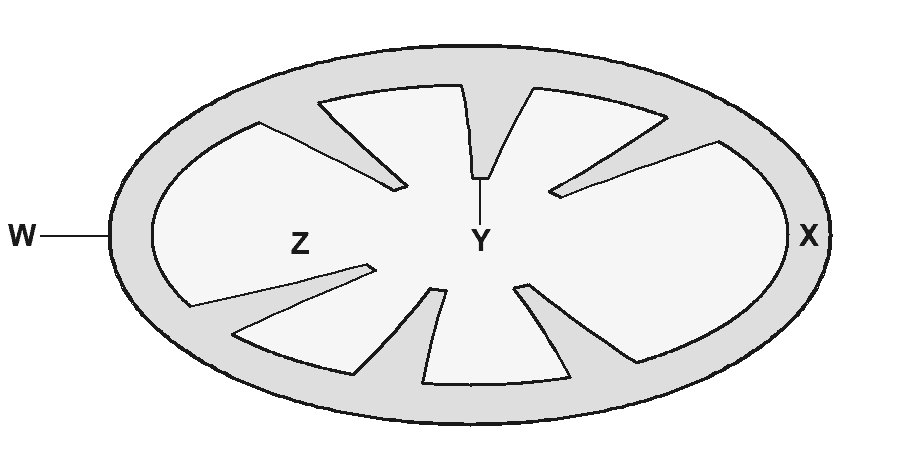
For each of the following, give the letter of the part in which it is found, and name that part:
(a) the enzymes that convert pyruvic acid to acetyl CoA and most enzymes of the Krebs cycle;
(b) the carriers of the electron transport system and the ATP synthase complexes;
(c) the space into which protons are pumped during electron transport;
(d) succinate dehydrogenase, the one Krebs-cycle enzyme that is also part of the electron transport system (complex II).
- 301 mark
Question 30
Which carrier of the electron transport system is NOT a protein, but a small molecule that moves within the inner mitochondrial membrane carrying electrons to the cytochrome bc₁ complex?
- 313 marks
Question 31
(Hypothetical data.) A drug blocks only NADH dehydrogenase (complex I) of the electron transport system. Mitochondria treated with the drug are supplied with one of two substrates:
- with succinic acid, they still take up oxygen and make ATP;
- with malic acid, they take up almost no oxygen and make almost no ATP.
Explain these results. (Hint: in the Krebs cycle, succinic acid is oxidised by succinate dehydrogenase (complex II), forming FADH₂; malic acid is oxidised by a dehydrogenase that forms NADH.)
- 321 mark
Question 32
Suppose the inner mitochondrial membrane became leaky, so that protons flowed back into the matrix through the membrane itself instead of through ATP synthase. What would happen in the respiring cell?
- 332 marks
Question 33
A student wrote the path of electrons in the electron transport system as follows:
NADH → cytochrome c → ubiquinone → cytochrome bc₁ complex → cytochrome oxidase complex → O₂
Find the two errors and write the correct sequence.
- 342 marks
Question 34
No reaction of the Krebs cycle uses oxygen, yet the Krebs cycle stops within minutes when a plant tissue is deprived of oxygen. Explain why.
- 353 marks
Question 35
(Hypothetical data.) Isolated mitochondria respiring pyruvic acid took up molecules of oxygen (O₂).
(a) Write the equation for the reaction at the end of the electron transport chain, using one molecule of O₂.
(b) How many molecules of water were formed, and how many electrons did the oxygen accept?
(c) If all these electrons came from NADH, how many NADH molecules were oxidised?
- 361 mark
Question 36
In the complete aerobic respiration of one glucose molecule, taking 1 NADH = 3 ATP and 1 FADH₂ = 2 ATP, as in the chapter, how many of the 38 ATP come from the oxidation of NADH alone?
- 374 marks
Question 37
(Hypothetical data.) In a germinating seed with a poor air supply, 10 glucose molecules are respired: 6 are oxidised completely by aerobic respiration and 4 are fermented to ethanol and CO₂. Take 38 ATP per glucose for aerobic respiration and 2 ATP per glucose for fermentation, as in the chapter.
(a) Calculate the total ATP gained.
(b) Calculate the number of CO₂ molecules released and of O₂ molecules taken up.
(c) Calculate the respiratory quotient (RQ) of the seed, and explain why it is more than 1 although the substrate is a carbohydrate.
- 381 mark
Question 38
In the chapter's balance sheet for aerobic respiration, glycolysis is credited with 8 ATP per glucose, but in fermentation it gives only 2 ATP. What is the reason for this difference?
- 393 marks
Question 39
Complete oxidation of one mole of glucose releases 2870 kJ. Take the energy trapped in one mole of ATP (released when it is hydrolysed to ADP) as 30.6 kJ.
(a) Calculate the percentage of the energy of glucose trapped in ATP if one glucose gives 38 ATP, as in the chapter.
(b) Repeat the calculation for today's estimate of about 30 ATP per glucose.
(c) What happens to the rest of the energy?
- 401 mark
Question 40
In the chapter's balance sheet for one glucose, how many ATP are formed directly (by transfer of phosphate from a substrate to ADP) in glycolysis and the Krebs cycle together, counting every ATP formed before the 2 ATP used in glycolysis are subtracted?
- 413 marks
Question 41
(Hypothetical data.) A mitochondrion receives 8 molecules of pyruvic acid from the cytoplasm and oxidises them completely. Answer taking 1 NADH = 3 ATP and 1 FADH₂ = 2 ATP, as in the chapter.
(a) Calculate the ATP produced inside the mitochondrion from these 8 pyruvic acid molecules.
(b) These 8 pyruvic acid molecules came from 4 glucose molecules, which would give 4 × 38 = 152 ATP in complete aerobic respiration. Account for the difference between your answer to (a) and 152.
- 423 marks
Question 42
Two students drew up the ATP balance sheet for the complete aerobic respiration of one glucose molecule, taking 1 NADH = 3 ATP and 1 FADH₂ = 2 ATP, as in the chapter.
- Student 1 wrote: glycolysis 8 ATP; pyruvic acid to acetyl CoA 6 ATP; Krebs cycle 2 ATP + 6 NADH + 2 FADH₂ = 26 ATP; total 40 ATP.
- Student 2 wrote: pyruvic acid to acetyl CoA 6 ATP; Krebs cycle 24 ATP; total 30 ATP.
(a) Find the error made by each student.
(b) Give the correct total.
- 431 mark
Question 43
(Hypothetical data.) A respiring plant tissue took up 9.0 cm³ of oxygen and gave out 12.0 cm³ of carbon dioxide in the same time. Which substrate is it most likely to be respiring?
- 444 marks
Question 44
A respirometer is set up as shown in the figure. In set-up A the solution at the bottom of the tube is potassium hydroxide (KOH), which absorbs carbon dioxide; in set-up B it is water. Each set-up holds the same mass of the same germinating seeds, and both are kept at the same temperature. The distance moved by the coloured drop towards the seeds in 1 hour was measured for two kinds of seeds, P and Q. (Hypothetical data.)
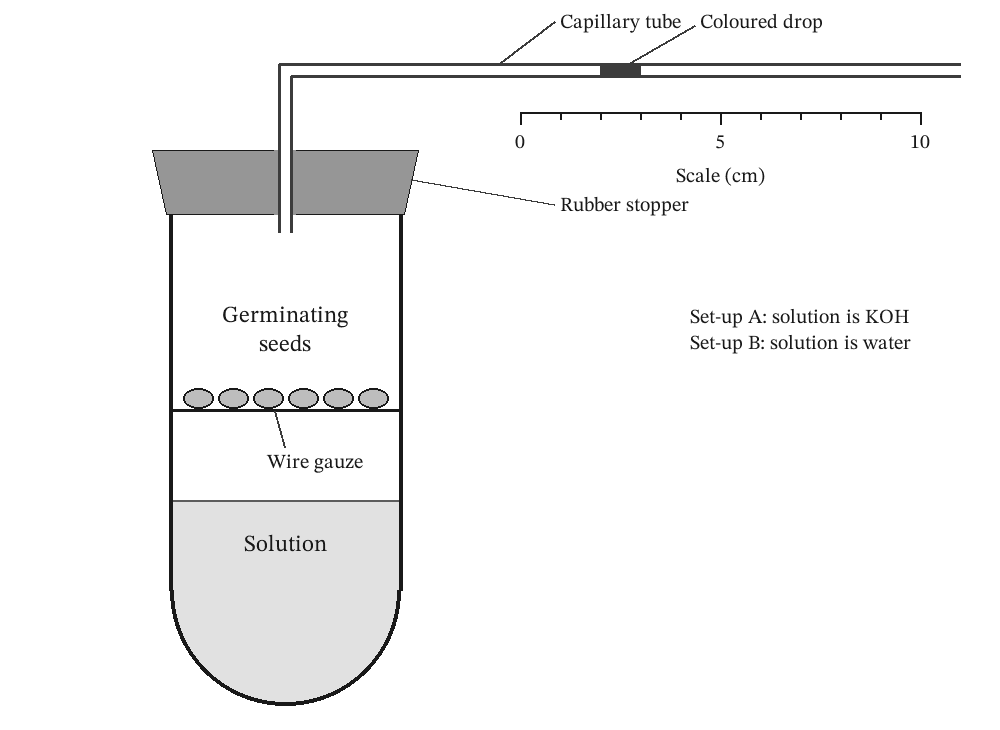
Seeds Drop movement in A (KOH), cm Drop movement in B (water), cm P 6.0 0.0 Q 5.0 1.5 (a) What does the drop movement in set-up A measure? Explain.
(b) What does the drop movement in set-up B measure?
(c) Calculate the RQ of seeds P and of seeds Q (the bore of the capillary is the same, so distance is proportional to volume).
(d) Which seeds are most likely to store fat, and which starch?
- 453 marks
Question 45
Citrus fruits contain a lot of citric acid, , which their cells can respire.
(a) Write a balanced equation for the complete oxidation of citric acid to CO₂ and water, using whole numbers.
(b) Calculate the RQ.
(c) Explain why the RQ is more than 1.
- 461 mark
Question 46
(Hypothetical data.) Yeast cells in a glucose solution, with glucose as their only substrate, took up 4.0 cm³ of oxygen and gave out 12.0 cm³ of carbon dioxide in 30 minutes. Which conclusion is best supported?
- 473 marks
Question 47
Classify each of the following processes as catabolic (breaking down for respiration) or anabolic (building up), and then explain why the respiratory pathway is called an amphibolic pathway.
(a) Fatty acids from stored fat are broken down to acetyl CoA, which enters the Krebs cycle.
(b) Acetyl CoA is withdrawn from the respiratory pathway to make fatty acids.
(c) α-Ketoglutaric acid is withdrawn from the Krebs cycle to make amino acids.
(d) Glycerol from stored fat is converted to glyceraldehyde 3-phosphate (PGAL) and respired.
- 481 mark
Question 48
When a germinating seed respires its stored fat, the fat is first broken down into glycerol and fatty acids. How do these two products enter the respiratory pathway?
- 493 marks
Question 49
(Hypothetical data.) Pieces of a plant tissue were kept in the dark with no sugar supply, and their gas exchange was measured on three days.
Day O₂ taken up (cm³) CO₂ given out (cm³) 1 20.0 20.0 4 20.0 14.2 8 20.0 18.0 (a) Calculate the RQ on each day.
(b) Suggest which substrate was mainly being respired on each day, and why the substrate changed.
(c) Why can the RQ on day 8 only suggest, and not prove, which substrate was being used?
- 503 marks
Question 50
When proteins are respired, they are first broken down to amino acids, and the amino group is removed from each amino acid. Removing the amino group from alanine gives pyruvic acid, from glutamic acid gives α-ketoglutaric acid, and from aspartic acid gives oxaloacetic acid.
(a) State the point at which the carbon skeleton of each amino acid enters the respiratory pathway.
(b) How many molecules of CO₂ are released when the carbon skeleton from one alanine molecule is completely oxidised?
(c) A rapidly growing cell withdraws a lot of α-ketoglutaric acid from the Krebs cycle to make amino acids. Explain why this can slow down the Krebs cycle.
- 511 mark
Question 51
During cellular respiration when the chemical bonds break and release energy in a stepwise oxidation
- 521 mark
Question 52
When ATP breaks down to ADP and Pi, the energy released is
- 531 mark
Question 53
Glycolysis takes place in
- 541 mark
Question 54
Krebs cycle takes place in
- 551 mark
Question 55
The end product of glycolysis is
- 561 mark
Question 56
During phosphorylation in glycolysis the molecules utilised are
- 571 mark
Question 57
During alcoholic fermentation, acetaldehyde is converted to ethyl alcohol by utilisation of
- 581 mark
Question 58
Lactic acid fermentation leads to net yield of
- 591 mark
Question 59
The net yield of aerobic respiration is
- 601 mark
Question 60
The enzymes for Krebs cycle are present in
- 611 mark
Question 61
During Krebs cycle, succinate is converted to
- 621 mark
Question 62
The final acceptor of electrons in ETC is
- 631 mark
Question 63
The enzymes for ETC are present in
- 641 mark
Question 64
F₁ particles are present in the mitochondria
- 651 mark
Question 65
During Krebs cycle one molecule of glucose gives a net yield of
(A) 4 NADH₂
(B) 6 NADH₂
(C) 8 NADH₂
(D) 10 NADH₂
- 661 mark
Question 66
In the interconversion of fats, carbohydrates and proteins the common metabolic pathway is
- 671 mark
Question 67
During anaerobic respiration, yeast converts glucose into
- 681 mark
Question 68
In an electron transport chain one molecule of NADH₂ yields
- 691 mark
Question 69
F₁ and F₀ are major components of
- 701 mark
Question 70
At CO₂ compensation point, photosynthesis is
- 711 mark
Question 71
Powerhouse of energy in the cells is
- 721 mark
Question 72
In Krebs cycle, the conversion of succinyl CoA to succinic acid requires
- 731 mark
Question 73
Overall goal of glycolysis, Krebs cycle and electron transport system is the formation of
- 741 mark
Question 74
Net gain of ATP molecules in glycolysis is
(A) 8
(B) 2
(C) 4
(D) all the above
- 751 mark
Question 75
Which of the following cells do not respire?
- 761 mark
Question 76
Pyruvic acid formed during glycolysis is oxidised to CO₂ and H₂O in a cycle called
- 771 mark
Question 77
Respiratory quotient (RQ) is equal to one in
- 781 mark
Question 78
Pyruvic acid is oxidised into ________ before entering citric acid cycle.
- 791 mark
Question 79
The RQ is ________ if respiratory substrate is oxalic acid.
- 801 mark
Question 80
Glycolysis takes place in ________.
- 811 mark
Question 81
F₀–F₁ complex participate in the synthesis of ________.
- 821 mark
Question 82
Acetyl CoA is accepted by ________ in the citric acid cycle.
- 831 mark
Question 83
In glycolysis, fructose 1,6 biphosphate splits into two three carbon molecules ________ and ________ which are interconvertible.
- 841 mark
Question 84
Oxidation of one NADH molecule releases ________ molecules.
- 851 mark
Question 85
Compensation point refers to the light intensity when rate of photosynthesis is ________ to the rate of ________ in plants.
- 861 mark
Question 86
Pyruvic acid is reduced to lactic acid by enzyme ________.
- 871 mark
Question 87
In ATP molecule most of the free energy is present in the last two covalent bonds present between the phosphate groups.
- 881 mark
Question 88
During glycolysis in plants sucrose is converted to glucose and fructose by enzyme hexokinase.
- 891 mark
Question 89
Net gain during glycolysis is 2 NADH and 2 ATP molecules.
- 901 mark
Question 90
The conversion of pyruvic acid to acetyl CoA occurs in the mitochondria.
- 911 mark
Question 91
Krebs cycle occurs both in the mitochondria and cell membrane of the cell.
- 921 mark
Question 92
Glycolysis is a common way for both aerobic and anaerobic respiration.
- 931 mark
Question 93
In the presence of oxygen, pyruvic acid is broken down to ethyl alcohol in plants.
- 941 mark
Question 94
In the Krebs cycle, acetyl CoA combines with oxaloacetic acid to produce citric acid.
- 951 mark
Question 95
Oxidation of a compound means addition of electrons or addition of hydrogen.
- 961 mark
Question 96
Oxidative phosphorylation occurs in the outer membrane of mitochondria.
- 971 mark
Question 97
A phase of aerobic respiration that does not need oxygen.
- 981 mark
Question 98
A kind of anaerobic respiration in which ethyl alcohol is produced.
- 991 mark
Question 99
A metabolic pathway through which electrons pass in a sequence from one carrier to another.
- 1001 mark
Question 100
A combination of oxidation reduction reactions that enable a cell to use energy in NADH and FADH₂ to convert ADP to ATP.
- 1011 mark
Question 101
A metabolic pathway in which the end product is pyruvic acid.
- 1021 mark
Question 102
A pathway which is catabolic as well as anabolic in nature.
- 1031 mark
Question 103
Early morning and evening hours when photosynthesis is equal to respiration and there is no net uptake of gases from the atmosphere.
- 1041 mark
Question 104
An organelle essential for aerobic respiration to occur.
- 1051 mark
Question 105
Net gain of ATP molecules in a normal human cell during respiration.
- 1061 mark
Question 106
Assertion (A): Glycolysis is the first step of respiration in which glucose completely breaks into CO₂ and H₂O.
Reason (R): In this process, there is a net gain of 24 ATP molecules.
- 1071 mark
Question 107
Assertion (A): Fructose-1,6 diphosphate is converted into glyceraldehyde-3-phosphate and dihydroxy-acetone-3-phosphate.
Reason (R): Each of these three carbon sugar phosphates—glyceraldehyde-3-phosphate and dihydroxy-acetone-3-phosphate is converted to pyruvate.
- 1081 mark
Question 108
Assertion (A): In TCA cycle, the first step is the condensation of pyruvate with oxaloacetic acid and water.
Reason (R): This reaction is catalysed by enzyme pyruvate synthase.
- 1091 mark
Question 109
Assertion (A): The inner membrane of mitochondria contains systems involving electron transport.
Reason (R): The mitochondrial matrix contains enzymes of Krebs cycle.
- 1101 mark
Question 110
Assertion (A): Oxidation of one NADH molecule produces three ATP molecules and one FADH₂ molecule produces 2 ATP molecules.
Reason (R): The number of ATP molecules synthesised depends on the nature of the electron donor.
- 1111 mark
Question 111
Assertion (A): Electron transport system (ETS) consists of a series of electron carriers through which electrons pass from one carrier to another.
Reason (R): ETS is present in the inner mitochondrial membrane.
- 1121 mark
Question 112
Assertion (A): In electron transport system the electrons are passed on to oxygen that results in the formation of H₂O.
Reason (R): Oxygen is the ultimate acceptor of electrons.
- 1131 mark
Question 113
Assertion (A): The RQ is equal to 1, when carbohydrates are used as substrate and are completely oxidised.
Reason (R): When proteins are used as substrate in respiration, the RQ is greater than 1.
- 1141 mark
Question 114
Assertion (A): In alcoholic fermentation, the hexose molecule is converted into ethyl alcohol and CO₂.
Reason (R): Alcoholic fermentation is anaerobic respiration.
- 1151 mark
Question 115
Assertion (A): During early morning and evening time, there is no net uptake of gases from the atmosphere.
Reason (R): The amount of CO₂ taken in during photosynthesis is almost same as the amount of CO₂ given out during respiration.
- 1162 marks
Question 116
What are respiratory substrates? Name the most common respiratory substrate.
- 1172 marks
Question 117
Define RQ. What is its value for fats?
- 1182 marks
Question 118
What is oxidative phosphorylation?
- 1192 marks
Question 119
What is the significance of stepwise release of energy in respiration?