
Question 515 marksMedium
How is acetyl CoA formed? What is its role in citric acid cycle? Describe the process and role of citric acid cycle in living organisms.
Confirming your payment
Sign up now and get 250 free tokens.
Respiration in Plants · Question 51 of 54
How is acetyl CoA formed? What is its role in citric acid cycle? Describe the process and role of citric acid cycle in living organisms.
Solution:
Concept: Acetyl CoA links glycolysis (cytoplasm) to the citric acid cycle (mitochondrial matrix).
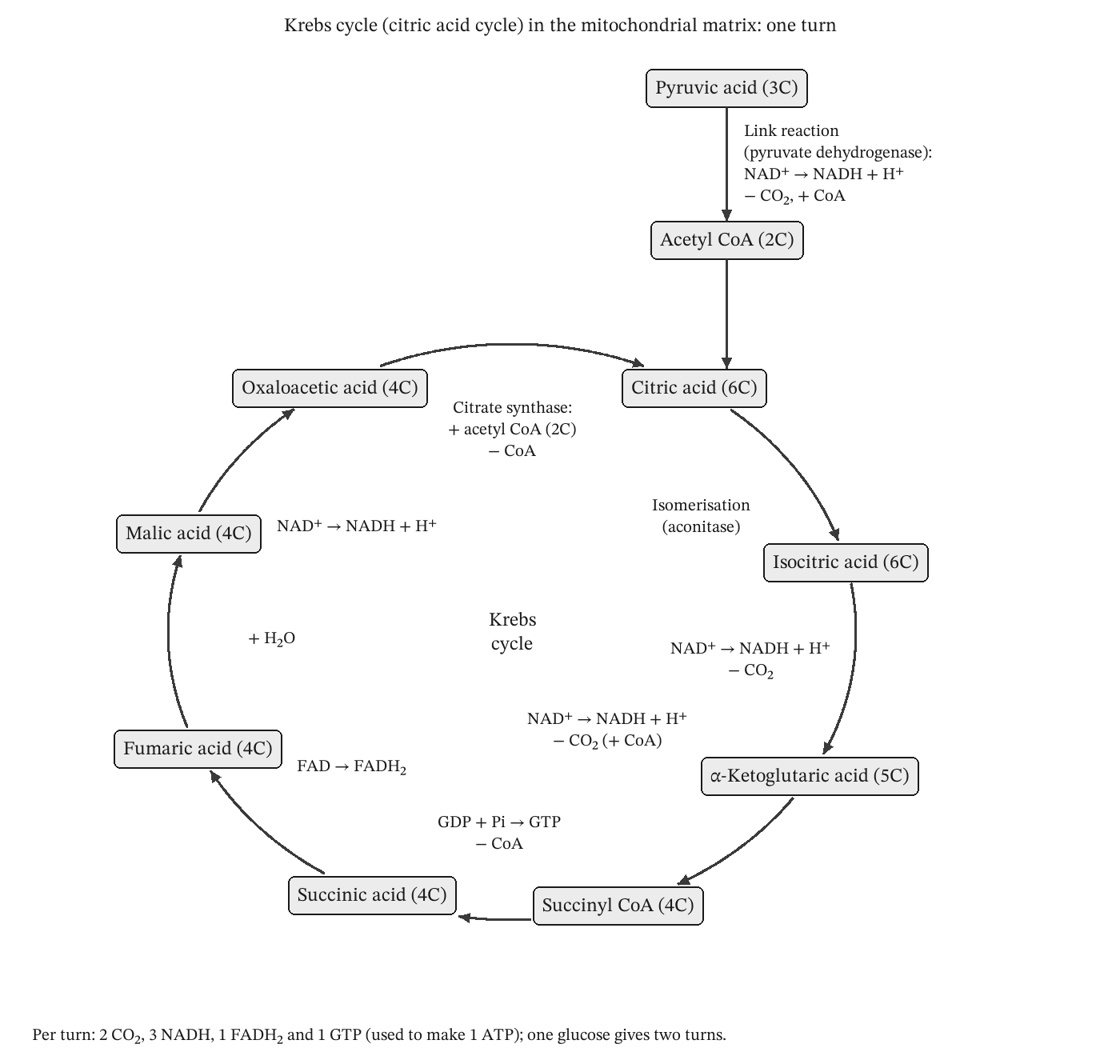
Step 1 — Formation of acetyl CoA: Pyruvic acid enters the mitochondrial matrix; pyruvate dehydrogenase removes one carbon as CO₂ and oxidises the rest (NAD⁺ → NADH), and the acetyl group (2C) joins coenzyme A.
Step 2 — Its role: Acetyl CoA brings the 2-carbon acetyl group into the cycle: it combines with oxaloacetic acid (4C) to form citric acid (6C), releasing CoA.
Step 3 — Process (1): Citric acid is isomerised to isocitric acid (6C); this is oxidatively decarboxylated to α-ketoglutaric acid (5C) (NADH, CO₂), which gives succinyl CoA (4C) (NADH, CO₂).
Step 4 — Process (2): Succinyl CoA gives succinic acid, making 1 ATP (GTP in animal cells); succinic acid is oxidised to fumaric acid (FADH₂), which takes up water to form malic acid, and malic acid is oxidised to oxaloacetic acid (NADH), so the cycle starts again.
Step 5 — Yield: Each turn releases 2 CO₂ and forms 3 NADH, 1 FADH₂ and 1 ATP (GTP in animal cells); one glucose gives two turns, worth 24 ATP (book basis).
Step 6 — Role in living organisms: It completes the oxidation of food to CO₂, supplies NADH and FADH₂ for ATP production in the ETS, and its intermediates (α-ketoglutaric acid, oxaloacetic acid, succinyl CoA) are used to make amino acids, chlorophyll and other molecules, so it is amphibolic.
Step 7 — Diagram: The cycle with carbon numbers and outputs is shown below.
Therefore, acetyl CoA is formed from pyruvic acid by oxidative decarboxylation and feeds its acetyl group into the citric acid cycle, which oxidises it to CO₂, yields NADH, FADH₂ and ATP (GTP in animal cells), and supplies carbon skeletons.