
Opening your dashboard
Class 11 Biology Chapter 11: Morphology and Anatomy of Different Systems of Cockroach Solutions
54 textbook questions with step-by-step answers, free to read, for ISC 2026-27.
Get talked through Ch 11, not just shown the answer
Reading a finished solution is not the same as being able to do it. The AI tutor takes one question at a time and works it with you, in your own words, until you can.
- Ask it out loud, in your own words
- It gives you the next step, not the answer
- Stuck on part (ii)? Start there
54 questions with solutions
1–5 marks · Mixed difficulty
- 11 mark
Question 1
Why is cockroach called a nocturnal animal?
Solve with AIWritten solution
Solution:
Concept: a nocturnal animal is one that rests by day and is active at night.
Step 1 — What is asked: the reason the cockroach is called nocturnal.
Step 2 — The fact: By day the cockroach hides in damp, dark corners and crevices of houses, godowns and drains; it comes out at night to look for food.
Step 3 — Answer: Cockroach is called nocturnal because it hides during the day and comes out at night to feed.
Cockroach is called nocturnal because it hides during the day and comes out at night to feed.
- 21 mark
Question 2
What is the scientific name of common cockroach found in Indian house hold?
Solve with AIWritten solution
Solution:
Concept: a scientific name has two parts: the genus (capital letter) and the species (small letter), written in italics.
Step 1 — What is asked: the scientific name of the common house cockroach in India.
Step 2 — The fact: It is the American cockroach, genus Periplaneta, species americana.
Step 3 — Answer: Periplaneta americana.
Periplaneta americana.
- 31 mark
Question 3
Give scientific name of other cockroaches found in India.
Solve with AIWritten solution
Solution:
Concept: besides Periplaneta americana, two smaller cockroaches are common in Indian homes.
Step 1 — What is asked: the scientific names of the other common cockroaches.
Step 2 — The facts: The oriental cockroach, Blatta orientalis (dark brown to black, about 2.5 cm; females have vestigial wings), and the German cockroach, Blattella germanica (light brown, about 1-1.5 cm, common in kitchens).
Step 3 — Answer: Blatta orientalis and Blattella germanica.
Blatta orientalis and Blattella germanica.
Note: the German cockroach was earlier named Blatta germanica; its accepted name today is Blattella germanica.
- 41 mark
Question 4
Which phylum and class of Kingdom Animalia do cockroach belong to?
Solve with AIWritten solution
Solution:
Concept: animals with jointed legs belong to phylum Arthropoda; arthropods with 3 pairs of legs and a body in head, thorax and abdomen are insects.
Step 1 — What is asked: the phylum and class of the cockroach.
Step 2 — Apply: The cockroach has jointed legs (Arthropoda), and three pairs of legs with a three-part body (Insecta).
Step 3 — Answer: Phylum Arthropoda, Class Insecta.
Phylum Arthropoda, Class Insecta.
- 51 mark
Question 5
How many pairs of working legs it has got?
Solve with AIWritten solution
Solution:
Concept: insects have one pair of walking legs on each thoracic segment.
Step 1 — What is asked: the number of pairs of walking legs.
Step 2 — Count: The prothorax, mesothorax and metathorax each carry one pair, so there are 3 pairs of jointed walking legs.
Step 3 — Answer: 3 pairs of jointed walking legs.
3 pairs of jointed walking legs.
- 61 mark
Question 6
What is the tough skeleton of cockroach made up of?
Solve with AIWritten solution
Solution:
Concept: the body is covered by a hard outer skeleton (exoskeleton) of plates called sclerites.
Step 1 — What is asked: the material of the exoskeleton.
Step 2 — The fact: The sclerites are made of chitin, which gives strength and elasticity; a wax layer on top makes them waterproof.
Step 3 — Answer: Chitin.
Chitin.
- 71 mark
Question 7
How many pairs of wings are present in cockroach?
Solve with AIWritten solution
Solution:
Concept: wings of insects arise from the second and third thoracic segments.
Step 1 — What is asked: the number of pairs of wings.
Step 2 — The fact: The forewings (tegmina) arise from the mesothorax and the hindwings from the metathorax.
Step 3 — Answer: Two pairs of wings.
Two pairs of wings.
- 81 mark
Question 8
Give distinguishing features in the 9th sternum of male and female cockroach.
Solve with AIWritten solution
Solution:
Concept: the hind end of the abdomen differs in the two sexes, so it is used to tell them apart.
Step 1 — What is asked: how the 9th sternum differs between the sexes.
Step 2 — Male: The male's 9th sternum is visible from below and bears a pair of short, unjointed anal styles.
Step 3 — Female: The female has no anal styles; her 8th and 9th sterna are hidden inside the genital pouch formed by the boat-shaped 7th sternum.
Step 4 — Answer: Male: the 9th sternum is visible and bears a pair of anal styles; female: no anal styles, and the 9th sternum is hidden in the genital pouch.
Male: the 9th sternum is visible and bears a pair of anal styles; female: no anal styles, and the 9th sternum is hidden in the genital pouch.
Note: the printed answer also counts the anal cerci here, but the anal cerci arise from the 10th segment in both sexes, so only the anal styles belong to the 9th sternum.
- 91 mark
Question 9
List various parts of the mouth parts of cockroach.
Solve with AIWritten solution
Solution:
Concept: the mouth parts of the cockroach are of the biting and chewing type and surround the pre-oral cavity.
Step 1 — What is asked: the names of the mouth parts.
Step 2 — List: A labrum (upper lip), a pair of mandibles, a pair of maxillae, a labium (lower lip) and a tongue-like hypopharynx.
Step 3 — Answer: Labrum, mandibles (1 pair), maxillae (1 pair), labium and hypopharynx.
Labrum, mandibles (1 pair), maxillae (1 pair), labium and hypopharynx.
- 101 mark
Question 10
What is the main function of gizzard?
Solve with AIWritten solution
Solution:
Concept: the gizzard is the last part of the foregut, a thick-walled round bag.
Step 1 — What is asked: the job of the gizzard.
Step 2 — The fact: Its lining has six chitinous teeth, which grind the food; its bristles also act as a filter, so only fine particles pass into the midgut.
Step 3 — Answer: The gizzard grinds the food with its chitinous teeth (and filters it).
The gizzard grinds the food with its chitinous teeth (and filters it).
- 111 mark
Question 11
What is the name given to 8 tubular and glandular structures present attached to midgut?
Solve with AIWritten solution
Solution:
Concept: blind, finger-like glandular tubes are attached where the foregut ends and the midgut begins.
Step 1 — What is asked: the name of these finger-like glandular tubes.
Step 2 — The fact: They are the hepatic (gastric) caeca, which make digestive enzymes.
Step 3 — Answer: Hepatic caeca.
Hepatic caeca.
Note: their number is usually given as 6-8.
- 121 mark
Question 12
Where are hepatic caecae found?
Solve with AIWritten solution
Solution:
Concept: the hepatic caeca are glandular tubes of the digestive system.
Step 1 — What is asked: the position of the hepatic caeca.
Step 2 — The fact: They are attached at the anterior (front) end of the midgut, at its junction with the gizzard (foregut).
Step 3 — Answer: At the anterior end of the midgut, at the junction of the foregut and midgut.
At the anterior end of the midgut, at the junction of the foregut and midgut.
- 131 mark
Question 13
What is the function of hepatic caecae?
Solve with AIWritten solution
Solution:
Concept: glands attached to the gut pour digestive juices into it.
Step 1 — What is asked: the work of the hepatic caeca.
Step 2 — The fact: They secrete digestive juice whose enzymes, together with the midgut's, digest food such as proteins and fats.
Step 3 — Answer: Hepatic caeca secrete digestive enzymes that digest proteins and fats.
Hepatic caeca secrete digestive enzymes that digest proteins and fats.
- 141 mark
Question 14
What is the function of malpighian tubules?
Solve with AIWritten solution
Solution:
Concept: Malpighian tubules hang in the haemolymph at the junction of the midgut and hindgut.
Step 1 — What is asked: their main function.
Step 2 — The fact: They take water and nitrogenous wastes out of the haemolymph, change the wastes into uric acid and pass it into the hindgut - this is excretion.
Step 3 — Answer: Excretion - removal of nitrogenous wastes (as uric acid) from the haemolymph.
Excretion - removal of nitrogenous wastes (as uric acid) from the haemolymph.
- 151 mark
Question 15
What kind of circulatory system does cockroach has?
Solve with AIWritten solution
Solution:
Concept: in an open system, blood is not kept inside vessels all the time.
Step 1 — What is asked: the type of circulatory system.
Step 2 — The fact: The heart pumps haemolymph into open spaces (sinuses) that bathe the organs; there are no capillaries.
Step 3 — Answer: An open circulatory system.
An open circulatory system.
- 161 mark
Question 16
What is the blood of cockroach called? What is its colour and why?
Solve with AIWritten solution
Solution:
Concept: the colour of blood comes from its respiratory pigment, if it has one.
Step 1 — Name: The blood is called haemolymph.
Step 2 — Colour and reason: It is colourless, because it has no haemoglobin (no respiratory pigment); it is a plasma with white corpuscles.
Step 3 — Answer: Haemolymph; it is colourless because it lacks haemoglobin.
Haemolymph; it is colourless because it lacks haemoglobin.
- 171 mark
Question 17
What is haemocoel?
Solve with AIWritten solution
Solution:
Concept: in the cockroach the true coelom is greatly reduced and is replaced by a blood-filled cavity.
Step 1 — What is asked: the meaning of haemocoel.
Step 2 — Definition: The haemocoel is the body cavity filled with haemolymph, in which the body organs lie freely, bathed by the blood.
Step 3 — Answer: Haemocoel is the blood-filled body cavity in which the organs lie freely in haemolymph.
Haemocoel is the blood-filled body cavity in which the organs lie freely in haemolymph.
- 181 mark
Question 18
List important parts of circulatory system of cockroach.
Solve with AIWritten solution
Solution:
Concept: an open circulatory system has a heart, a vessel and blood spaces.
Step 1 — What is asked: the main parts of the circulatory system.
Step 2 — List: Tubular heart (13 chambers), anterior aorta, pericardial sinus (with the diaphragm and alary muscles) and the haemocoel (perivisceral sinus), filled with haemolymph.
Step 3 — Answer: Tubular heart, anterior aorta, pericardial sinus and haemocoel.
Tubular heart, anterior aorta, pericardial sinus and haemocoel.
- 191 mark
Question 19
How many chambered heart does cockroach has?
Solve with AIWritten solution
Solution:
Concept: the heart is a long tube on the mid-dorsal line, divided into chambers with ostia.
Step 1 — What is asked: the number of chambers.
Step 2 — Count: 3 chambers lie in the thorax and 10 in the abdomen.
Step 3 — Answer: 13 chambers.
13 chambers.
- 201 mark
Question 20
Where is alary muscles present?
Solve with AIWritten solution
Solution:
Concept: the dorsal diaphragm separates the pericardial sinus from the rest of the haemocoel.
Step 1 — What is asked: where the alary muscles lie.
Step 2 — The fact: Pairs of triangular alary muscles are attached to this diaphragm, on either side of the heart, segment by segment.
Step 3 — Answer: On the dorsal diaphragm, on either side of the heart.
On the dorsal diaphragm, on either side of the heart.
- 211 mark
Question 21
What is the function of alary muscles?
Solve with AIWritten solution
Solution:
Concept: the heart lies in the pericardial sinus; haemolymph must refill this sinus from the haemocoel.
Step 1 — Contraction: When the alary muscles contract, haemolymph passes from the haemocoel into the pericardial sinus and then into the heart through the ostia.
Step 2 — Relaxation: When they relax, the heart muscles contract from behind forwards and push the haemolymph into the anterior aorta.
Step 3 — Answer: Alary muscles help the haemolymph flow from the haemocoel into the pericardial sinus and the heart.
Alary muscles help the haemolymph flow from the haemocoel into the pericardial sinus and the heart.
- 221 mark
Question 22
Name the system that carries respiratory function in cockroach.
Solve with AIWritten solution
Solution:
Concept: insects breathe by a network of air tubes, not by lungs or blood.
Step 1 — What is asked: the respiratory system's name.
Step 2 — The fact: Air reaches the cells through spiracles, tracheae and tracheoles - the tracheal system.
Step 3 — Answer: The tracheal system.
The tracheal system.
- 231 mark
Question 23
What are spiracles? Where are they present?
Solve with AIWritten solution
Solution:
Concept: spiracles are the openings through which air enters the tracheal system.
Step 1 — What they are: Spiracles are small slit-like openings on the sides of the body wall.
Step 2 — Where: There are 10 pairs: 2 pairs on the thorax (2nd and 3rd thoracic segments) and 8 pairs on the first eight abdominal segments.
Step 3 — Answer: Spiracles are slit-like openings, 10 pairs: on the 2nd and 3rd thoracic segments and the first eight abdominal segments.
Spiracles are slit-like openings, 10 pairs: on the 2nd and 3rd thoracic segments and the first eight abdominal segments.
- 241 mark
Question 24
What is the flow of air in tracheal system?
Solve with AIWritten solution
Solution:
Concept: air moves inward from the body surface through ever finer tubes.
Step 1 — What is asked: the path of air.
Step 2 — Path: Air enters through spiracles, flows through the tracheae, then the very fine tracheoles, and finally reaches the tissues.
Step 3 — Answer: Spiracles → tracheae → tracheoles → tissues.
Spiracles → tracheae → tracheoles → tissues.
- 251 mark
Question 25
What is the main excretory product?
Solve with AIWritten solution
Solution:
Concept: animals that must save water excrete nitrogen as a nearly insoluble waste.
Step 1 — What is asked: the main nitrogenous waste.
Step 2 — The fact: The cockroach excretes uric acid, so it is uricotelic.
Step 3 — Answer: Uric acid.
Uric acid.
- 261 mark
Question 26
Name the main excretory organs.
Solve with AIWritten solution
Solution:
Concept: the main excretory organs of insects are thin tubes attached to the gut.
Step 1 — What is asked: the main excretory organs.
Step 2 — The fact: These are the 100-150 yellow Malpighian tubules at the midgut-hindgut junction; the fat body, nephrocytes and uricose glands also help.
Step 3 — Answer: Malpighian tubules.
Malpighian tubules.
- 271 mark
Question 27
Where is the nerve cord present?
Solve with AIWritten solution
Solution:
Concept: in insects the heart is dorsal and the main nerve cord is ventral.
Step 1 — What is asked: the position of the nerve cord.
Step 2 — The fact: The double nerve cord runs along the ventral side (floor) of the body.
Step 3 — Answer: On the ventral side of the cockroach.
On the ventral side of the cockroach.
- 281 mark
Question 28
What is ootheca?
Solve with AIWritten solution
Solution:
Concept: after fertilisation, the eggs of the cockroach are packed in a protective case.
Step 1 — What is asked: the meaning of ootheca.
Step 2 — Definition: The ootheca (egg case) is a dark reddish to blackish-brown capsule, about 8 mm long, made by the secretion of the colleterial glands around 14-16 fertilised eggs, arranged in two rows.
Step 3 — Answer: Ootheca is the egg case formed around a group of 14-16 fertilised eggs.
Ootheca is the egg case formed around a group of 14-16 fertilised eggs.
- 291 mark
Question 29
Name the stages in the development of cockroach?
Solve with AIWritten solution
Solution:
Concept: the cockroach develops through nymphs (paurometabolous development), with no larva or pupa.
Step 1 — What is asked: the stages of development.
Step 2 — Stages: The egg hatches into a nymph, which moults many times (the number varies) and becomes the adult.
Step 3 — Answer: Egg → nymph → adult.
Egg → nymph → adult.
- 301 mark
Question 30
Is there a caterpillar or pupa stage?
Solve with AIWritten solution
Solution:
Concept: a caterpillar (larva) and pupa occur only in complete metamorphosis, as in butterflies.
Step 1 — What is asked: whether the cockroach has a larva or pupa.
Step 2 — Apply: The young that hatches from the egg is a nymph that looks like a small adult and grows by moulting.
Step 3 — Answer: No - development is egg → nymph → adult, with no caterpillar or pupa.
No - development is egg → nymph → adult, with no caterpillar or pupa.
- 312 marks
Question 31
Name various mouth parts of cockroach.
Solve with AIWritten solution
Solution:
Concept: the mouth parts of the cockroach are of the biting and chewing type and bound the pre-oral cavity.
Step 1 — Upper and lower lips: A labrum (upper lip) in front and a labium (lower lip) behind the mouth.
Step 2 — Jaws: A pair of hard, toothed mandibles on the sides, which bite and chew food, and a pair of maxillae behind them, which hold and push the food.
Step 3 — Tongue: A flat, tongue-like hypopharynx in the middle of the pre-oral cavity.
Mouth parts: labrum, a pair of mandibles, a pair of maxillae, labium and hypopharynx.
- 322 marks
Question 32
Give functions of hepatic caecae, salivary glands and gizzard.
Solve with AIWritten solution
Solution:
Concept: digestion needs both mechanical breaking (grinding) and chemical breaking (enzymes).
Step 1 — Hepatic caeca: These finger-like tubes at the front of the midgut secrete digestive enzymes that, with the midgut, digest proteins and fats.
Step 2 — Salivary glands: The pair of salivary glands beside the crop pour saliva into the pre-oral cavity; its amylase begins the digestion of starch into simpler sugars.
Step 3 — Gizzard: Its six chitinous teeth grind the food, and its bristles filter it so only fine particles enter the midgut.
Hepatic caeca: enzymes for proteins and fats; salivary glands: amylase for starch; gizzard: grinding and filtering.
- 332 marks
Question 33
What is the role of circulatory system in cockroach?
Solve with AIWritten solution
Solution:
Concept: in the cockroach, gases are carried by the tracheal system, so the blood does other work.
Step 1 — Carrying food and hormones: Haemolymph bathes every organ in the haemocoel, so it distributes digested food (nutrients) and hormones to the tissues.
Step 2 — Removing wastes: It collects metabolic wastes from the tissues and brings them to the Malpighian tubules for excretion.
Step 3 — No gas transport: It has no haemoglobin, so it plays almost no part in carrying oxygen.
The circulatory system distributes food and hormones and removes wastes; it does not carry oxygen.
- 342 marks
Question 34
How does a compound eye function?
Solve with AIWritten solution
Solution:
Concept: a compound eye is made of thousands of small hexagonal units (textbooks give about 2,000) called ommatidia, each a tiny eye of its own.
Step 1 — Each ommatidium sees a part: Each ommatidium picks up light only from the small part of the scene in front of it.
Step 2 — Mosaic image: The animal puts these small pieces together, like the tiles of a mosaic, into one picture - mosaic vision.
Step 3 — Result: The picture is not sharp (less resolution), but it is very sensitive and covers a wide field, so even the slightest movement is noticed.
Each ommatidium forms part of the image; together they give a mosaic image that detects movement well.
- 352 marks
Question 35
Name the phylum, class and order to which the cockroach belongs.
Solve with AIWritten solution
Solution:
Concept: classification places an animal in groups of increasing rank: phylum → class → order → family → genus → species.
Step 1 — Phylum and class: Jointed legs place it in phylum Arthropoda; three pairs of legs and a body in head, thorax and abdomen place it in class Insecta.
Step 2 — Order: Cockroaches form the order Blattodea (together with termites), which belongs to the larger group Dictyoptera; older books list the order itself as Dictyoptera.
Phylum Arthropoda, Class Insecta, Order Blattodea (older name Dictyoptera).
- 362 marks
Question 36
Where is spermatheca present?
Solve with AIWritten solution
Solution:
Concept: a spermatheca is a sac in which a female stores sperms received during mating.
Step 1 — Position: A pair of spermathecae is present in the 6th abdominal segment of the female cockroach.
Step 2 — Opening: They open into the genital chamber, where the stored sperms fertilise the eggs.
In the 6th abdominal segment of the female, opening into the genital chamber.
- 373 marks
Question 37
How many pairs of legs does cockroach have?
Solve with AIWritten solution
Solution:
Concept: insects have three pairs of jointed walking legs, one pair on each thoracic segment.
Step 1 — Number: The cockroach has 3 pairs of legs - the forelegs on the prothorax, the middle legs on the mesothorax and the hind legs on the metathorax.
Step 2 — Parts of a leg: Each leg has 5 parts: a basal coxa, a small trochanter, a long broad femur, a long spiny tibia and a foot, the tarsus.
Step 3 — Grip: The tarsus has adhesive pads and ends in two curved claws; the claws grip rough surfaces and the pads hold on to smooth ones.
The cockroach has 3 pairs of jointed legs, one pair on each thoracic segment.
- 383 marks
Question 38
What are tegmina and what is their function?
Solve with AIWritten solution
Solution:
Concept: the cockroach has two pairs of wings: forewings on the mesothorax and hindwings on the metathorax.
Step 1 — What tegmina are: Tegmina (also called elytra) are the first pair of wings (forewings), arising from the mesothorax.
Step 2 — Structure: They are thick, dark, opaque and leathery.
Step 3 — Function: They are protective: at rest they cover the thin membranous hindwings, which are folded like a fan beneath them. The hindwings are the ones used in flight.
Tegmina are the leathery mesothoracic forewings; they protect and cover the hindwings.
- 393 marks
Question 39
How many sterna are visible in male and female cockroaches? How do you distinguish between anal cerci and anal styles?
Solve with AIWritten solution
Solution:
Concept: the sternum is the ventral plate of each abdominal segment; the hind end of the abdomen differs in the two sexes.
Step 1 — Sterna: From below, 9 sterna are visible in the male but only 7 in the female, because her boat-shaped 7th sternum forms the genital pouch that hides the 8th and 9th.
Step 2 — Anal cerci: Anal cerci are a pair of long, jointed, sensory threads on the 10th segment, present in both sexes.
Step 3 — Anal styles: Anal styles are a pair of short, unjointed threads on the 9th sternum, present only in males.
Male 9 sterna, female 7; cerci are jointed, on the 10th segment of both sexes; styles are unjointed, on the 9th sternum of males only.
- 403 marks
Question 40
Give a schematic diagram of life cycle of cockroach.
Solve with AIWritten solution
Solution:
Concept: the cockroach shows paurometabolous development: egg → nymph → adult, with no larva or pupa.
Step 1 — Eggs in an ootheca: After internal fertilisation in the genital chamber, the female forms an ootheca around 14-16 fertilised eggs (in two rows) and drops or glues it in a humid crack near food.
Step 2 — Nymph: Each egg hatches into a nymph, which looks like the adult but is much smaller, wingless and sexually immature.
Step 3 — Moults to adult: The nymph grows by moulting many times (the book says about 13; the number varies); wing pads appear in the later nymphal stages and grow at each moult, and the final moult gives the winged, sexually mature adult, which mates again.
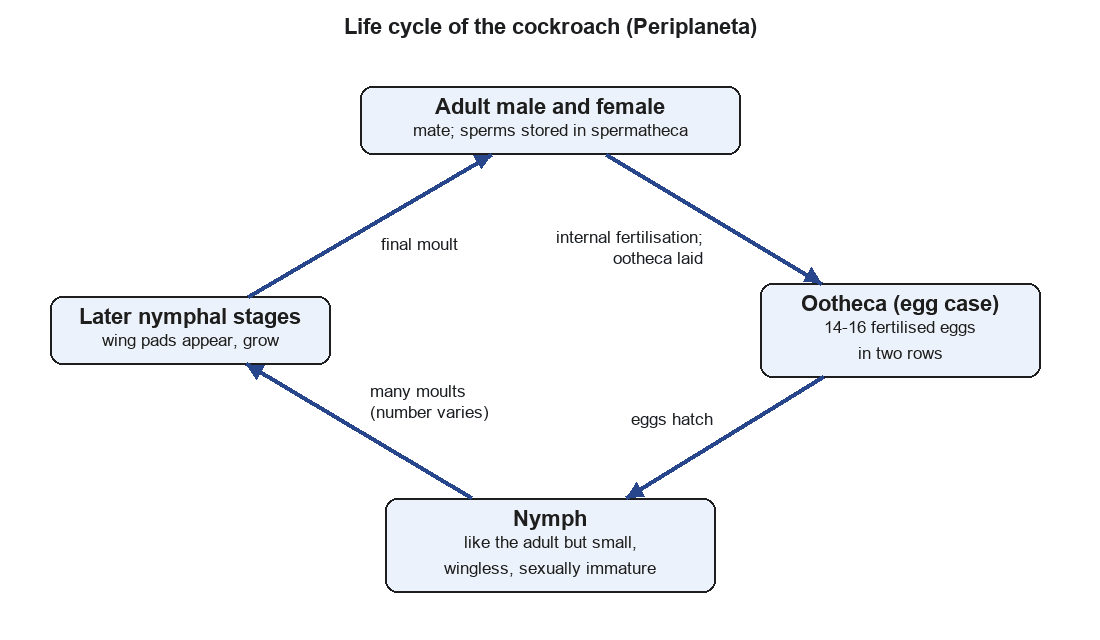
Life cycle: adult → ootheca (eggs) → nymph → (many moults) → adult.
- 413 marks
Question 41
What is the role of spermatheca?
Solve with AIWritten solution
Solution:
Concept: in the cockroach, fertilisation is internal; sperms are passed from male to female during mating.
Step 1 — Receiving sperms: During mating the male transfers sperms in spermatophores into the female's genital chamber; the freed sperms reach the spermatheca (in the 6th segment).
Step 2 — Storing sperms: The spermatheca stores these sperms until eggs are ready.
Step 3 — Fertilisation: As the eggs pass into the genital chamber, the spermatheca releases sperms into it and the eggs are fertilised there.
The spermatheca stores the sperms received at mating and releases them to fertilise the eggs in the genital chamber.
- 423 marks
Question 42
Give three important differences between male and female cockroach visible to the eye.
Solve with AIWritten solution
Solution:
Concept: male and female cockroaches differ mainly in the abdomen.
Step 1 — Width of abdomen: The male's abdomen is narrower; the female's is broader.
Step 2 — Anal styles: The male has a pair of anal styles on the 9th sternum (besides the anal cerci); the female has only anal cerci.
Step 3 — Sterna: 9 sterna are visible in the male, only 7 in the female, whose 7th sternum is boat-shaped (the genital pouch).
Male: narrow abdomen, anal styles, 9 sterna; female: broad abdomen, no anal styles, 7 sterna with a boat-shaped 7th.
- 433 marks
Question 43
Name various parts of stomodaeum and mention one important function of each part .
Solve with AIWritten solution
Solution:
Concept: the stomodaeum (foregut) is the first part of the alimentary canal, lined with cuticle.
Step 1 — Pre-oral cavity and mouth: Pre-oral cavity - food is received and mixed with saliva; the mouth at its base leads food into the pharynx.
Step 2 — Pharynx and oesophagus: Pharynx - a short tube that passes food to the oesophagus, which carries it through the neck into the thorax.
Step 3 — Crop and gizzard: Crop - a large pear-shaped bag that stores food (some digestion by the enzymes mixed with it begins here); gizzard - its six chitinous teeth grind food and its bristles filter it.
Stomodaeum: pre-oral cavity, mouth, pharynx, oesophagus, crop (storage) and gizzard (grinding).
- 443 marks
Question 44
Explain the open circulatory system of cockroach by a schematic diagram along with arrows.
Solve with AIWritten solution
Solution:
Concept: in an open circulatory system, blood (haemolymph) leaves the vessel and flows through open spaces that bathe the organs.
Step 1 — Pumping: The 13-chambered dorsal heart contracts in waves from behind forwards and pushes haemolymph into the anterior aorta, which opens into the head sinus.
Step 2 — Bathing the organs: Haemolymph flows back through the haemocoel (sinuses), bathing the organs directly and exchanging food, hormones and wastes with them.
Step 3 — Return: When the alary muscles contract, haemolymph passes into the pericardial sinus and enters the heart through the ostia, and the cycle repeats.
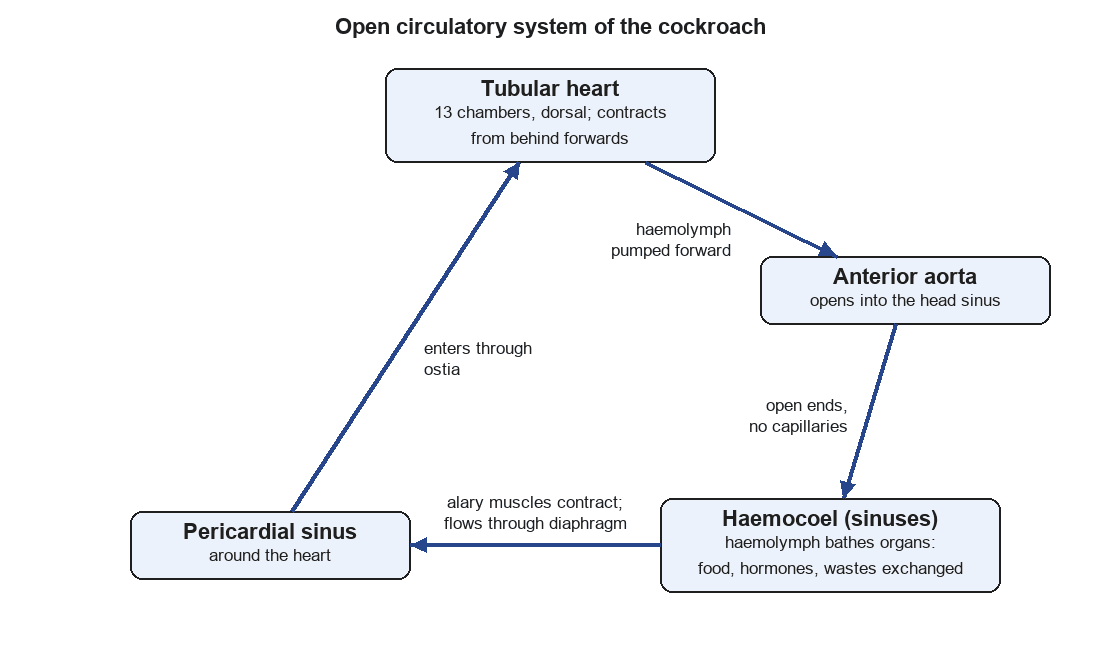
Heart → anterior aorta → haemocoel (bathes organs) → pericardial sinus → ostia → heart.
- 453 marks
Question 45
Explain the role of (a) spiracles (b) tracheal tubes and (c) Malpighian tubules in cockroach.
Solve with AIWritten solution
Solution:
Concept: breathing and excretion are done by separate tube systems in the cockroach.
Step 1 — (a) Spiracles: The 10 pairs of slit-like spiracles on the thorax and abdomen are the entry and exit points for air into the tracheal system.
Step 2 — (b) Tracheal tubes: Tracheae, kept open by chitin thickenings, branch into fine tracheoles that carry air directly to the tissues, where oxygen and carbon dioxide are exchanged without the blood.
Step 3 — (c) Malpighian tubules: These 100-150 yellow tubules take water and nitrogenous wastes from the haemolymph, form uric acid and pass it into the hindgut, so they are the main excretory organs.
Spiracles let air in, tracheal tubes deliver it to the tissues, and Malpighian tubules excrete uric acid.
- 463 marks
Question 46
List various important parts and their location that form the central nervous system of cockroach.
Solve with AIWritten solution
Solution:
Concept: the central nervous system of the cockroach is a chain of ganglia joined by connectives.
Step 1 — In the head: The bilobed supra-oesophageal (cerebral) ganglion - the brain - lies above the oesophagus; the sub-oesophageal ganglion (3 fused pairs of ganglia) lies below it; two circum-oesophageal connectives join them around the oesophagus.
Step 2 — Ventral nerve cord: From the sub-oesophageal ganglion a double ventral nerve cord runs back along the ventral side.
Step 3 — Ganglia on the cord: It bears 3 thoracic ganglia (one in each thoracic segment) and 6 abdominal ganglia - five small ones in the first five abdominal segments and a larger sixth one further back.
Brain (above oesophagus), sub-oesophageal ganglion, circum-oesophageal connectives and a ventral nerve cord with 3 thoracic and 6 abdominal ganglia.
- 472 marks
Question 47
Male cockroach and female cockroach.
Solve with AIWritten solution
Solution:
Concept: the two sexes differ mainly in the abdomen and its last segments.
Feature Male cockroach Female cockroach Abdomen Narrower Broader Sterna visible from below 9 7 (7th sternum boat-shaped) Anal styles (9th sternum) Present Absent Genital pouch Absent Present, formed by the 7th sternum Step 1 — Compare the abdomen: The male's abdomen is narrow and the female's broad.
Step 2 — Compare the hind end: The male shows 9 sterna and a pair of anal styles; the female shows only 7 sterna, no anal styles, and a boat-shaped 7th sternum forming the genital pouch.
The male has a narrow abdomen, 9 sterna and anal styles; the female has a broad abdomen, 7 sterna and no anal styles.
- 482 marks
Question 48
Peripheral and sympathetic nervous system.
Solve with AIWritten solution
Solution:
Concept: besides the central chain of ganglia, the cockroach has nerves to all body parts (peripheral) and a separate set controlling internal organs (sympathetic).
Feature Peripheral nervous system Sympathetic nervous system Made of Nerves arising from the brain and the ganglia of the CNS 3 ganglia joined to the brain by connectives, with their nerves Supplies Eyes, antennae, mouth parts, legs and each body segment Muscles of internal organs, alimentary canal and spiracles Example 3 pairs of nerves from the brain to eyes, antennae and labrum Nerves controlling the movements of the gut Step 1 — Peripheral system: It is all the nerves that leave the CNS - e.g., from the brain, the sub-oesophageal ganglion and every thoracic and abdominal ganglion - to reach the sense organs, mouth parts and segments.
Step 2 — Sympathetic system: It has its own 3 ganglia, joined to the brain, and controls the activity of the alimentary canal, spiracles and other internal organs.
The peripheral system links the CNS to all body parts; the sympathetic system controls internal organs.
- 492 marks
Question 49
Male and female reproductive system.
Solve with AIWritten solution
Solution:
Concept: both systems have paired gonads, ducts, glands and external genitalia.
Feature Male reproductive system Female reproductive system Gonads A pair of testes in the 4th-6th abdominal segments A pair of large ovaries in the 2nd-6th abdominal segments (8 ovarioles each) Ducts Vasa deferentia → seminal vesicle → ejaculatory duct → male gonopore Oviducts → common oviduct (vagina) → genital chamber Glands Mushroom-shaped gland (6th-7th segments) Colleterial glands (form the ootheca) Special parts Phallomeres; sperms packed in spermatophores Spermathecae (store sperms); gonapophyses Step 1 — Compare gonads and ducts: Testes make sperms that pass down the ejaculatory duct; ovaries make eggs that pass down the oviducts to the genital chamber.
Step 2 — Compare glands and parts: The male has the mushroom gland and phallomeres; the female has colleterial glands for the ootheca and spermathecae to store sperms.
Male: testes, ejaculatory duct, mushroom gland, phallomeres; female: ovaries, oviducts, genital chamber, spermathecae, colleterial glands.
- 505 marks
Question 50
List a few important external features of cockroach.
Solve with AIWritten solution
Solution:
Concept: the cockroach (Periplaneta americana) is a nocturnal, omnivorous insect whose body shows the typical insect plan.
Step 1 — Shape, size and colour: The body is elongated, bilaterally symmetrical and flattened from top to bottom, about 4 cm long, and shiny reddish-brown.
Step 2 — Exoskeleton: It is covered by a tough chitinous exoskeleton of hard plates (sclerites) joined by soft arthrodial membranes; a wax layer makes it waterproof.
Step 3 — Head: The triangular head (6 fused segments) is held at right angles to the body on a flexible neck. It carries a pair of long antennae (touch and smell), a pair of kidney-shaped compound eyes and biting and chewing mouth parts.
Step 4 — Thorax: It has three segments - prothorax, mesothorax and metathorax - with 3 pairs of jointed walking legs (one pair each) and 2 pairs of wings: leathery tegmina on the mesothorax and membranous flight wings on the metathorax.
Step 5 — Abdomen: It has 10 segments, each with a dorsal tergum, a ventral sternum and side pleura. The 10th segment bears a pair of anal cerci in both sexes; males also have a pair of anal styles on the 9th sternum.
Step 6 — Spiracles: 10 pairs of spiracles - 2 on the thorax and 8 on the abdomen - let air into the tracheae.
Key external features: chitinous exoskeleton, head-thorax-abdomen, antennae, compound eyes, chewing mouth parts, 3 pairs of legs, 2 pairs of wings, 10 abdominal segments with cerci (and styles in males) and 10 pairs of spiracles.
- 515 marks
Question 51
Explain the nervous system of cockroach briefly.
Solve with AIWritten solution
Solution:
Concept: the nervous system of the cockroach has three parts: the central, the peripheral and the sympathetic nervous system; its ganglia are segmentally arranged on the ventral side.
Step 1 — Brain: The bilobed supra-oesophageal (cerebral) ganglion lies in the head above the oesophagus and works as the brain.
Step 2 — Sub-oesophageal ganglion and connectives: Below the oesophagus is the sub-oesophageal ganglion, formed by fusion of 3 pairs of ganglia. Two circum-oesophageal connectives join it to the brain, forming a ring round the oesophagus.
Step 3 — Ventral nerve cord: A double ventral nerve cord (the two cords are not fused) runs from the sub-oesophageal ganglion along the whole body. It carries 3 thoracic ganglia and 6 abdominal ganglia (five small ones in the first five abdominal segments and a larger sixth one, formed by fusion of several ganglia).
Step 4 — Peripheral nervous system: Nerves arise from all these ganglia: 3 pairs from the brain to the eyes, antennae and labrum, 3 pairs from the sub-oesophageal ganglion to the mandibles, maxillae and labium, many pairs from each thoracic and abdominal ganglion to their segments, and 5 pairs from the last ganglion to the hind segments.
Step 5 — Sympathetic nervous system: It consists of 3 ganglia joined to the brain; their nerves control the alimentary canal, muscles and spiracles.
Step 6 — Sense organs: Antennae, compound eyes (thousands of ommatidia each; textbooks give about 2,000; giving mosaic vision), maxillary and labial palps and anal cerci pick up stimuli and send them to the ganglia.
The nervous system has a brain, sub-oesophageal ganglion, connectives and a double ventral nerve cord with 3 thoracic and 6 abdominal ganglia, plus peripheral nerves, a sympathetic system and sense organs.
- 525 marks
Question 52
Describe the mouth parts of cockroach and mention their functions.
Solve with AIWritten solution
Solution:
Concept: the mouth parts of the cockroach are of the biting and chewing type; they surround the pre-oral cavity, in front of the mouth, where food is received.
Step 1 — Labrum: The labrum (upper lip) is a flap in front of the mouth; it covers the pre-oral cavity from the front and holds the food in place.
Step 2 — Mandibles: The pair of hard, dark mandibles on the sides have toothed incising and grinding edges; they bite, cut and chew the food.
Step 3 — Maxillae: The pair of maxillae behind the mandibles carry jointed maxillary palps; they hold the food and push it into the mouth, and the palps are sensory.
Step 4 — Labium: The labium (lower lip) closes the pre-oral cavity from behind and bears labial palps, which help in tasting and handling food.
Step 5 — Hypopharynx: The flat, tongue-like hypopharynx lies in the middle of the pre-oral cavity; saliva is poured in at its base and mixed with the food, as a tongue would do.
Labrum (front cover), mandibles (bite and chew), maxillae (hold and push food), labium (back cover, palps) and hypopharynx (tongue; mixes saliva) together form biting-chewing mouth parts.
- 535 marks
Question 53
Draw a labelled diagram of alimentary canal of a cockroach.
Solve with AIWritten solution
Solution:
Concept: the alimentary canal of the cockroach is a long tube in three regions - foregut (stomodaeum), midgut (mesenteron) and hindgut (proctodaeum) - with salivary glands, hepatic caeca and Malpighian tubules attached.
Step 1 — Foregut: Starting at the mouth (at the base of the pre-oral cavity): pharynx → narrow oesophagus through the neck → large pear-shaped crop (stores food) → small round, thick-walled gizzard with six chitinous teeth (grinds food). A pair of salivary glands lies beside the crop, their ducts running forward to the mouth region.
Step 2 — Midgut: A long narrow tube (mesenteron) for digestion and absorption; 6-8 finger-like hepatic caeca are attached at its front end.
Step 3 — Junction: At the junction of the midgut and hindgut, 100-150 fine yellow Malpighian tubules hang in the haemolymph.
Step 4 — Hindgut: A short ileum → long coiled colon → broad rectum (absorbs water) → anus.
Step 5 — The diagram: The labelled diagram below shows these parts in order from the mouth to the anus.
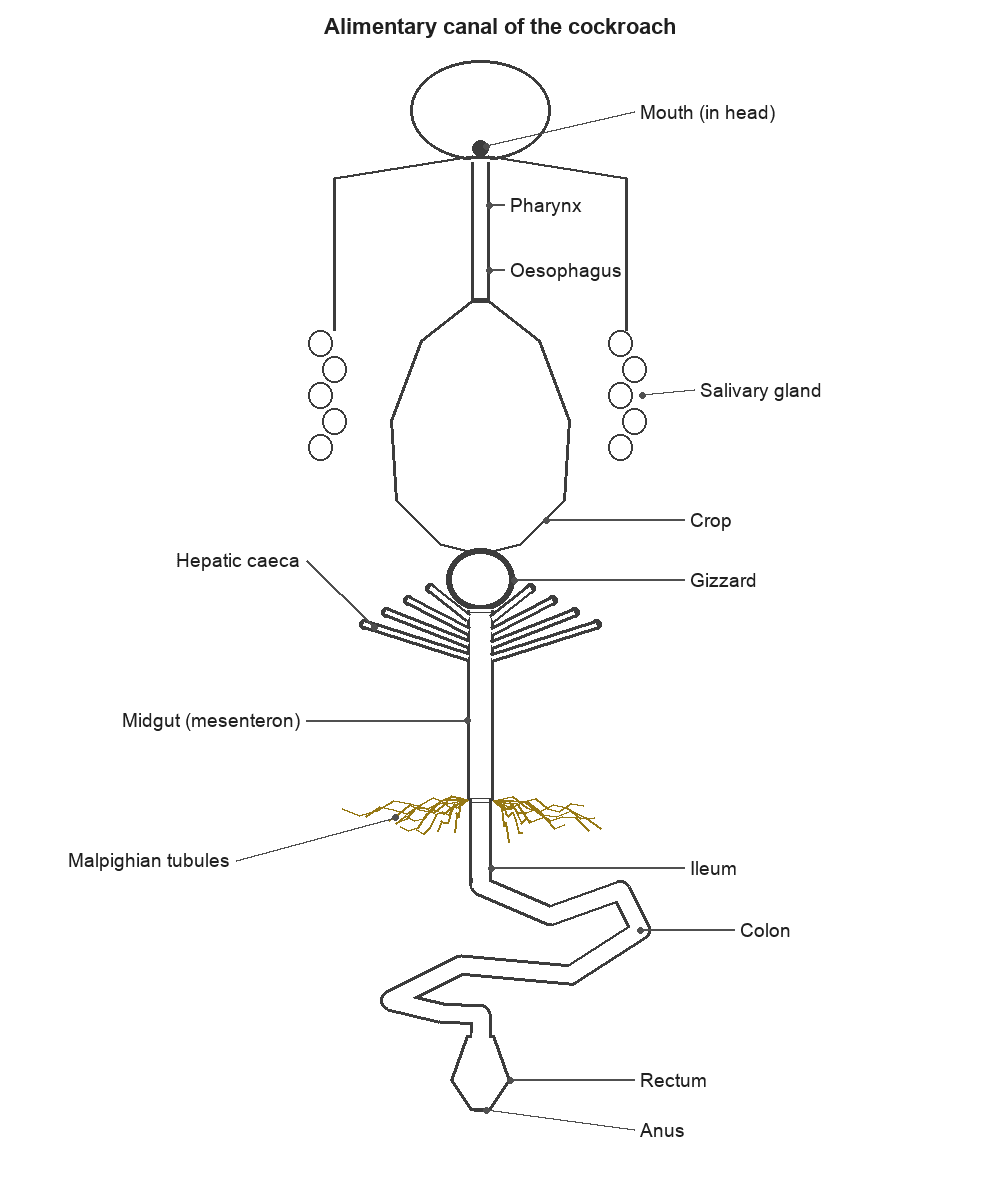
Labels: mouth, pharynx, oesophagus, salivary glands, crop, gizzard, hepatic caeca, midgut, Malpighian tubules, ileum, colon, rectum, anus.
- 545 marks
Question 54
How does tracheal system work?
Solve with AIWritten solution
Solution:
Concept: the cockroach breathes by a tracheal system of air tubes that carry air straight to the tissues, so gases are exchanged without the blood.
Step 1 — Entry of air: Air enters through 10 pairs of spiracles - slit-like openings on the 2nd and 3rd thoracic and the first eight abdominal segments.
Step 2 — Tracheae: Spiracles lead into tracheae, a network of tubes running lengthwise and crosswise through the body. Spiral thickenings of chitin in their lining keep them rigid and always open.
Step 3 — Tracheoles: Each trachea branches into very fine tubes, the tracheoles (about 1 µm wide), which have only a very thin cuticle lining without spiral thickening and end blindly among the cells of the tissues.
Step 4 — Gas exchange: The blind ends of the tracheoles hold a watery fluid; oxygen dissolves in it and diffuses into the cells, while carbon dioxide diffuses out. During hard muscular work part of this fluid is drawn into the tissues, so air comes closer and more oxygen enters.
Step 5 — Ventilation: Rhythmic movements of the thoracic and abdominal muscles pump air in and out of the tubes, so the air is renewed. The haemolymph does not carry the gases.
Air path: spiracles → tracheae → tracheoles → tissues, where gases diffuse directly; muscle movements renew the air.
What Class 11 Biology Ch 11 covers
The sections of the chapter, in the order the book takes them. Every question above comes from one of these.
- 01Cockroach - Habitat and External Morphology
- 02Digestive System
- 03Circulatory System
- 04Respiratory System
- 05Excretory System
More ways to study this chapter
The same chapter asked three other ways. Practise it, revise it, and see what the board has set on Ch 11 before.
Class 11 Biology Ch 11 questions students ask
How many questions are there in Class 11 Biology Ch 11?
54 questions. Every one is solved step by step on this page.
Are these Class 11 Biology solutions free?
Yes. Every question and its full working is free to read, with no account needed.
Can I download the Class 11 Biology Ch 11 solutions as a PDF?
There is no PDF to download. Every solution is on this page instead, which means it is searchable, always the current syllabus, and readable on a phone. Use your browser's print option if you want it on paper.