
Opening your dashboard
Class 11 Biology Chapter 11 Morphology and Anatomy of Different Systems of Cockroach: Practice Questions
80 questions on Chapter 11, each worked through on its own page with the AI tutor. Class 11 Biology, ICSE 2026-27.
80 questions
1–4 marks · Mixed difficulty
- 11 mark
Question 1
Which one of the following lists contains only structures found on the head of a cockroach?
- 21 mark
Question 2
Which wings of a cockroach arise from the mesothorax, and what is their main role?
- 32 marks
Question 3
Cockroaches often live in warm, dry places such as kitchen cupboards, yet their bodies do not dry up, and they can still bend and run easily. Explain two features of the exoskeleton that make this possible.
- 42 marks
Question 4
A cockroach that had lost both its antennae in an accident was placed in a dark box with a piece of bread. It kept bumping into the walls, and it took much longer to find the bread than a normal cockroach did. Explain both observations.
- 53 marks
Question 5
The figure shows a transverse section through one abdominal segment of a cockroach.
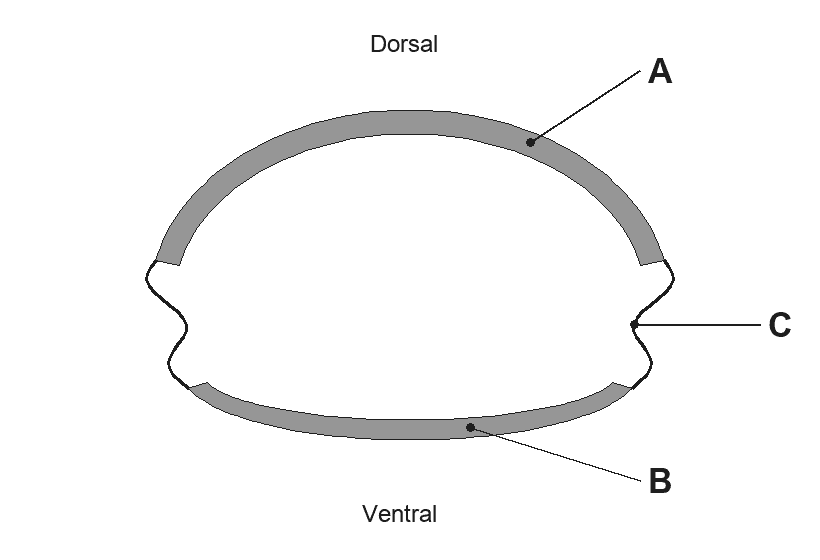
(a) Name the parts A, B and C.
(b) Which of the three parts is soft? How does its softness help the abdomen?
- 63 marks
Question 6
A cockroach can run fast across a rough stone floor and can also climb up a smooth glass window.
(a) List the five segments of its walking leg in order, starting from the one joined to the body.
(b) Name the structure that helps it grip the rough floor, the structure that helps it hold on to the smooth glass, and the leg segment that bears both.
- 71 mark
Question 7
Which mouth part of a cockroach has a toothed incising (cutting) region and a grinding region for chewing food?
- 81 mark
Question 8
Which sequence correctly shows the path of food through the alimentary canal of a cockroach?
- 91 mark
Question 9
Which structure stops food that has passed into the midgut of a cockroach from moving back into the gizzard?
- 103 marks
Question 10
Extracts from two parts of the digestive system of a cockroach were each mixed with three foods and kept warm. The results are shown below. (Hypothetical data.)
Extract Starch Protein (egg white) Fat Salivary gland extract digested not digested not digested Midgut and hepatic caeca extract digested digested digested (a) Which food is acted on by the salivary extract? Name the enzyme responsible.
(b) Which region of the gut produces the enzymes that digest proteins and fats?
(c) Digestion of starch begins even before food reaches the midgut. Explain where this happens and why.
- 113 marks
Question 11
In a cockroach, the lining of the foregut (stomodaeum) and of the hindgut is covered by a thin layer of cuticle, while the midgut is lined by endodermal cells with no such covering. Using this information, explain why
(a) most of the digested food is absorbed in the midgut rather than in the crop, and
(b) the gizzard can have hard teeth in its lining.
- 122 marks
Question 12
The droppings of a cockroach are small and fairly dry. Name the part of the alimentary canal mainly responsible for this, and explain why this is useful to an insect that often lives in dry places.
- 134 marks
Question 13
Study the simplified figure of the alimentary canal of a cockroach.
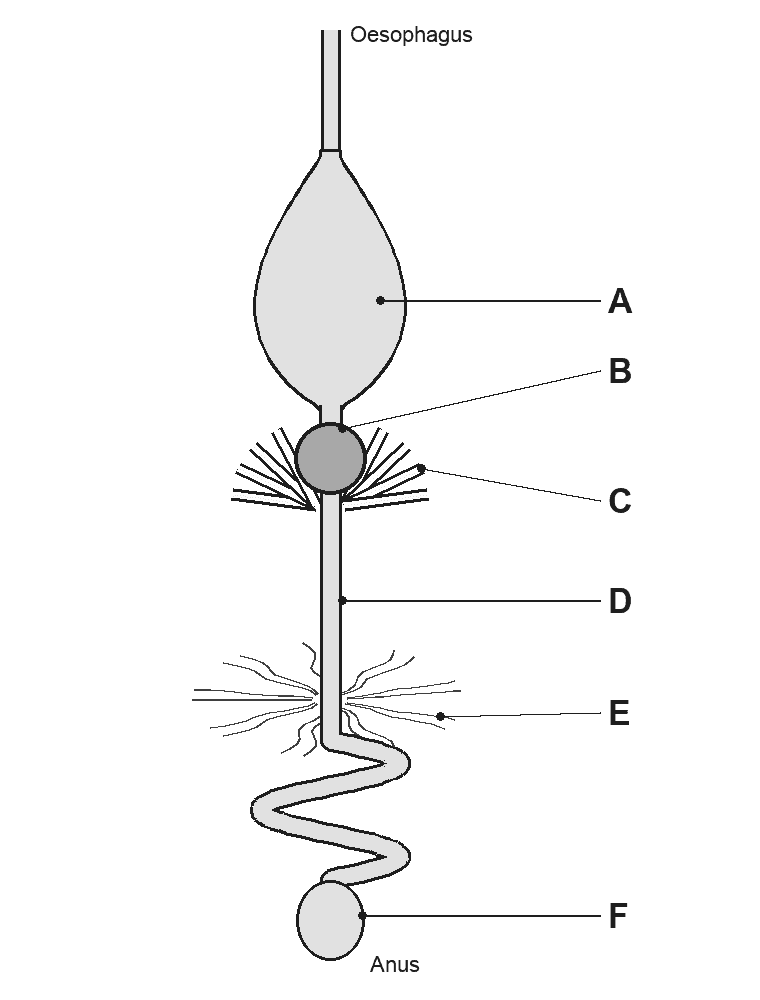
(a) Name the parts A, B, C, D, E and F.
(b) State one function each of A and B.
(c) The fine threads E are attached to the gut but play no part in digestion. What is their function?
- 141 mark
Question 14
Each ostium of the heart of a cockroach has a valve that lets haemolymph in but not out. If these valves stopped working, what would happen each time the heart contracted?
- 151 mark
Question 15
Which order correctly traces haemolymph through one complete round of circulation in a cockroach?
- 163 marks
Question 16
The figure shows a simplified transverse section of the body of a cockroach.
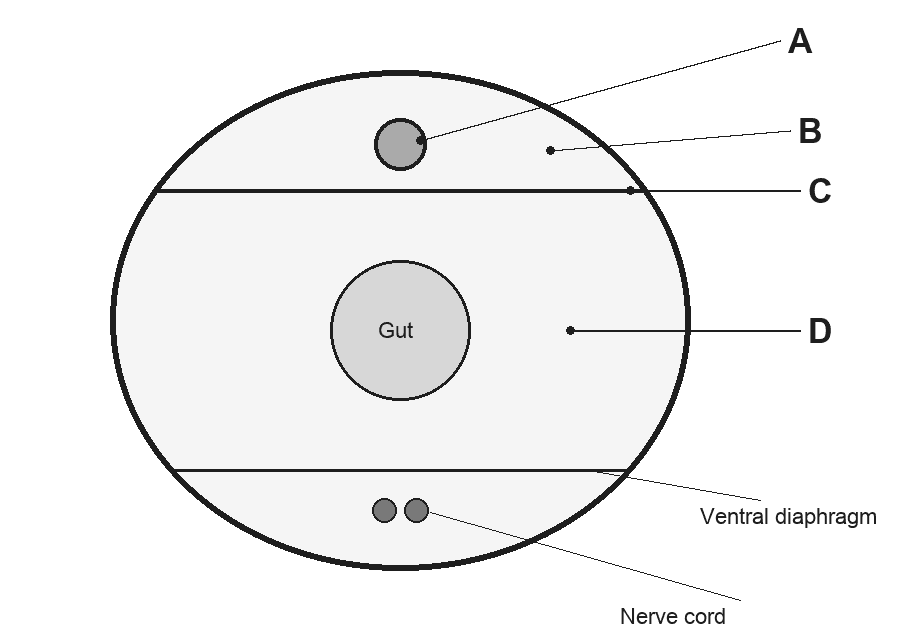
(a) Name the parts A, B, C and D.
(b) In which space, B or D, do most of the body organs lie bathed in haemolymph?
(c) Through which openings does haemolymph pass from B into A?
- 172 marks
Question 17
The heart of a cockroach contracts in a wave that starts at its hind end and moves forward. Explain why the wave must run in this direction and not the other way.
- 182 marks
Question 18
Give reasons:
(a) When the body wall of a cockroach is pricked almost anywhere, haemolymph oozes out, although no blood vessel has been cut.
(b) The haemolymph of a cockroach delivers food to every organ even though the animal has no capillaries.
- 191 mark
Question 19
Spiracles of a cockroach are found on its thorax and abdomen. Which thoracic segment has no spiracles?
- 201 mark
Question 20
Why do the tracheae of a cockroach not collapse, but stay open for air to pass through?
- 211 mark
Question 21
Where does the actual exchange of oxygen and carbon dioxide take place in a cockroach?
- 222 marks
Question 22
A spiracle is one single slit-like opening. Work out the total number of spiracles on a cockroach, and the number that lie on one side of its abdomen.
- 233 marks
Question 23
When a cockroach runs hard, part of the watery fluid at the blind ends of its tracheoles is drawn into the muscle tissue. Explain how this helps the muscles to get more oxygen.
- 243 marks
Question 24
Differentiate between a trachea and a tracheole of a cockroach under the headings: connection, size, ending and main role.
- 254 marks
Question 25
A thin film of oil can kill an insect. Suppose all the spiracles of a cockroach are sealed with oil, while its mouth, head and haemolymph are unharmed.
(a) Explain why the cockroach would soon die.
(b) Why would oil smeared only on its head not have the same effect?
(c) Why can the haemolymph not make up for the blocked air supply?
(d) Name the movements that normally renew the air in the tracheal system.
- 261 mark
Question 26
A cockroach lives in dry kitchens and store rooms, and its main nitrogenous waste is uric acid. Which statement best explains why uric acid suits such a land insect?
- 271 mark
Question 27
While dissecting a cockroach, a student notices white, chalky deposits inside the loose, whitish tissue that fills much of the body cavity. These deposits are most likely uric acid stored in the
- 282 marks
Question 28
The Malpighian tubules of a cockroach do not open directly to the outside. Instead, they empty their contents into the alimentary canal at the junction of the midgut and hindgut. Give two reasons why this arrangement is useful to the insect.
- 293 marks
Question 29
Trace the path taken by a nitrogenous waste formed in a muscle cell of a cockroach's leg until it leaves the body. Name each structure on the way and say what happens there.
- 304 marks
Question 30
(Hypothetical data.) In an experiment, 100 mg of the fluid that enters the hindgut of a cockroach from its Malpighian tubules and midgut is found to be 80% water. By the time this material leaves the anus as a faecal pellet, the pellet is only 50% water. Assume that all of the non-water (dry) matter stays in the gut and leaves in the pellet.
(a) Find the mass of the faecal pellet formed.
(b) Find the mass of water reabsorbed, and express it as a percentage of the water that entered the hindgut.
(c) Name the part of the hindgut where most of this water is taken back, and explain why this matters to a cockroach.
- 311 mark
Question 31
A thin section through one Malpighian tubule of a cockroach is examined under a microscope. Its wall would be seen to consist of
- 322 marks
Question 32
In earthworms and humans, excretory organs receive wastes from blood flowing in vessels and capillaries. In a cockroach, the Malpighian tubules simply hang freely in the body cavity. Explain how this arrangement allows the tubules to collect wastes efficiently in the cockroach.
- 331 mark
Question 33
In a cockroach, the suboesophageal ganglion is formed by the fusion of three pairs of ganglia. The nerves arising from it supply the
- 341 mark
Question 34
Counting only the ganglia that lie along the ventral nerve cord of a cockroach behind the suboesophageal ganglion, how many ganglia are there in all?
- 352 marks
Question 35
A cockroach whose head has been cut off can still stand and move its legs for some time. Using the structure of its nervous system, explain why.
- 364 marks
Question 36
The figure shows a simplified diagram of the central nervous system of a cockroach, seen from above.
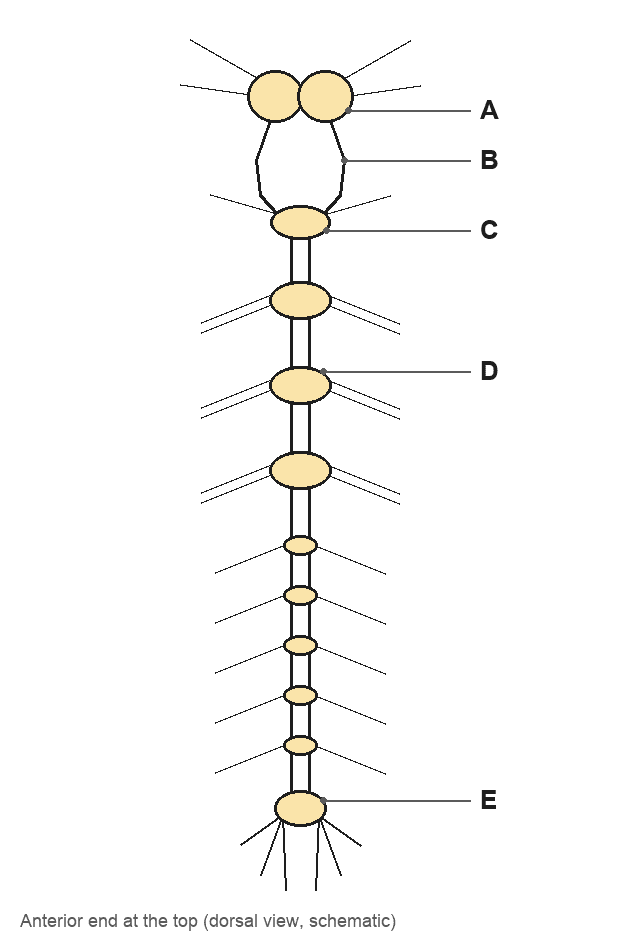
(a) Name the parts labelled A, B, C, D and E.
(b) Which lettered part sends nerves to the mandibles, maxillae and labium?
(c) Which lettered part is called the brain, and which organs do its nerves supply?
- 371 mark
Question 37
In a cockroach, the brain lies above the oesophagus and the suboesophageal ganglion lies below it. The two are joined to each other by the
- 383 marks
Question 38
Most abdominal ganglia of a cockroach are small. However, the suboesophageal ganglion and the last (sixth) abdominal ganglion are both larger.
(a) Explain why each of these two ganglia is larger.
(b) State which parts of the body each of them supplies.
- 391 mark
Question 39
The anal cerci, which act as sense organs at the hind end of a cockroach, are found in
- 404 marks
Question 40
In a dimly lit kitchen, a cockroach runs away the moment a hand moves slowly towards it from behind.
(a) How do the compound eyes help it notice such a movement in dim light, even though they do not give a sharp image?
(b) Which sense organs at the hind end could also pick up the approach of the hand?
(c) Trace, in order, the parts of the nervous system through which the message passes from these hind sense organs to the leg muscles.
- 411 mark
Question 41
The mushroom-shaped gland of a male cockroach lies in which abdominal segments, and what is its role?
- 421 mark
Question 42
After fertilisation, the eggs of a female cockroach are enclosed in a hard capsule. The material of this capsule is secreted by the
- 433 marks
Question 43
(Hypothetical data.) In a laboratory culture, one female cockroach produced 8 oothecae. Six of them held 16 eggs each and the other two held 14 eggs each. 75% of all the eggs hatched.
(a) Find the total number of eggs she laid.
(b) Find the number of nymphs that hatched.
(c) The young that hatch must moult many times before becoming adults. Explain why growth in a cockroach needs moulting.
- 442 marks
Question 44
A student finds a small, cockroach-like insect in a store room. It has no wings, only short wing pads, but otherwise looks much like an adult cockroach.
(a) Name the stage of the life cycle the student has found.
(b) Give two ways in which it differs from an adult cockroach.
- 451 mark
Question 45
In a male cockroach, the sperms are stored and glued together into bundles called spermatophores in the
- 464 marks
Question 46
Trace the path of a sperm from the testis of a male cockroach until it fertilises an egg in the female. Name each structure on the way and state what happens there.
- 472 marks
Question 47
Give reasons:
(a) Fertilisation in the cockroach is said to be internal.
(b) A female cockroach drops or glues her ootheca in a humid crack or crevice close to a source of food.
- 481 mark
Question 48
An ootheca of Periplaneta americana usually holds up to 16 eggs, arranged in two rows. Which feature of the female reproductive system best accounts for this number?
- 493 marks
Question 49
State where each of the following is found in a cockroach and give its role in reproduction:
(a) phallomeres
(b) gonapophyses
(c) genital pouch
- 504 marks
Question 50
Draw a labelled diagram of the female reproductive system of a cockroach, and state the position of the ovaries and of the spermathecae.
- 511 mark
Question 51
Cockroach has one pair of large eyes which are
- 521 mark
Question 52
In the circulatory system of cockroach the function of haemolymph is to
- 531 mark
Question 53
The exoskeleton of cockroach is made up of
- 541 mark
Question 54
Malpighian tubules are a part of
- 551 mark
Question 55
The double nerve cord in cockroach is present on the
- 561 mark
Question 56
The excretory organs of cockroach are
- 571 mark
Question 57
Tubular heart of cockroach has how many chambers?
- 581 mark
Question 58
Cockroach has following pair of legs
- 591 mark
Question 59
Eggs of cockroach are fertilised in the
- 601 mark
Question 60
The cockroach belongs to Phylum Arthropoda because of presence of
- 611 mark
Question 61
The excretory organs of cockroach are ____________ .
- 621 mark
Question 62
The last segment of a jointed leg called ____________ has adhesive pads.
- 631 mark
Question 63
____________ are slit like openings on either side of the body.
- 641 mark
Question 64
Attached to diaphragm are a series of muscles called ____________ .
- 651 mark
Question 65
The main excretory product of cockroach is ____________ .
- 661 mark
Question 66
Ventrally only 7 sterna are visible in male cockroach.
- 671 mark
Question 67
Gizzard is a part of midgut region.
- 681 mark
Question 68
Cockroach has compound eyes which produce a mosaic vision which may not be clear but gives a wider vision.
- 691 mark
Question 69
The heart consists of 10 chambers of which 2 are in thoracic region and 8 in the abdominal region.
- 701 mark
Question 70
The supra-oesophageal ganglion is a bilobed ganglion which is also referred as the brain of cockroach.
- 711 mark
Question 71
Give the common name of Periplaneta americana.
- 721 mark
Question 72
In which part of alimentary canal are hepatic caecae present?
- 731 mark
Question 73
What is the position of ovaries in cockroach?
- 741 mark
Question 74
How many segments are present in the abdomen of cockroach?
- 751 mark
Question 75
Where do you find Malpighian tubules?
- 761 mark
Question 76
Assertion (A): Spiracles in cockroaches play a vital role in respiration.
Reason (R): Spiracles are openings on the exoskeleton that allow air to enter the tracheal system for gas exchange.
- 771 mark
Question 77
Assertion (A): The digestive system of cockroach has specialised organs like crop and gizzard.
Reason (R): The crop absorbs water, while gizzard helps in digestion of food.
- 781 mark
Question 78
Assertion (A): Cockroaches have compound eyes and antennae as part of their sensory system.
Reason (R): Compound eyes allow cockroaches for mosaic vision and movement while antennae are both tactile and olfactory in function.
- 791 mark
Question 79
Assertion (A): Cockroaches have an open circulatory system.
Reason (R): In cockroach, the haemolymph directly bathes the organs and tissues.
- 801 mark
Question 80
Assertion (A): The Malpighian tubules of cockroach are attached to the alimentary canal between midgut and hindgut.
Reason (R): Malpighian tubules help in removal of undigested wastes from the alimentary canal.