
Opening your dashboard
Class 11 Biology Chapter 11 Morphology and Anatomy of Different Systems of Cockroach: Competency-Based Questions (CBQ)
40 questions on Chapter 11, each worked through on its own page with the AI tutor. Class 11 Biology, ICSE 2026-27.
40 questions
1–5 marks · Mixed difficulty
- 14 marks
Question 1
A pest-control team at a college hostel in Bhopal wants to know how narrow a gap must be to keep cockroaches out of the kitchen store. In a laboratory, adult cockroaches are offered a dark shelter that can be reached only through a slit of fixed height. The relaxed body of these cockroaches is about 6.0 mm thick from the back (tergum) to the belly (sternum). (Hypothetical data.)
Height of the slit Cockroaches that squeezed through (%) 6.0 mm 100 5.0 mm 100 4.0 mm 95 3.0 mm 60 2.0 mm 0 (a) Which features of the body and of the exoskeleton of a cockroach allow it to flatten itself to get through slits thinner than its own body? (1 mark)
(b) By what percentage must a cockroach squash the thickness of its body to pass through the 3.0 mm slit? (1 mark)
(c) The hostel warden says, "A gap of 3 mm under the store-room door is narrow enough to keep cockroaches out." Use the data to judge this claim, and suggest what the gap should be. (2 marks)
- 23 marks
Question 2
During a zoology practical at a school in Shillong, three preserved adult cockroaches, P, Q and S, are examined on their ventral (lower) side. A student records the features below.
Feature P Q S Shape of the abdomen Broad Narrow Narrow Anal cerci on the 10th segment Present Present Present Thin, unjointed anal styles on the 9th sternum Absent Present Not seen; two tiny broken stumps on the 9th sternum 7th sternum Boat-shaped, forming a keel-like genital pouch Not boat-shaped Not boat-shaped (a) State whether P and Q are male or female, giving one reason for each. (1 mark)
(b) All three specimens have anal cerci. Explain why the cerci do not help to tell the sexes apart. (1 mark)
(c) A classmate says S must be a female because it has no anal styles. Do you agree? Decide the sex of S using two features from the table. (1 mark)
- 31 mark
Question 3
Assertion (A): When a cockroach feeds, its mouthparts point downwards towards the food.
Reason (R): The head of a cockroach is formed by the fusion of six segments.
- 41 mark
Question 4
While grooming, a cockroach bends its head down and sideways and pulls each long antenna through its mouthparts to clean it. The head of a cockroach can be turned this freely mainly because
- 51 mark
Question 5
Cockroaches are seen at night in the kitchen of a district hospital, near the patients' food trolleys. Which plan is the safest and most effective way for the hospital to control them?
- 64 marks
Question 6
In a college laboratory in Kolkata, a cockroach that has not been fed for two days is given a meal of moist bread mixed with a harmless blue food dye. The time at which the dye is first seen in each part of its gut is recorded (seen through the body wall after the cockroach is anaesthetised at different times). The crop is found to be empty of dye only after 10 hours. (Hypothetical data.)
Part of the gut Dye first seen (hours after the meal) Crop 0.1 Gizzard 1.0 Midgut 1.5 Hindgut (colon) 8.0 Droppings 14.0 (a) The dye reaches the crop almost at once, but the crop takes 10 hours to empty. What does this tell you about the role of the crop? (1 mark)
(b) When the midgut contents are examined, the bread is found only as very fine particles. Explain how the gizzard brings this about. (1 mark)
(c) Calculate how long the dyed food spends in the midgut before the first of it reaches the hindgut, and explain why the food needs to stay in the midgut for a long time. (2 marks)
- 71 mark
Question 7
Assertion (A): The hepatic caeca of a cockroach help in the digestion of proteins and fats.
Reason (R): The hepatic caeca are attached at the junction of the foregut and the midgut.
- 81 mark
Question 8
In a school library, cockroaches chewed the paste and paper of old book bindings, ate biscuit crumbs left by readers and fed on dead insects behind the shelves. This shows that the cockroach is
- 93 marks
Question 9
In an animal physiology lab in Chennai, students count the heartbeats of a resting cockroach through the thin dorsal body wall at four room temperatures. (Hypothetical data.)
Temperature (°C) Heartbeats per minute 15 42 20 56 25 70 30 84 (a) Describe the trend in the data and state the rise in heart rate for every 5 °C rise in temperature. (1 mark)
(b) If the volume of haemolymph pushed out by each beat stays the same, how many times more haemolymph is pumped per minute at 30 °C than at 15 °C? (1 mark)
(c) A student says, "At 30 °C the faster heart sends more oxygen to the cockroach's muscles." Explain why this is not correct, and state what the faster circulation really carries more quickly. (1 mark)
- 101 mark
Question 10
Assertion (A): The heart of a cockroach lies along the mid-ventral line of the body, below the alimentary canal.
Reason (R): The double nerve cord of a cockroach runs along the ventral side of the body.
- 111 mark
Question 11
In an experiment, a drug that paralyses only the alary muscles of a cockroach is applied, while its heart muscles keep working. (Hypothetical.) Which change would you expect first?
- 124 marks
Question 12
A student in Jaipur measures how fast a resting cockroach uses oxygen with the simple respirometer shown. The cockroach rests on wire gauze above pellets of potassium hydroxide (KOH), which absorb carbon dioxide. The capillary tube has an inner cross-section of 1 mm², so each millimetre moved by the coloured drop stands for 1 mm³ of gas. The cockroach has a mass of 0.9 g. In 20 minutes the drop moves 60 mm. An identical tube without a cockroach is set up beside it; its drop does not move. (Hypothetical data.)
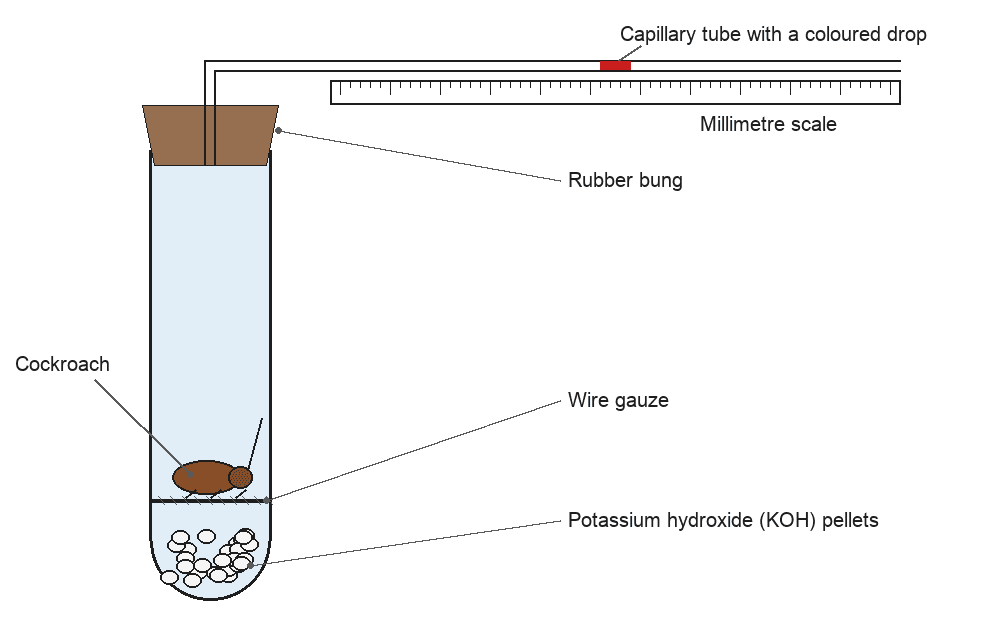
(a) In which direction does the drop move — towards the boiling tube or away from it? Explain why. (1 mark)
(b) Calculate the volume of oxygen used per minute and per hour, and the volume used per gram of cockroach per hour. (2 marks)
(c) Why was the identical tube without a cockroach set up, and what would it mean if its drop had also moved? (1 mark)
- 131 mark
Question 13
Assertion (A): The air inside the tracheal system of a cockroach is renewed regularly instead of lying still.
Reason (R): Rhythmic movements of the thoracic and abdominal muscles pump air into and out of the tracheal system.
- 141 mark
Question 14
At a science museum in Bengaluru, a guide explains that insects which breathe through tracheae, such as cockroaches, never grow as large as a dog. Which feature of the tracheal system best supports this idea?
- 154 marks
Question 15
At a university insect-physiology lab in Pune, live Malpighian tubules are removed from a cockroach and placed in a drop of salt solution that is like haemolymph and contains a red dye. After one hour, fluid that has collected inside the tubules is drawn off and its dye concentration is compared with that of the bath. The test is repeated with tubules whose cells have been poisoned so that they cannot release energy. (Hypothetical data.)
Tubules Dye in the bath (units) Dye in fluid inside the tubules (units) Volume of fluid collected (nL) Healthy 1 6 20 Poisoned 1 1 2 The students also compare two ways of building about the same total volume of tubule (all tubes 15 mm long):
Arrangement Number of tubes Diameter of each tube Real cockroach 120 0.05 mm Imagined 5 0.25 mm (a) What do the healthy and poisoned results together show about how the tubule cells work? (1 mark)
(b) The cells lining each tubule bear microvilli. How does this help the tubule do its job? (1 mark)
(c) Calculate the total outer surface area of the tubules in each arrangement, and use your answer to explain why many thin tubules are better than a few wide ones. (2 marks)
- 161 mark
Question 16
Assertion (A): A cockroach is uricotelic.
Reason (R): Uric acid is highly toxic and must be removed dissolved in a large volume of water.
- 171 mark
Question 17
While studying stained slices of a cockroach, a researcher notices special cells lying along the heart, which store nitrogenous wastes that may later be removed by the haemolymph. These cells are the
- 183 marks
Question 18
In a neurobiology lab in Delhi, four anaesthetised cockroaches, W, X, Y and Z, each have one ganglion of the central nervous system damaged under a microscope. After they recover, the students note what each can and cannot do. (Hypothetical data.)
Cockroach Cannot do Can still do W Move its antennae; respond to light shone on its compound eyes Chew food; walk normally X Move its mandibles, maxillae and labium, so it cannot chew Move its antennae; walk normally Y Move its hindlegs and hindwings Use its forelegs and middle legs Z Move its middle legs and forewings Use its forelegs and hindlegs (a) Name the ganglion damaged in W and in X. (1 mark)
(b) Name the ganglion damaged in Y and in Z. (1 mark)
(c) Explain why damage to one ganglion in Y or Z affects only one part of the body, while the rest works normally. (1 mark)
- 193 marks
Question 19
In a dark room at a research institute in Thiruvananthapuram, a gentle puff of air is blown at the hind end of resting cockroaches, and the percentage that start running within a fraction of a second is recorded. Each group has 40 cockroaches. (Hypothetical data.)
Group Cockroaches that ran (%) Untreated 95 Cerci coated with a thin layer of wax 15 Eyes painted over; cerci untouched 93 (a) Name the sense organs that detect the puff of air, and state where they are found. (1 mark)
(b) Why did painting over the eyes make almost no difference to the result? (1 mark)
(c) The nerves from the hind end enter the last (sixth) abdominal ganglion, yet the legs that make the cockroach run are on the thorax. Explain how the message reaches the legs. (1 mark)
- 201 mark
Question 20
Assertion (A): The nerve cord of a cockroach is a single, hollow tube that runs along the dorsal side of the body.
Reason (R): The ganglia of the cockroach's nerve cord are arranged segment by segment along its length.
- 211 mark
Question 21
In a feeding test, a cockroach repeatedly taps a crumb with short, jointed feelers that hang from its mouthparts before it starts to bite. These feelers are its
- 224 marks
Question 22
A student rearing cockroaches for a school science project in Lucknow measures the body length of one nymph just after it hatches and just after each of its first five moults. Between moults, its length does not change. Its later nymphal stages show small wing pads, which grow larger with each moult. (Hypothetical data.)
Stage Body length (mm) Just hatched 5.0 After moult 1 6.2 After moult 2 7.6 After moult 3 9.2 After moult 4 11.0 After moult 5 13.0 (a) Explain why the body length increases in steps at each moult and stays the same between moults. (1 mark)
(b) Name the type of development shown by the cockroach, and give two ways in which this nymph differs from an adult. (2 marks)
(c) Find the average increase in length per moult over the first five moults. (1 mark)
- 233 marks
Question 23
In a laboratory culture in Hyderabad, 10 female cockroaches are each allowed to mate once on day 0 and are then kept with no males. The eggs in their oothecae are followed for ten weeks. A second group of 10 females that never mated also lays some oothecae, but none of their eggs hatch. (Hypothetical data.)
Week after the single mating Eggs that hatched (%) 2 92 4 90 6 88 8 75 10 55 (a) Name the structure in the female that allows her to lay fertile eggs for weeks after a single mating, and say where it lies. (1 mark)
(b) Suggest why the hatching percentage falls in weeks 8 and 10. (1 mark)
(c) A pest-control worker removes all the male cockroaches from a building. Use the data to explain why this alone would not stop new cockroaches appearing for several weeks. (1 mark)
- 241 mark
Question 24
Assertion (A): Cockroaches are described as dioecious animals.
Reason (R): In cockroaches, the testes and the ovaries occur in separate individuals, the males and the females.
- 251 mark
Question 25
Assertion (A): The development of Periplaneta americana is paurometabolous.
Reason (R): The nymph of a cockroach passes through an inactive pupal stage before it becomes an adult.
- 265 marks
Question 26
Match the following:
Column A Column B 1. Pericardium (a) Colourless plasma that does not contain haemoglobin 2. Trachea (b) A large sinus that has heart in it 3. Hepatic caeca (c) Long, thick and leathery wings used for flight 4. Haemolymph (d) Special tubes attached to spiracles for respiration. 5. Tegmina (e) Finger-like structures attached to the midgut region - 275 marks
Question 27
Read the sources given and answer any four from the questions given below.
The circulatory system of cockroach is an open circulatory system, where blood or haemolymph- the colourless plasma, directly bathes the organs. The circulatory system consists of a dorsal heart, located along the back, which pumps haemolymph into the body cavity called haemocoel. The haemolymph flows freely, bathing the organs and tissues. It serves to distribute the nutrients and hormones while simultaneously removing metabolic waste products. The circulation is aided by the alary muscles present within the body. In cockroaches, oxygen distribution primarily occurs through the respiratory system, not the circulatory system. Cockroaches have a system of tracheal tubes that deliver oxygen directly to tissues and cells, bypassing the need for blood vessels to transport oxygen. Spiracles play a crucial role in respiration by allowing air to enter the tracheal system.
(1) What is the function of circulatory system in cockroach?
(a) Transport of oxygen
(b) Transport of blood
(c) Transport of nutrients
(d) both (a) and (c)
(2) Which of the following is associated with the respiratory system in cockroach?
(a) blood
(b) haemolymph
(c) Haemocoel
(d) spiracles
(3) Which of the following system is not associated with the haemocoel?
(i) digestive system
(ii) respiratory system
(iii) circulatory system
(iv) excretory system
(a) only (i)
(b) Both (i) and (ii)
(c) only (iii)
(d) Both (iii) and (iv)
(4) Which of the following statements is correct for cockroach?
(a) The haemolymph flows in the tracheal system.
(b) Various blood vessels are connected to the heart present in the centre of the body.
(c) The red pigment haemoglobin is absent in the blood.
(d) Haemolymph transports both oxygen and carbon dioxide to and fro from the tissues.
(5) Choose the correct statement from the following.
(a) Spiracles are connected to the heart
(b) Spiracles are connected to the tracheal system.
(c) Tracheal tubes contain haemolymph.
(d) Tracheal system is directly connected to the heart for pumping of air.
- 281 mark
Question 28
In a laboratory study at a college in Nagpur, the tegmina (forewings) of an adult cockroach are carefully trimmed short, while its hindwings are left whole. (Hypothetical study.) Which change is most likely to follow?
- 291 mark
Question 29
A student draws the alimentary canal of a cockroach from memory. Her labels are:
- the oesophagus widens into the crop, which leads into the gizzard;
- eight finger-like tubes drawn at the junction of the midgut and the hindgut are labelled “hepatic caeca”;
- a tuft of many fine yellow threads drawn at the front end of the midgut, just behind the gizzard, is labelled “Malpighian tubules”.
Which change will correct her drawing?
- 301 mark
Question 30
Assertion (A): In a cockroach, oxygen reaches its working leg muscles without being carried there by the haemolymph.
Reason (R): The haemolymph of a cockroach contains no haemoglobin.
- 311 mark
Question 31
Assertion (A): A male cockroach transfers its sperms to the female in bundles called spermatophores.
Reason (R): The sperms of a male cockroach are produced in the mushroom-shaped gland of the 6th and 7th abdominal segments.
- 321 mark
Question 32
A student dissects a freshly anaesthetised cockroach under saline in a college laboratory in Bhubaneswar and writes down four observations. All four are correct. Which observation is the best evidence that the circulatory system of the cockroach is of the open type?
- 332 marks
Question 33
While weeding the school garden in Guwahati, a student finds a small animal that has a hard outer covering of chitin, a body in two parts (a fused head-and-thorax and an abdomen), four pairs of jointed legs, no antennae and no wings. She says:
“It has jointed legs and a chitin exoskeleton, so it belongs to the same class as the cockroach.”
(a) Which part of her claim is correct? Give the reason. (1 mark)
(b) Use two features of a cockroach to show why the animal does not belong to the same class as the cockroach. (1 mark)
- 342 marks
Question 34
In a laboratory in Bhopal, two groups of cockroaches are reared for four weeks. Group P is fed a protein-rich diet of dried fish meal, and group Q is fed rice flour, which is mostly starch. On dissection, the loose whitish tissue (fat body) of group P contains many more white deposits of uric acid than that of group Q. (Hypothetical data.)
(a) Explain why the protein-rich diet leads to more uric acid being formed. (1 mark)
(b) The uric acid in group P stays stored in the fat body for weeks. Explain why this storage does not harm the cockroach, and how it helps a cockroach that lives in a dry store room. (1 mark)
- 352 marks
Question 35
A laboratory cockroach in Ahmedabad is fed one meal of bread mixed with boiled egg white and a little butter. When its droppings are tested, they contain almost no starch, but a large amount of undigested protein and fat. Normal cockroaches given the same meal leave very little undigested protein or fat. (Hypothetical data.)
(a) Which part or parts of its digestive system are most likely not working properly? Give the reason. (1 mark)
(b) Use the results to show that its salivary glands are most likely working normally. (1 mark)
- 363 marks
Question 36
At a college laboratory in Mysuru, students watch the abdomen of a cockroach through a hand lens and count its rhythmic pumping movements per minute under different conditions. (Hypothetical data.)
Condition Pumping movements per minute Resting at 25 °C 12 Just after 1 minute of forced running 42 5 minutes after the running stopped 24 10 minutes after the running stopped 13 (a) What do these pumping movements do for the respiratory system of the cockroach? (1 mark)
(b) Calculate the percentage increase in the pumping rate just after running, compared with rest, and explain why the increase is needed. (1 mark)
(c) Suppose each pumping movement renews about 3 mm³ of the air in the tracheal system. Find the volume of air renewed per minute at rest and just after running, and how many times as much air is renewed after running. (1 mark)
- 373 marks
Question 37
Two students in a zoology club in Dehradun argue about how a cockroach finds a drop of sugar solution in the dark. Riya thinks it smells the sugar from a distance with its antennae. Kabir thinks it uses its maxillary palps, the jointed feelers at its mouthparts.
(a) Design a fair laboratory test, using groups of cockroaches, to decide between their two ideas. Your test must be harmless to the animals. (2 marks)
(b) State the results that would support Riya's idea, and the results that would support Kabir's idea. (1 mark)
- 383 marks
Question 38
In a laboratory study in Kolkata, freshly laid oothecae of Periplaneta americana are kept at the same temperature (28 °C) but at different relative humidities, and the percentage of eggs that hatch is recorded. (Hypothetical data.)
Relative humidity (%) Eggs that hatched (%) 30 12 50 40 70 82 90 86 (a) Describe how hatching depends on humidity, and state between which two humidities the rise in hatching is the greatest. (1 mark)
(b) Ten oothecae with 15 eggs each are kept at 30% humidity, and another ten such oothecae at 70% humidity. Find the number of nymphs that hatch in each case. (1 mark)
(c) A college laboratory breeds cockroaches for its practical classes. Keeping the box of oothecae at 90% humidity takes much more effort than keeping it at 70%, and the wetter box also lets mould grow on the oothecae. Use the data for ten oothecae of 15 eggs to decide which of these two humidities the laboratory should choose. (1 mark)
- 395 marks
Question 39
Read the passage and the data, and answer the questions that follow.
Pest-control workers often treat kitchens with a gel bait: a tasty food paste mixed with a small amount of a slow-acting poison that acts on the nervous system. A cockroach chews and swallows the bait, walks back to its hiding crack, and dies there several hours later. Other cockroaches in the crack, including young nymphs, may then feed on its droppings or its body and are also poisoned. Contact sprays work differently: they kill only the insects that are reached by the spray or walk over the sprayed surface.
In a trial in Mumbai, two identical store rooms with similar cockroach numbers were treated on day 0. Room X received gel bait placed inside cracks. Room Y was sprayed once on its open floors and walls. The cockroaches caught in sticky traps overnight were counted on different days. (Hypothetical data.)
Day Cockroaches caught in room X (bait) Cockroaches caught in room Y (spray) 0 120 120 2 110 60 4 70 70 7 30 95 14 6 115 (a) Trace the path of the poison from the moment the cockroach bites the bait until it reaches the ganglia of the ventral nerve cord. Name each part on the way and what happens there. (2 marks)
(b) Calculate the percentage fall in the catch from day 0 to day 14 in each room. (1 mark)
(c) The catch in room Y fell sharply by day 2 but then rose again. Explain this, and explain why a slow-acting poison works better in a bait than a poison that kills at once. (2 marks)
- 404 marks
Question 40
Students at a college in Kochi test how adult cockroaches climb. Each cockroach is placed at the foot of a rough sandpaper ramp and, separately, at the foot of a smooth vertical glass plate, and the students note whether it reaches the top within one minute. Group 2 have the tiny claws at the tips of their legs gently trimmed. Group 3 have the soft adhesive pads on the underside of their feet dusted with fine talc powder. Each group has 20 cockroaches. (Hypothetical data.)
Group Reached the top of the rough ramp (%) Reached the top of the smooth glass (%) 1: untreated 100 90 2: tarsal claws trimmed 35 85 3: adhesive pads dusted with talc 95 10 (a) For groups 2 and 3, find the fall in success, in percentage points, on each surface compared with group 1. (1 mark)
(b) Use your answers to (a) to state the role of the claws and the role of the adhesive pads, and name the segment of the leg that bears both. (1 mark)
(c) A shopkeeper plans to stop cockroaches climbing into his grain bins by fixing a band of smooth, clean plastic round each bin. Use the data to evaluate his plan, and suggest how the band could be made to work better. (2 marks)