
A student in Jaipur measures how fast a resting cockroach uses oxygen with the simple respirometer shown. The cockroach rests on wire gauze above pellets of potassium hydroxide (KOH), which absorb carbon dioxide. The capillary tube has an inner cross-section of 1 mm², so each millimetre moved by the coloured drop stands for 1 mm³ of gas. The cockroach has a mass of 0.9 g. In 20 minutes the drop moves 60 mm. An identical tube without a cockroach is set up beside it; its drop does not move. (Hypothetical data.)
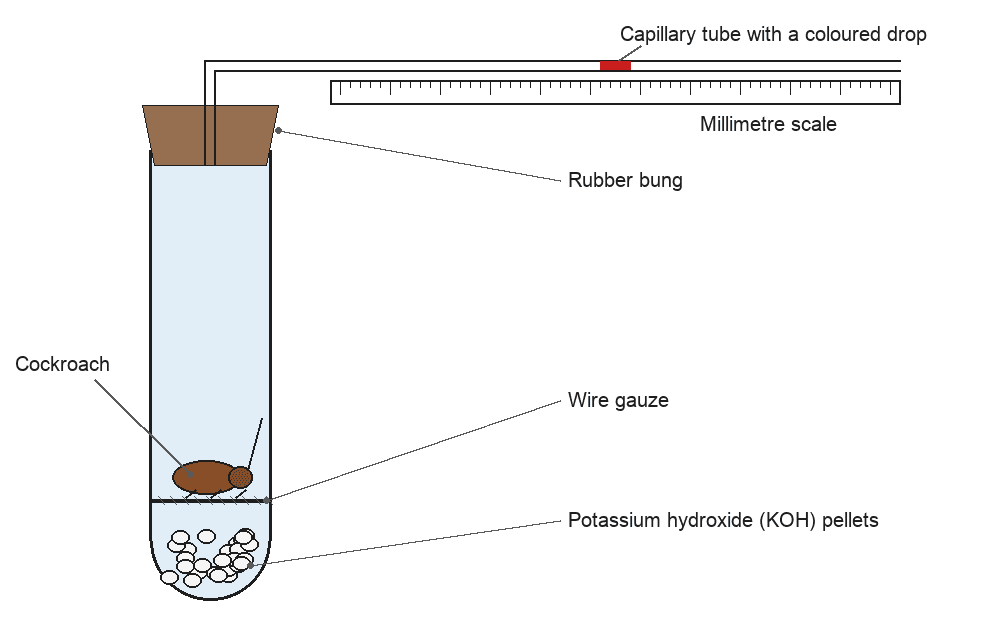
(a) In which direction does the drop move — towards the boiling tube or away from it? Explain why. (1 mark)
(b) Calculate the volume of oxygen used per minute and per hour, and the volume used per gram of cockroach per hour. (2 marks)
(c) Why was the identical tube without a cockroach set up, and what would it mean if its drop had also moved? (1 mark)