
Question 432 marksEasy
How does (a) resistance, and (b) specific resistance of a wire depend on its (i) length, and (ii) radius ?
Confirming your payment
Sign up now and get 250 free tokens.
Current Electricity · Question 43 of 160
How does (a) resistance, and (b) specific resistance of a wire depend on its (i) length, and (ii) radius ?
Solution:
Concept: The resistance of a wire is R = ρl ÷ a, where l is its length, a its area of cross-section and ρ the specific resistance (resistivity) of its material. So R ∝ l and R ∝ 1/a; for a wire of radius r, a = πr², so R ∝ 1/r². Specific resistance ρ is the resistance of a wire of the material of unit length and unit area of cross-section; its S.I. unit is the ohm metre (Ω m). It depends only on the material and its temperature, not on the length or thickness of the sample.
Step 1 — Write R in terms of the radius.
For a round wire of radius r the area of cross-section is a = πr², so the resistance can be written with r.
(a)(i)
Step 2 — Resistance and length.
With ρ and r fixed, R is directly proportional to the length, so doubling the length doubles the resistance.
(a)(ii)
Step 3 — Resistance and radius.
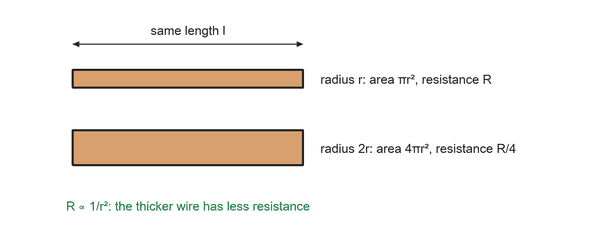
With ρ and l fixed, R is inversely proportional to the square of the radius. Doubling the radius makes the area 4 times, so the resistance becomes one-fourth.
(b)(i) and (ii)
Step 4 — Specific resistance, length and radius.
The specific resistance does not depend on the length or on the radius of the wire. It depends only on the material of the wire and its temperature.
Watch out: R varies as 1/r², not as 1/r: halving the radius makes the resistance 4 times, not 2 times.
Therefore, (a) resistance is (i) directly proportional to the length and (ii) inversely proportional to the square of the radius; (b) specific resistance is independent of both (i) the length and (ii) the radius.