
Question 442 marksEasy
(a) Name the material used for making connection wires. Give a reason for your answer.
(b) Why should a connection wire be thick ?
Confirming your payment
Sign up now and get 250 free tokens.
Current Electricity · Question 44 of 160
(a) Name the material used for making connection wires. Give a reason for your answer.
(b) Why should a connection wire be thick ?
Solution:
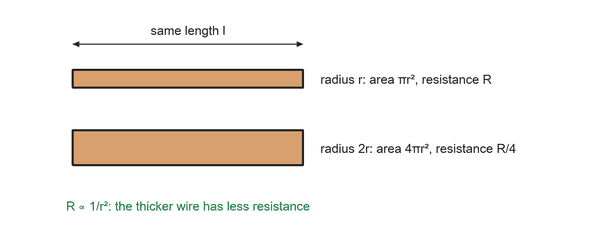
Concept: The resistance of a wire is R = ρl ÷ a, where l is its length, a its area of cross-section and ρ the specific resistance (resistivity) of its material. So R ∝ l and R ∝ 1/a; for a wire of radius r, a = πr², so R ∝ 1/r².
(a)
Step 1 — Name the material.
Connection wires are made of copper (aluminium is also used, for example in overhead power lines).
Step 2 — Give the reason.
Copper has a very low specific resistance, so the connection wires have almost no resistance. The current in the circuit is then not reduced, and very little electrical energy is wasted as heat in the wires. Silver has an even lower specific resistance, but it is too costly.
(b)
Step 3 — Explain why the wire is thick.
A thick wire has a large area of cross-section, and R ∝ 1/a, so its resistance is even lower. Less heat is then produced in the wire, so it can carry a large current safely without getting hot, and less energy is lost.
Watch out: A connection wire should have LOW resistance; it is the heating element, not the connecting wire, that needs high resistance.
Therefore, (a) connection wires are made of copper because of its very low specific resistance, and (b) they are thick so that their large area of cross-section makes their resistance (and the heat wasted in them) even smaller.