
Question 421 markEasy
How does the specific resistance of a semi-conductor change with the increase in temperature ?
Confirming your payment
Sign up now and get 250 free tokens.
Current Electricity · Question 42 of 160
How does the specific resistance of a semi-conductor change with the increase in temperature ?
Solution:
Concept: With a rise in temperature the resistance of a metal increases, that of an alloy (manganin, constantan, nichrome) increases only very slightly, and that of a semiconductor or carbon decreases.
Step 1 — State the change.
The specific resistance of a semiconductor decreases as its temperature increases.
Step 2 — Give the cause.
On heating, more electrons in a semiconductor get enough energy to break free and carry current, so the number of charge carriers increases.
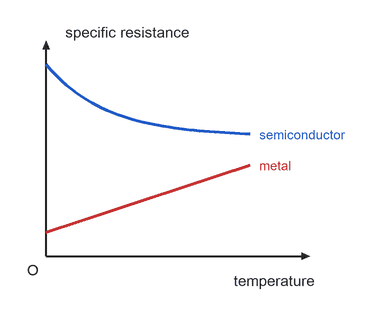
Step 3 — Give the effect.
With more charge carriers the semiconductor conducts better, so its specific resistance falls.
Watch out: A metal behaves the opposite way: its specific resistance rises with temperature.
Therefore, the specific resistance of a semiconductor decreases with an increase in temperature.