
Question 393 marksEasy
Name three factors on which resistance of a given wire depends and state how it is affected by the factors stated by you.
Confirming your payment
Sign up now and get 250 free tokens.
Current Electricity · Question 39 of 160
Name three factors on which resistance of a given wire depends and state how it is affected by the factors stated by you.
Solution:
Concept: The resistance of a wire is R = ρl ÷ a, where l is its length, a its area of cross-section and ρ the specific resistance (resistivity) of its material. So R ∝ l and R ∝ 1/a; for a wire of radius r, a = πr², so R ∝ 1/r². For a metal wire, ρ (and so R) also increases with temperature.
Step 1 — First factor: length of the wire.
The resistance is directly proportional to the length (R ∝ l). A longer wire has more resistance, because the electrons make more collisions on their way through it.
Step 2 — Second factor: area of cross-section of the wire.
The resistance is inversely proportional to the area of cross-section (R ∝ 1/a). A thicker wire has less resistance, because more electrons can drift through its larger cross-section at the same time.
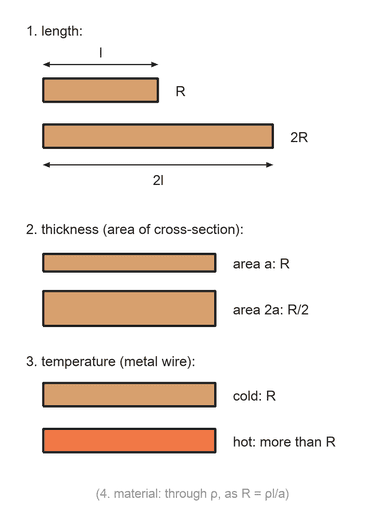
Step 3 — Third factor: temperature of the wire.
For a metal wire the resistance increases as the temperature rises, because the ions vibrate more strongly and the electrons collide with them more often.
Step 4 — Mention the material.
The resistance also depends on the material of the wire, through its specific resistance ρ; for a given wire this is fixed.
Watch out: A thicker wire has LESS resistance, not more; R falls as the area of cross-section grows.
Therefore, the resistance of a given wire depends on (i) its length (R ∝ l), (ii) its area of cross-section (R ∝ 1/a) and (iii) its temperature (R increases as the temperature rises, for a metal).