
Question 382 marksEasy
Two wires, one of copper and the other of iron, are of the same length and same radius. Which will have more resistance ? Give reason.
Confirming your payment
Sign up now and get 250 free tokens.
Current Electricity · Question 38 of 160
Two wires, one of copper and the other of iron, are of the same length and same radius. Which will have more resistance ? Give reason.
Solution:
Concept: The resistance of a wire is R = ρl ÷ a, where l is its length, a its area of cross-section and ρ the specific resistance (resistivity) of its material. So R ∝ l and R ∝ 1/a; for a wire of radius r, a = πr², so R ∝ 1/r².
Step 1 — Compare what is the same.
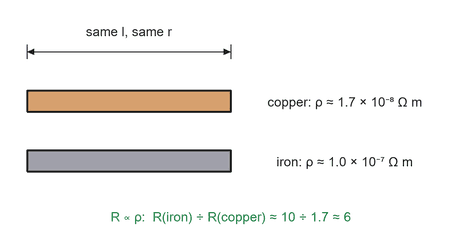
Both wires have the same length l and the same radius, so they have the same area of cross-section a. In R = ρl ÷ a only ρ is different, so the resistance is proportional to the specific resistance.
Step 2 — Compare the specific resistances.
The specific resistance of iron is about 1.0 × 10⁻⁷ Ω m, while that of copper is about 1.7 × 10⁻⁸ Ω m. So the specific resistance of iron is about six times that of copper.
Step 3 — Conclude.
Since R ∝ ρ here, the iron wire has the larger resistance, about six times that of the copper wire.
Watch out: The wires are of the same size, so the difference comes only from the material, through ρ.
Therefore, the iron wire has more resistance, because the specific resistance of iron is more than that of copper.