
Question 372 marksEasy
How does the resistance of a metallic wire depend on its temperature ? Explain with reason.
Confirming your payment
Sign up now and get 250 free tokens.
Current Electricity · Question 37 of 160
How does the resistance of a metallic wire depend on its temperature ? Explain with reason.
Solution:
Concept: With a rise in temperature the resistance of a metal increases, that of an alloy (manganin, constantan, nichrome) increases only very slightly, and that of a semiconductor or carbon decreases.
Step 1 — State the dependence.
The resistance of a metallic wire increases as its temperature increases.
Step 2 — Give the cause.
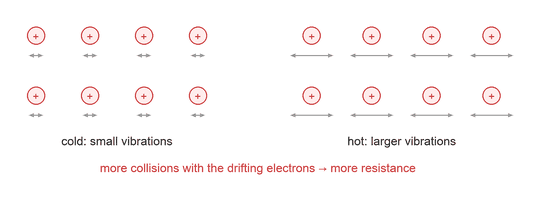
When the wire is heated, the positive ions of the metal vibrate about their fixed positions with a larger amplitude.
Step 3 — Give the effect.
The free electrons drifting through the metal then collide with these ions more often. More collisions mean more opposition to the drift of the electrons, so the resistance of the wire increases.
Step 4 — Give an example.
The tungsten filament of a bulb has a much larger resistance when it is glowing (hot) than when it is cold.
Watch out: This is for metals; the resistance of a semiconductor or carbon decreases on heating.
Therefore, the resistance of a metallic wire increases with a rise in temperature, because the ions vibrate more and the electrons collide with them more often.