
Question 362 marksEasy
How does the resistance of a wire depend on its length ? Give a reason for your answer.
Confirming your payment
Sign up now and get 250 free tokens.
Current Electricity · Question 36 of 160
How does the resistance of a wire depend on its length ? Give a reason for your answer.
Solution:
Concept: The resistance of a wire is R = ρl ÷ a, where l is its length, a its area of cross-section and ρ the specific resistance (resistivity) of its material. So R ∝ l and R ∝ 1/a; for a wire of radius r, a = πr², so R ∝ 1/r².
Step 1 — State the dependence.
For a wire of a given material and thickness, the resistance is directly proportional to its length.
Step 2 — Give the reason.
In a longer wire the free electrons have to drift through a longer distance in the metal, so each electron makes more collisions with the positive ions on its way. More collisions mean more opposition to the flow, so the resistance is greater.
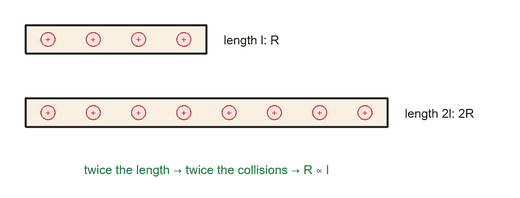
Step 3 — See why it is in proportion.
A wire of length 2l is like two wires of length l joined end to end in series, and resistances in series add up. So doubling the length doubles the resistance.
Watch out: This holds only when the material, the thickness and the temperature of the wire stay the same.
Therefore, the resistance of a wire is directly proportional to its length (R ∝ l), because in a longer wire the electrons make more collisions with the ions.