
Question 402 marksEasy
Define the term specific resistance and state its S.I. unit.
Confirming your payment
Sign up now and get 250 free tokens.
Current Electricity · Question 40 of 160
Define the term specific resistance and state its S.I. unit.
Solution:
Concept: The resistance of a wire is R = ρl ÷ a, where l is its length, a its area of cross-section and ρ the specific resistance (resistivity) of its material. So R ∝ l and R ∝ 1/a; for a wire of radius r, a = πr², so R ∝ 1/r².
Step 1 — Write ρ from the formula.
Rearranging R = ρl ÷ a gives the specific resistance in terms of R, l and a.
Step 2 — Define specific resistance.
If l = 1 m and a = 1 m², the formula gives ρ = R. So the specific resistance (resistivity) of a material is the resistance of a wire of that material of unit length and unit area of cross-section. In other words, it is the resistance between the opposite faces of a unit cube of the material.
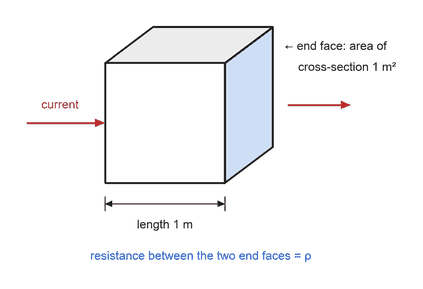
Step 3 — Find its S.I. unit.
Put the S.I. units of R (ohm), a (square metre) and l (metre) into ρ = Ra ÷ l.
Watch out: The unit is ohm metre (Ω m), not ohm per metre (Ω/m).
Therefore, specific resistance is the resistance of a wire of the material of unit length and unit area of cross-section, and its S.I. unit is the ohm metre (Ω m).