
Question 1164 marksEasy
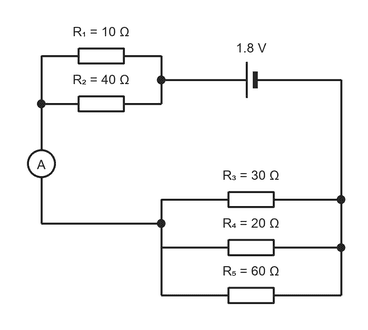
The diagram below in Fig. 8.55 shows the arrangement of five different resistances connected to a battery of e.m.f. 1.8 V. Calculate :
(a) the total resistance of the circuit, and
(b) the reading of ammeter A.
Confirming your payment
Sign up now and get 250 free tokens.
Current Electricity · Question 116 of 160
The diagram below in Fig. 8.55 shows the arrangement of five different resistances connected to a battery of e.m.f. 1.8 V. Calculate :
(a) the total resistance of the circuit, and
(b) the reading of ammeter A.
Solution:
Concept: In series the same current flows through each resistor, the p.d.s add up (V = V₁ + V₂ + …), and the equivalent resistance is R = R₁ + R₂ + …, more than the largest one. In parallel the p.d. is the same across each resistor, the currents add up (I = I₁ + I₂ + …), and the equivalent resistance is given by 1/R = 1/R₁ + 1/R₂ + …, less than the smallest one. For two resistors, R = R₁R₂ ÷ (R₁ + R₂).
Given: R₁ = 10 Ω, R₂ = 40 Ω, R₃ = 30 Ω, R₄ = 20 Ω, R₅ = 60 Ω, ε = 1.8 V.
Step 1 — Read the circuit.
R₁ and R₂ are joined side by side, forming one parallel block. R₃, R₄ and R₅ are joined side by side, forming a second parallel block. The two blocks, the ammeter and the battery are all in series.
(a)
Step 2 — Reduce the first block.
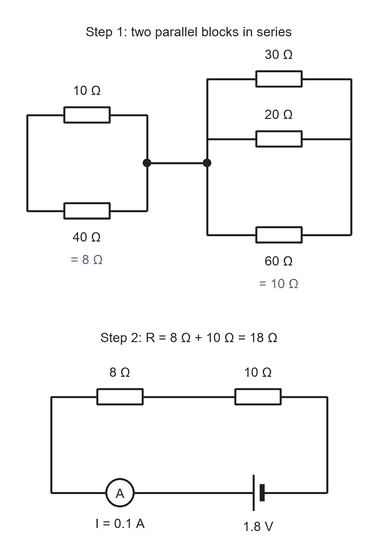
R₁ = 10 Ω and R₂ = 40 Ω are in parallel, so use product ÷ sum.
Step 3 — Reduce the second block.
R₃ = 30 Ω, R₄ = 20 Ω and R₅ = 60 Ω are in parallel, so their reciprocals add; the common denominator is 60.
So R'' = 10 Ω.
Step 4 — Add the two blocks.
The two blocks carry the same current, so they are in series and add.
(b)
Step 5 — Find the ammeter reading.
The ammeter is in the main line, so it reads the e.m.f. divided by the total resistance (taking the battery's internal resistance as negligible).
Watch out: Reduce each parallel block first; do not add all five resistors.
Therefore, (a) the total resistance of the circuit is 18 Ω, and (b) the ammeter A reads 0.1 A.