
Question 1153 marksEasy
Three resistors of 6.0 Ω, 2.0 Ω and 4.0 Ω are joined to an ammeter A and a cell of e.m.f. 6.0 V as shown in Fig. 8.54. Calculate :
(a) the effective resistance of the circuit, and
(b) the reading of ammeter.

Confirming your payment
Sign up now and get 250 free tokens.
Current Electricity · Question 115 of 160
Three resistors of 6.0 Ω, 2.0 Ω and 4.0 Ω are joined to an ammeter A and a cell of e.m.f. 6.0 V as shown in Fig. 8.54. Calculate :
(a) the effective resistance of the circuit, and
(b) the reading of ammeter.
Solution:
Concept: In series the same current flows through each resistor, the p.d.s add up (V = V₁ + V₂ + …), and the equivalent resistance is R = R₁ + R₂ + …, more than the largest one. In parallel the p.d. is the same across each resistor, the currents add up (I = I₁ + I₂ + …), and the equivalent resistance is given by 1/R = 1/R₁ + 1/R₂ + …, less than the smallest one. For two resistors, R = R₁R₂ ÷ (R₁ + R₂).
Given: R₁ = 6.0 Ω, R₂ = 2.0 Ω, R₃ = 4.0 Ω, ε = 6.0 V.
Step 1 — Read the circuit.
Tracing the circuit from the ammeter, the current splits at the junction: one branch goes through R₁ (6.0 Ω) alone, and the other goes through R₃ (4.0 Ω) and then R₂ (2.0 Ω). So R₃ and R₂ are in series, and that branch is in parallel with R₁.
(a)
Step 2 — Add R₃ and R₂.
R₃ and R₂ are joined end to end in the same branch, so they add.
Step 3 — Combine with R₁.
This 6.0 Ω branch is in parallel with R₁ = 6.0 Ω, so use product ÷ sum.
(b)
Step 4 — Find the ammeter reading.
The ammeter is in the main line, so it reads the total current, the e.m.f. divided by the effective resistance (taking the cell's internal resistance as negligible).
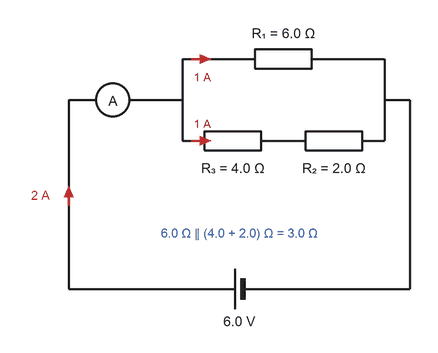
Step 5 — See how it divides.
Both branches are 6.0 Ω, so the current splits equally: 1.0 A through R₁ and 1.0 A through R₃ and R₂.
Watch out: R₂ and R₃ are in series with each other (one branch), not in parallel with R₁ separately.
Therefore, (a) the effective resistance of the circuit is 3.0 Ω, and (b) the ammeter reads 2.0 A.