Solution:
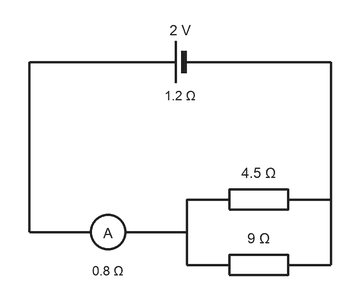
Concept: The e.m.f. ε of a cell is the p.d. across its terminals when it sends no current (open circuit). When it sends a current I through an external resistance R, a part Ir of the e.m.f. is used up inside the cell (internal resistance r), so the terminal voltage is V = ε − Ir, and ε = I(R + r). Here the 4.5 Ω and 9 Ω are in parallel, and that pair, the ammeter and the cell's internal resistance are all in series.
Given: ε = 2 V, r = 1.2 Ω, ammeter resistance 0.8 Ω, 4.5 Ω in parallel with 9 Ω.
Step 1 — Combine the parallel pair.
The 4.5 Ω and 9 Ω are in parallel, so use product ÷ sum.
Rp=4.5+94.5×9=13.540.5=3 Ω
Step 2 — Find the total resistance.
The internal resistance, the ammeter's resistance and the pair are in series, so they add.
Rtotal=1.2+0.8+3=5 Ω
(a)
Step 3 — Find the ammeter reading.
Divide the e.m.f. by the total resistance.
I=52=0.4 A
(b)
Step 4 — Find the terminal voltage V.
Subtract the drop Ir inside the cell from its e.m.f.
V=ε−Ir=2−0.4×1.2=2−0.48=1.52 V
This is also the p.d. across the ammeter and the pair together, 0.4 A × (0.8 + 3) Ω = 1.52 V.
(c)
Step 5 — Find the p.d. across the 4.5 Ω resistor.
The 4.5 Ω is part of the parallel pair, so its p.d. is the p.d. across the pair, I × Rₚ.
Vp=0.4×3=1.2 V
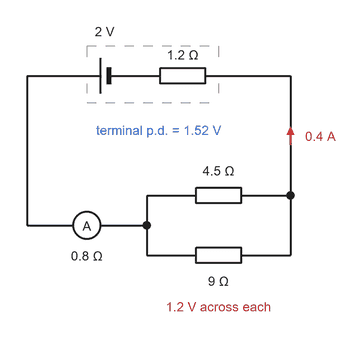
Watch out: The ammeter's 0.8 Ω takes 0.32 V, so the p.d. across the 4.5 Ω (1.2 V) is less than the terminal p.d. (1.52 V).
Therefore, (a) the ammeter reads 0.4 A, (b) the p.d. across the terminals of the cell is 1.52 V, and (c) the p.d. across the 4.5 Ω resistor is 1.2 V.