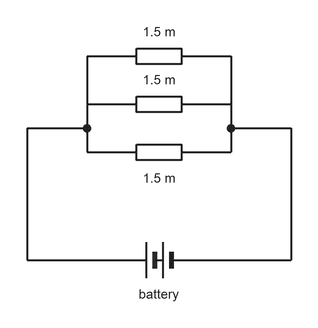
Solution:
Concept: The resistance of a wire is R = ρl ÷ a, where l is its length, a its area of cross-section and ρ the specific resistance (resistivity) of its material. So R ∝ l and R ∝ 1/a; for a wire of radius r, a = πr², so R ∝ 1/r². In parallel the p.d. is the same across each resistor, the currents add up (I = I₁ + I₂ + …), and the equivalent resistance is given by 1/R = 1/R₁ + 1/R₂ + …, less than the smallest one. For two resistors, R = R₁R₂ ÷ (R₁ + R₂).
Given: 3.0 Ω per metre; three lengths of 1.5 m each; 2.0 A in each length.
Step 1 — Find the resistance of one 1.5 m length.
The wire has 3.0 Ω for every metre, so 1.5 m of it has 1.5 times as much.
R1=3.0×1.5=4.5 Ω
(a)
Step 2 — Join three lengths in parallel.
For n equal resistors, each of resistance R₁, in parallel, the equivalent resistance is R₁ ÷ n.
R=34.5=1.5 Ω
(b)
Step 3 — Find the p.d. V of the battery.
In parallel each length has the full battery p.d. across it, and each must carry 2.0 A, so the p.d. is I × R₁.
V=2.0×4.5=9 V
The battery then supplies 3 × 2.0 = 6.0 A in all, and 9 V ÷ 1.5 Ω gives the same 6.0 A.
(c)
Step 4 — Find 5 m of the same wire.
Resistance is proportional to length, so 5 m of this wire has 5 times 3.0 Ω.
R′=3.0×5=15 Ω
Step 5 — Double the area of cross-section.
Resistance is inversely proportional to the area, so twice the area gives half the resistance.
R′′=215=7.5 Ω
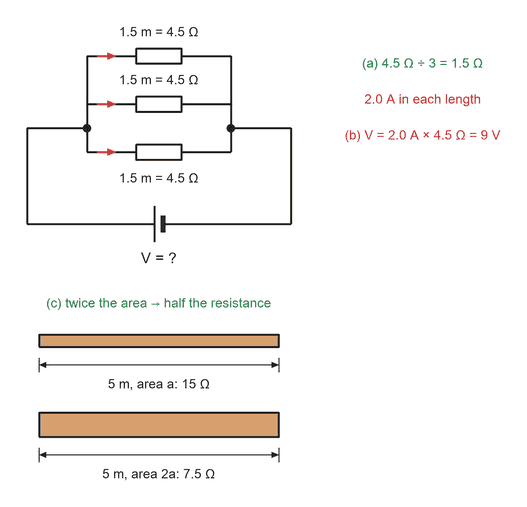
Watch out: In (b) use the resistance of ONE length (4.5 Ω) with 2.0 A; or the total 1.5 Ω with the total 6.0 A.
Therefore, (a) the total resistance is 1.5 Ω, (b) the p.d. of the battery is 9 V, and (c) the resistance of the 5 m wire of twice the area is 7.5 Ω.