
Question 1104 marksMedium
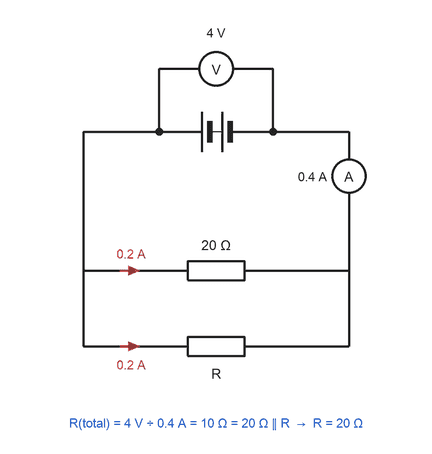
In Fig 8.52, calculate :
(a) the total resistance of the circuit,
(b) the value of , and
(c) the current flowing in .

Confirming your payment
Sign up now and get 250 free tokens.
Current Electricity · Question 110 of 160
In Fig 8.52, calculate :
(a) the total resistance of the circuit,
(b) the value of , and
(c) the current flowing in .
Solution:
Concept: In parallel the p.d. is the same across each resistor, the currents add up (I = I₁ + I₂ + …), and the equivalent resistance is given by 1/R = 1/R₁ + 1/R₂ + …, less than the smallest one. For two resistors, R = R₁R₂ ÷ (R₁ + R₂). Ohm's law: the current in a conductor is directly proportional to the p.d. across its ends, provided its physical conditions (temperature) stay the same. So V = IR, where R is the resistance, measured in ohm (1 Ω = 1 V A⁻¹). The voltmeter across the battery reads the p.d. applied to the outer circuit, and the ammeter in the main line reads the total current (the meters are taken as ideal).
Given: voltmeter reading 4 V, ammeter reading 0.4 A, 20 Ω in parallel with R.
(a)
Step 1 — Find the total resistance.
The p.d. across the outer circuit is 4 V and the total current is 0.4 A, so by Ohm's law the total resistance is V ÷ I.
(b)
Step 2 — Set up the equation for R.
The 20 Ω and R are in parallel, and together they must give 10 Ω.
Step 3 — Solve for R.
Multiply both sides by (20 + R) and collect the R terms.
(c)
Step 4 — Find the current in R.
R is joined directly across the 4 V, so the current in it is 4 V ÷ 20 Ω.
Step 5 — See that it makes sense.
The two 20 Ω resistors are equal, so they share the 0.4 A equally, 0.2 A each.
Watch out: The 10 Ω is the combined value; R itself is larger than 10 Ω, since a parallel combination is less than each part.
Therefore, (a) the total resistance of the circuit is 10 Ω, (b) R = 20 Ω, and (c) the current in R is 0.2 A.