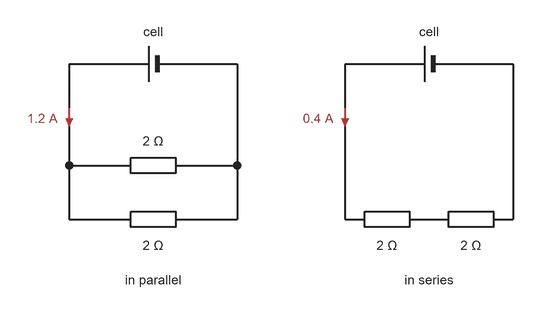
Solution:
Concept: The e.m.f. ε of a cell is the p.d. across its terminals when it sends no current (open circuit). When it sends a current I through an external resistance R, a part Ir of the e.m.f. is used up inside the cell (internal resistance r), so the terminal voltage is V = ε − Ir, and ε = I(R + r). The same cell is used with two different external resistances, so the two cases give two equations in ε and r.
Given: 1.2 A with two 2 Ω in parallel; 0.4 A with the same two in series.
Step 1 — Find the external resistance in parallel.
Two 2 Ω resistors in parallel give product ÷ sum.
Rp=2+22×2=1 Ω
Step 2 — Find the external resistance in series.
The same two resistors in series give their sum.
Rs=2+2=4 Ω
Step 3 — Write the two equations.
In each case the e.m.f. equals the current times the total resistance (external plus internal).
ε=1.2×(1+r)
ε=0.4×(4+r)
(i)
Step 4 — Equate and solve for r.
Both right-hand sides equal the same e.m.f., so they are equal to each other. Open the brackets and collect the r terms.
1.2×(1+r)=0.4×(4+r)
1.2+1.2r=1.6+0.4r
1.2r−0.4r=1.6−1.2
0.8r=0.4
r=0.5 Ω
(ii)
Step 5 — Find the e.m.f. ε.
Put r = 0.5 Ω into the first equation.
ε=1.2×(1+0.5)=1.8 V

Check: The series case gives the same e.m.f.
0.4×(4+0.5)=1.8 V
Watch out: The larger current (1.2 A) goes with the SMALLER external resistance, the parallel one (1 Ω).
Therefore, (i) the internal resistance is 0.5 Ω, and (ii) the e.m.f. of the cell is 1.8 V.