Solution:
Concept: Ohm's law: the current in a conductor is directly proportional to the p.d. across its ends, provided its physical conditions (temperature) stay the same. So V = IR, where R is the resistance, measured in ohm (1 Ω = 1 V A⁻¹). At each reading, therefore, the resistance of the filament is V ÷ I; if the filament obeyed Ohm's law, the two values would be equal.
Given: V₁ = 0.2 V, I₁ = 100 mA; V₂ = 1.0 V, I₂ = 400 mA
Step 1 — Change the currents into ampere.
Ohm's law needs the current in ampere, and 1 mA = 10⁻³ A.
I1=100 mA=0.1 A
I2=400 mA=0.4 A
Step 2 — Find the resistance in the first case.
Divide the p.d. by the current for the first reading.
R1=I1V1=0.1 A0.2 V=2.0 Ω
Step 3 — Find the resistance in the second case.
Divide the p.d. by the current for the second reading.
R2=I2V2=0.4 A1.0 V=2.5 Ω
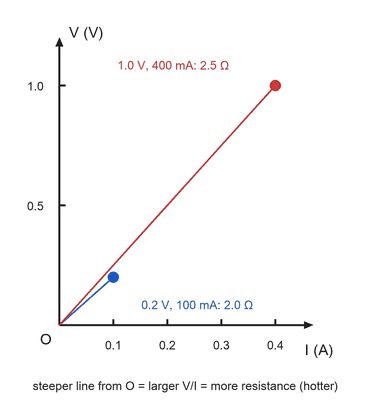
Step 4 — Account for the difference.
The larger current in the second case produces more heat in the filament, so its temperature rises. The resistance of a metal filament increases with temperature, so the resistance is greater in the second case. Since V ÷ I does not stay constant, the filament is a non-ohmic resistor.
Watch out: The change in resistance comes from the rise in temperature, not from the higher voltage itself.
Therefore, the resistance of the filament is 2.0 Ω in the first case and 2.5 Ω in the second; it is more in the second case because the filament gets hotter.
