
Question 681 markMCQEasy
The emf of a cell depends on :
Confirming your payment
Sign up now and get 250 free tokens.
Current Electricity · Question 68 of 160
The emf of a cell depends on :
(A) the material of electrodes
(B) the shape of electrodes
(C) the distance between the electrodes
(D) the amount of electrolyte in the cell
Answer: (A) the material of electrodes
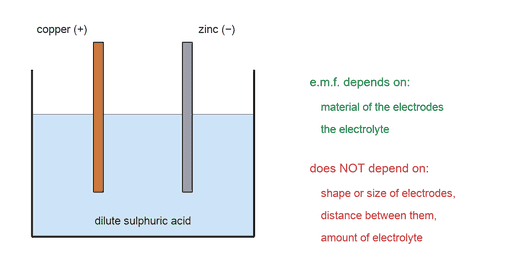
Concept: The e.m.f. of a cell comes from the chemical reaction between its electrodes and its electrolyte. So it depends only on what the electrodes and the electrolyte are made of, not on the size or the arrangement of the cell.
Step 1 — Recall where the e.m.f. comes from.
In a cell, the chemical reaction between the electrodes and the electrolyte changes chemical energy into electrical energy. The e.m.f. measures this energy given to each unit of charge.
Step 2 — See what changes the e.m.f. ε.
A different pair of electrode materials gives a different reaction, so it gives a different e.m.f. For example, a simple voltaic cell (copper and zinc plates in dilute sulphuric acid) has an e.m.f. of about 1 V, while a Leclanché cell has an e.m.f. of 1.5 V.
Step 3 — See what does not change it.
Making the plates a different shape, moving them closer or farther apart, or adding more electrolyte does not change the reaction. So the e.m.f. stays the same; these changes alter only the internal resistance of the cell.
Watch out: The distance between the electrodes changes the internal resistance of the cell, not its e.m.f.
Why the other options are wrong:
Therefore, the e.m.f. of a cell depends on the material of the electrodes, option (A).