
Question 663 marksEasy
What length of copper wire of specific resistance Ω m and radius 1 mm is required so that its resistance is 2 Ω ?
Confirming your payment
Sign up now and get 250 free tokens.
Current Electricity · Question 66 of 160
What length of copper wire of specific resistance Ω m and radius 1 mm is required so that its resistance is 2 Ω ?
Solution:
Concept: The resistance of a wire is R = ρl ÷ a, where l is its length, a its area of cross-section and ρ the specific resistance (resistivity) of its material. So R ∝ l and R ∝ 1/a; for a wire of radius r, a = πr², so R ∝ 1/r².
Given: ρ = 1.7 × 10⁻⁸ Ω m, r = 1 mm, R = 2 Ω
Step 1 — Change the radius into metre.
The specific resistance is in Ω m, so the radius must be in metre; 1 mm = 10⁻³ m.
Step 2 — Find the area of cross-section.
The wire is round, so its area is πr². Take π = 3.14.
Step 3 — Rearrange the formula for the length.
From R = ρl ÷ a, multiply both sides by a and divide by ρ.
Step 4 — Substitute the values.
Put R = 2 Ω, a = 3.14 × 10⁻⁶ m² and ρ = 1.7 × 10⁻⁸ Ω m.
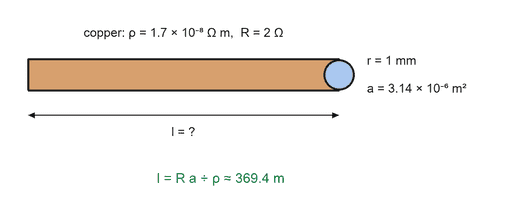
Step 5 — Interpret the result.
Copper's specific resistance is so small that a very long wire, nearly 370 m, is needed for a resistance of only 2 Ω.
Watch out: Change 1 mm into 10⁻³ m before squaring; the area is then 10⁻⁶ times π, in m².
Note: With the more exact value π = 3.1416 the length comes to about 369.6 m. To the two significant figures of ρ, both values give about 370 m.
Therefore, the length of copper wire required is about 369.4 m.