
Question 653 marksEasy
A wire of resistance 9 ohm having length 30 cm is tripled on itself. What is its new resistance ?
Confirming your payment
Sign up now and get 250 free tokens.
Current Electricity · Question 65 of 160
A wire of resistance 9 ohm having length 30 cm is tripled on itself. What is its new resistance ?
Solution:
Concept: 'Tripled on itself' means the wire is folded into three equal parts lying side by side, joined at the ends. The volume does not change, so the length becomes one-third and the area of cross-section becomes three times. The resistance of a wire is R = ρl ÷ a, where l is its length, a its area of cross-section and ρ the specific resistance (resistivity) of its material. So R ∝ l and R ∝ 1/a; for a wire of radius r, a = πr², so R ∝ 1/r².
Given: R = 9 Ω, l = 30 cm
Step 1 — Find the new length and area.
The 30 cm wire becomes three 10 cm strands side by side.
Step 2 — Find the new resistance.
Put the new length and the new area into R = ρl ÷ a; ρ does not change.
Step 3 — Substitute R = 9 Ω.
The new resistance is one-ninth of the old one.
Check: Each 10 cm strand is one-third of the wire, so it has 9 Ω ÷ 3 = 3 Ω. Three 3 Ω strands side by side are in parallel, and equal resistors in parallel give one resistor's value divided by their number.
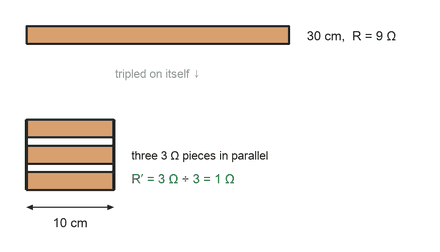
Watch out: Folding changes BOTH the length (one-third) and the area (three times), so R becomes one-ninth, not one-third.
Therefore, the new resistance of the wire is 1 Ω.