
Question 553 marksEasy
In a conductor, electrons flow from its end A to B in 2 s. Find the current flowing through the conductor. ( C)
Confirming your payment
Sign up now and get 250 free tokens.
Current Electricity · Question 55 of 160
In a conductor, electrons flow from its end A to B in 2 s. Find the current flowing through the conductor. ( C)
Solution:
Concept: Charge is carried in whole numbers of electrons: one electron carries a charge of 1.6 × 10⁻¹⁹ C, so n electrons carry Q = ne. Current is the rate of flow of charge, I = Q ÷ t, and the conventional current flows opposite to the drift of the electrons.
Given: n = 6.25 × 10¹⁶ electrons, t = 2 s, e = 1.6 × 10⁻¹⁹ C
Step 1 — Find the charge that flows.
The charge carried by n electrons is n times the charge of one electron.
Step 2 — Find the current.
Current is the charge that flows divided by the time taken.
Step 3 — Find the direction of the current.
The electrons move from A to B, and the conventional current flows opposite to the electrons, so the current flows from B to A.
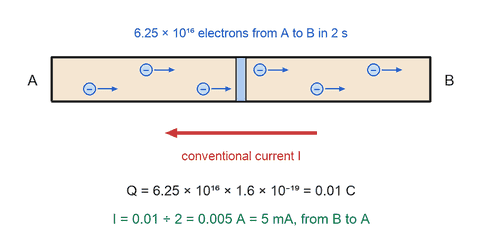
Watch out: The current flows from B to A, opposite to the motion of the electrons.
Therefore, the current is 0.005 A (5 mA), flowing from B to A.