
Question 544 marksEasy
(a) How does the resistance of a wire depend on its radius ? Explain your answer.
(b) Two copper wires are of the same length, but one is thicker than the other. Which will have more resistance ?
Confirming your payment
Sign up now and get 250 free tokens.
Current Electricity · Question 54 of 160
(a) How does the resistance of a wire depend on its radius ? Explain your answer.
(b) Two copper wires are of the same length, but one is thicker than the other. Which will have more resistance ?
Solution:
Concept: The resistance of a wire is R = ρl ÷ a, where l is its length, a its area of cross-section and ρ the specific resistance (resistivity) of its material. So R ∝ l and R ∝ 1/a; for a wire of radius r, a = πr², so R ∝ 1/r².
(a)
Step 1 — State the dependence.
Putting the area of a round wire, πr², into R = ρl ÷ a shows that, for a given material and length, the resistance is inversely proportional to the square of the radius.
Step 2 — Explain it.
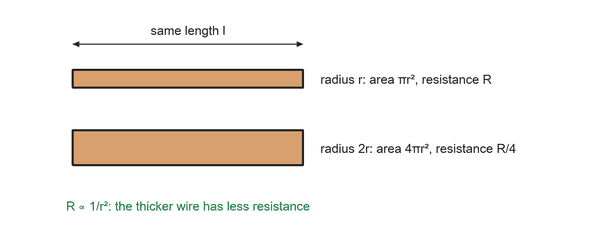
In a thicker wire the electrons have a larger area of cross-section to flow through, so more of them can drift through at the same time and the wire offers less opposition. The area grows as r², so doubling the radius makes the area 4 times and the resistance one-fourth; tripling the radius makes the resistance one-ninth.
(b)
Step 3 — Compare the two copper wires.
Both wires are of copper (the same specific resistance) and of the same length, so the wire with the smaller area of cross-section, the thinner one, has the larger resistance.
Watch out: R ∝ 1/r², so doubling the radius makes the resistance one-fourth, not one-half.
Therefore, (a) the resistance of a wire is inversely proportional to the square of its radius, and (b) the thinner copper wire has more resistance.