
Question 563 marksEasy
A current of 3.2 mA flows through a conductor. If charge on an electron is coulomb, find the number of electrons that will pass each second through the cross section of that conductor.
Confirming your payment
Sign up now and get 250 free tokens.
Current Electricity · Question 56 of 160
A current of 3.2 mA flows through a conductor. If charge on an electron is coulomb, find the number of electrons that will pass each second through the cross section of that conductor.
Solution:
Concept: Charge is carried in whole numbers of electrons. One electron carries the charge C (negative), so electrons carry , and 1 C is the charge of electrons. A current of I ampere means that I coulomb of charge crosses a section of the conductor every second.
Given: I = 3.2 mA, t = 1 s, charge on an electron = −1.6 × 10⁻¹⁹ C
Step 1 — Change the current into ampere.
The current is given in milliampere, and 1 mA = 10⁻³ A.
Step 2 — Find the charge passing in 1 s.
The charge is the current multiplied by the time.
Step 3 — Find the number of electrons.
Divide this charge by the size of the charge on one electron.
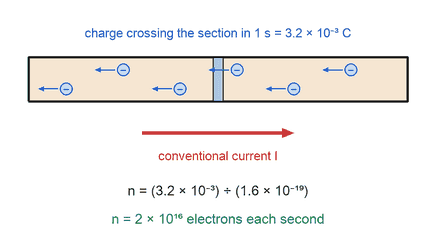
Watch out: Use the size of the electron's charge; its minus sign only tells us that the electrons move opposite to the current, and a number of electrons cannot be negative.
Therefore, 2 × 10¹⁶ electrons pass through the cross-section of the conductor each second.