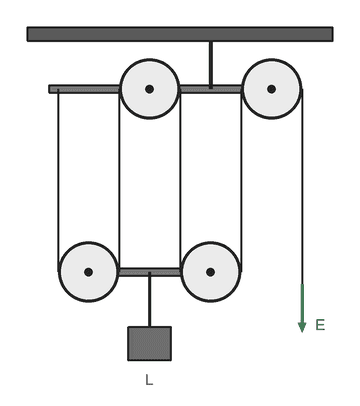
Solution:
Concept: In a block and tackle, every strand running between the two blocks pulls the lower block up with the tension T. If n strands hold up the lower block, then ideally L = nT and E = T, so M.A. = n; and when the load rises by x, each of the n strands shortens by x, so the effort end moves nx and V.R. = n.
(a)
Step 1 — Count the supporting strands.
The string is tied to the upper block and runs down and up between the blocks; 4 strands support the lower block.
(b)
Step 2 — Mark the tension.
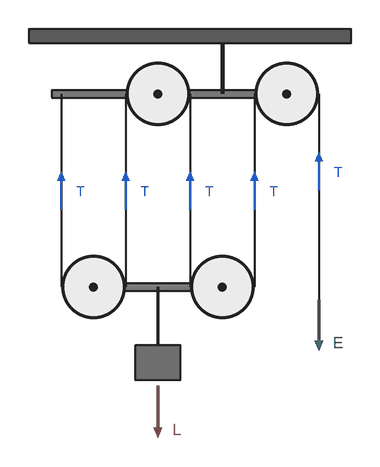
The tension T acts upward on the lower block in each of the four supporting strands, and in the free effort strand it pulls the hand upward, towards the pulley, while E pulls down.
(c)
Step 3 — Find the mechanical advantage.
Ideally L = 4T and E = T.
M.A.=T4T=4
(d)
Step 4 — Find the distance moved by the effort.
The V.R. is 4, so the effort moves 4 times as far as the load.
dE=V.R.×dL=4×1 m=4 m
(e)
Step 5 — Find the effort for 100 N.
Divide the load by the M.A.
E=4100 N=25 N
(f)
Step 6 — Find the V.R. with a heavier block.
The V.R. depends only on the number of supporting strands, not on the weight of the block, so it stays 4. A heavier block lowers the M.A. and the efficiency, not the V.R.
Therefore, (a) 4 strands support the load, (c) the M.A. is 4, (d) the effort end moves 4 m, (e) an effort of 25 N is needed, and (f) the V.R. stays 4.