Solution:
Concept: M.A. = efficiency × V.R., and the load moves (1 ÷ V.R.) times the distance moved by the effort. The kilogram-force (kgf) is the weight of a 1 kg mass, about 9.8 N. M.A. is a ratio of two forces, so we can keep every force in kgf.
Given: V.R. = 3; effort E = 200 kgf; efficiency η = 60% (0.60); effort distance = 60 cm.
Step 1 — Draw the system.
A V.R. of 3 uses 3 pulleys, 2 in the upper block and 1 in the lower block, with the string tied to the lower block. The load L acts downward on the lower block and the effort E acts downward at the free end.
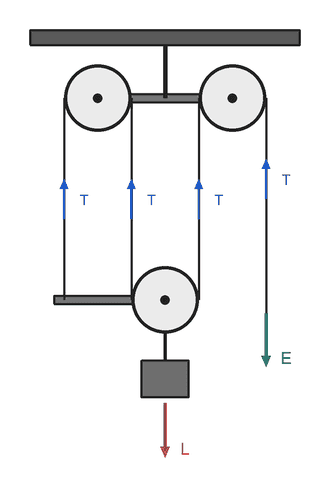
(a)
Step 2 — Find the mechanical advantage.
Multiply the efficiency by the V.R.
M.A.=η×V.R.=0.60×3=1.8
Step 3 — Find the maximum load.
Since M.A. = L ÷ E, the load is the M.A. times the largest effort.
L=M.A.×E=1.8×200 kgf=360 kgf
(b)
Step 4 — Find the distance moved by the load.
The V.R. is not changed by friction, so the distances still follow V.R. = 3.
dL=V.R.dE=360 cm=20 cm
Watch out: Use the efficiency for the force (M.A.), but the V.R. alone for the distances.
Therefore, (a) he can raise a maximum load of 360 kgf, and (b) the load moves 20 cm.
