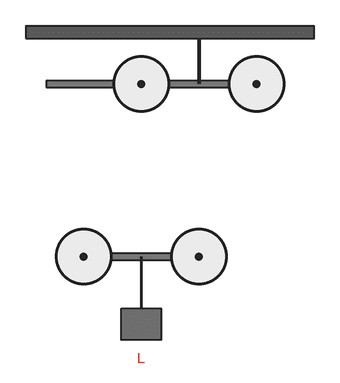
Solution:
Concept: In a block and tackle, every strand running between the two blocks pulls the lower block up with the tension T. If n strands hold up the lower block, then ideally L = nT and E = T, so M.A. = n; and when the load rises by x, each of the n strands shortens by x, so the effort end moves nx and V.R. = n. With two pulleys in each block and the effort applied downward, the string is tied to the upper block.
(a)
Step 1 — Draw the string and the effort.
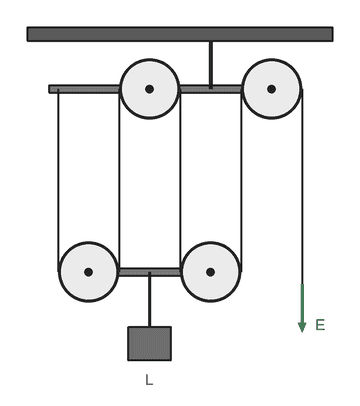
Tie one end of the string to the hook of the upper block, pass it alternately under the lower pulleys and over the upper pulleys, and let the free end come down from the last upper pulley. The effort E is applied downward at this free end.
(b)
Step 2 — Find the velocity ratio.
4 strands support the lower block. When the load rises by x, each shortens by x, so the effort end moves 4x.
V.R.=x4x=4
(c)
Step 3 — Relate the load and the effort.
Each strand carries the tension T, and the effort strand carries the same T, so E = T. The four strands hold up the load.
L=4T=4E
(d)
Step 4 — State the assumptions.
There is no friction in the pulley bearings, the lower block is weightless (negligible weight), the string is light and inextensible, and the effort is applied downward.
Therefore, (b) the V.R. is 4, (c) load = 4 × effort, and (d) we assume no friction, a lower block of negligible weight and an effort applied downward.