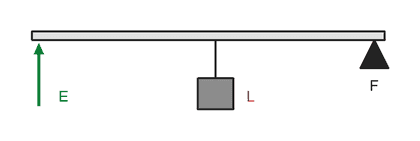
Solution:
Concept: Levers are classed by which of the fulcrum (F), the load (L) and the effort (E) lies in the middle: F in the middle → class I; L in the middle → class II; E in the middle → class III. The M.A. of a lever is effort arm ÷ load arm.
(a)
Step 1 — Name the class.
In the figure the load L is between the effort E (at one end) and the fulcrum F (at the other end), so it is a class II lever.
(b)
Step 2 — See what changes.
Shifting the load towards the fulcrum shortens the load arm, while the effort arm stays the same.
Step 3 — Find the effect on the M.A.
A smaller load arm in the denominator gives a larger value, so the M.A. increases and less effort is needed.
M.A.=Load armEffort arm
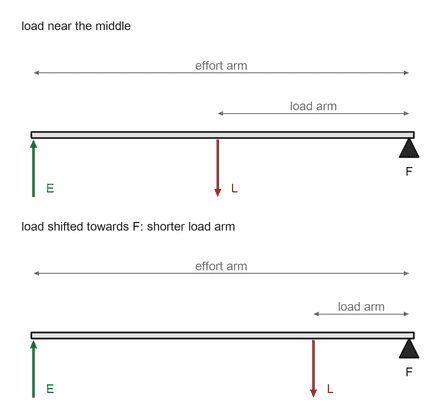
Therefore, (a) it is a class II lever, and (b) its mechanical advantage increases when the load is shifted towards the fulcrum.