Solution:
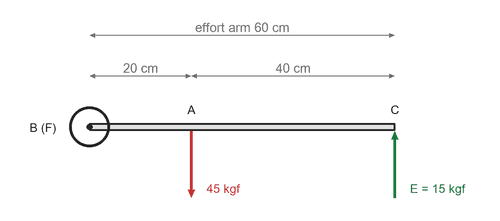
Concept: The wheel barrow is a class II lever turning about the wheel centre B. The load is the total weight (barrow + load) acting at A, and the effort acts upward at the handle tip C. The kilogram-force (kgf) is the weight of a 1 kg mass, about 9.8 N. M.A. is a ratio of two forces, so we can keep every force in kgf.
Given: Mass of barrow 15 kg (weight 15 kgf); load 30 kgf; both act at A; AB = 20 cm, AC = 40 cm (horizontal).
Step 1 — Find the total load.
A mass of 15 kg weighs 15 kgf, and it acts at A together with the 30 kgf load.
L=15+30=45 kgf
(a)
Step 2 — Find the load arm.
The load acts at A, a horizontal distance AB from the fulcrum B.
Load arm BA=20 cm
(b)
Step 3 — Find the effort arm.
The effort acts at C, and BC is BA plus AC.
Effort arm BC=20+40=60 cm
(c)
Step 4 — Find the mechanical advantage.
Divide the effort arm by the load arm.
M.A.=20 cm60 cm=3
(d)
Step 5 — Find the minimum effort.
Take moments about B: the effort's moment must equal the load's moment.
E×60=45×20
E=60900=15 kgf
Watch out: Include the barrow's own weight (15 kgf) in the load, and measure the effort arm from B to C, not from A to C.
Therefore, (a) the load arm is 20 cm, (b) the effort arm is 60 cm, (c) the M.A. is 3, and (d) a minimum effort of 15 kgf keeps the leg just off the ground.

