Solution:
Concept: For a lever, V.R. = effort arm ÷ load arm, which depends only on its dimensions; M.A. = η × V.R. changes with the efficiency η. Levers are classed by which of the fulcrum (F), the load (L) and the effort (E) lies in the middle: F in the middle → class I; L in the middle → class II; E in the middle → class III.
Given: Length of lever = 9 cm; load arm = 5 cm; effort arm = 9 cm.
(a)
Step 1 — Name the class.
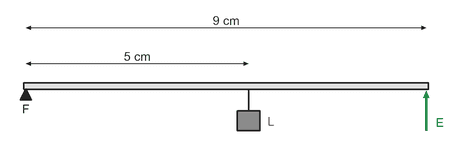
The effort arm (9 cm) equals the whole length of the lever, so the fulcrum is at one end and the effort at the other end. The load is 5 cm from the fulcrum, that is, between them, so it is a class II lever.
(b)
Step 2 — Draw the diagram.
The fulcrum F is at one end, the load L acts downward 5 cm from F, and the effort E acts upward at the other end, 9 cm from F.
(c)
Step 3 — Find V.R. and M.A. at 100% efficiency.
The V.R. is the ratio of the arms.
V.R.=Load armEffort arm=5 cm9 cm=1.8
For an ideal lever η = 1, so the M.A. equals the V.R., which is 1.8.
(d)
Step 4 — Find V.R. and M.A. at 50% efficiency.
The V.R. depends only on the dimensions, so it stays 1.8. The M.A. is η × V.R.
M.A.=0.5×1.8=0.9
Watch out: A lower efficiency lowers the M.A., but the V.R. of a lever never changes with efficiency.
Therefore, (a) it is a class II lever; (c) at 100% efficiency M.A. = 1.8 and V.R. = 1.8; (d) at 50% efficiency M.A. = 0.9 and V.R. = 1.8.
