
Question 954 marksEasy
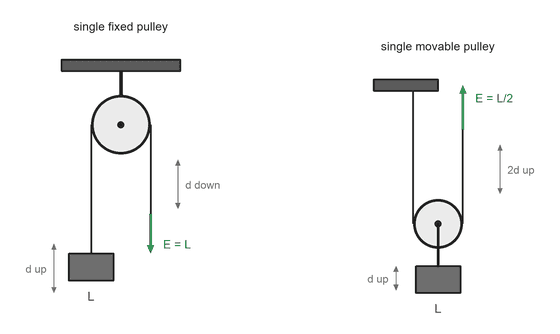
State four differences between a single fixed pulley and a single movable pulley.
Confirming your payment
Sign up now and get 250 free tokens.
Machines · Question 95 of 109
State four differences between a single fixed pulley and a single movable pulley.
Solution:
Concept: The fixed pulley's axle stays in place and it only changes the direction of the force; the movable pulley moves with the load and (ideally) halves the effort.
Step 1 — List four differences.
The table gives four differences.
| Single fixed pulley | Single movable pulley |
|---|---|
| 1. Its axle is fixed to a rigid support. | 1. Its axle is not fixed; it moves with the load. |
| 2. Its ideal M.A. is 1. | 2. Its ideal M.A. is 2. |
| 3. Its V.R. is 1. | 3. Its V.R. is 2. |
| 4. It is used to change the direction of the effort. | 4. It is used as a force multiplier. |
Step 2 — Note two more.
With a fixed pulley the load moves opposite to the effort, while with a movable pulley the load moves in the same direction as the effort. The weight of a fixed pulley does not affect its M.A., while the weight of a movable pulley reduces it.
Therefore, a fixed pulley is fixed to a support, has M.A. 1 and V.R. 1 and changes the direction of the effort, while a movable pulley moves with the load, has M.A. 2 and V.R. 2 and is a force multiplier.