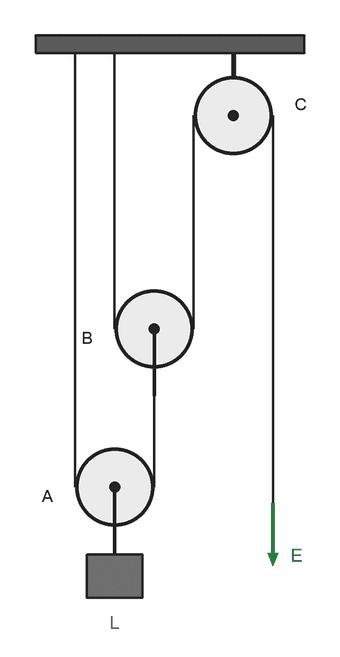
Solution:
Concept: If friction and the weight of the string are neglected, the tension T is the same all along one string, and in every strand it pulls the body at the end of that strand towards the pulley. Each movable pulley is held by two strands of its own string, so it doubles the force; the fixed pulley only turns the effort downward.
(a)
Step 1 — Name the pulleys.
A and B move with the load, so they are movable pulleys; C is fixed to the support, so it is a fixed pulley.
(b)
Step 2 — Mark the forces.
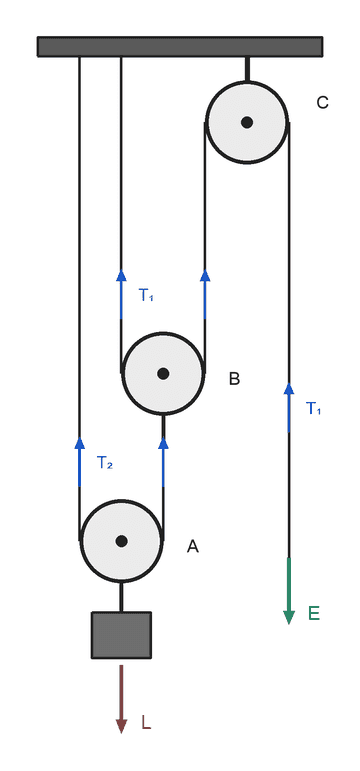
The load L acts downward on A, and the effort E acts downward on the free end that comes over C. In the string holding A, the tension T2 acts upward on A in both strands. In the string holding B (which passes over C to the effort), the tension T1 acts upward on B in both strands and upward on the hand at the effort end, towards C.
(c)
Step 3 — Relate E to the tension.
The effort strand belongs to the string with tension T1.
E=T1
Step 4 — Relate the two tensions.
B is held up by two strands of T1 and pulled down by the string from A, which is tied to B's hook and carries T2.
T2=2T1
Step 5 — Relate L to the tension.
A is held up by two strands of T2.
L=2T2=4T1
(d)
Step 6 — Find the mechanical advantage.
Divide the load by the effort.
M.A.=EL=T14T1=4
Step 7 — Find the velocity ratio.
If the load rises by x, both strands of A's string shorten by x, so B rises by 2x. Then both strands of B's string shorten by 2x, so the effort end moves 4x.
V.R.=x4x=4
(e)
Step 8 — State the assumptions.
The pulleys A and B are weightless, there is no friction in the pulley bearings, and the strings are light and inextensible.
Therefore, (a) A and B are movable pulleys and C is a fixed pulley; (c) L = 4T₁ and E = T₁; (d) M.A. = 4 and V.R. = 4; (e) we assume weightless pulleys A and B, no friction and light, inextensible strings.