Solution:
Concept: If friction and the weight of the string are neglected, the tension T is the same all along one string, and in every strand it pulls the body at the end of that strand towards the pulley. Counting the strands that hold the moving pulley gives both the force relation and the velocity ratio.
(a)
Step 1 — Name the pulleys.
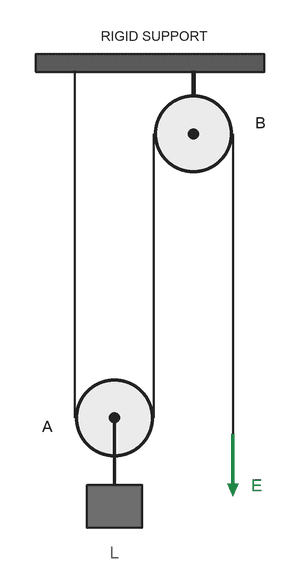
A is a movable pulley (it moves with the load); B is a fixed pulley (its axle is fixed to the support).
(b)
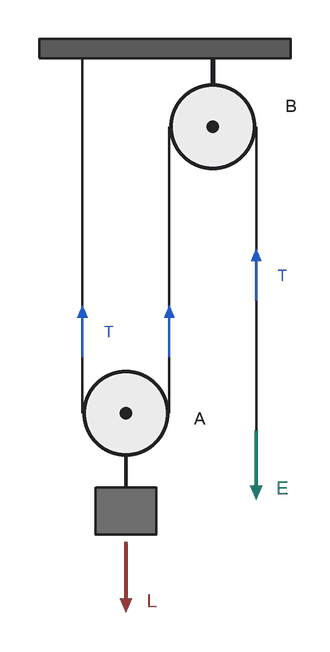
Step 2 — Mark the tension.
The tension T acts upward on A in both strands holding it, and in the effort strand it pulls the hand upward, towards B, while the effort E pulls down.
(c)
Step 3 — State the purpose of B.
Pulley B changes the direction of the effort, so that it can be applied downward, which is more convenient. It does not change the M.A.
(d)
Step 4 — (i) Relate T and E.
The effort pulls the same string, so the tension equals the effort.
T=E
Step 5 — (ii) Relate E and L.
Two strands of tension T hold up A.
L=2T=2E
So the effort is half the load.
E=2L
(e)
Step 6 — Find the velocity ratio.
If the load rises by x, each of the two strands holding A shortens by x, so the effort end moves 2x.
V.R.=x2x=2
(f)
Step 7 — Find the mechanical advantage.
With an efficiency of 100% (η = 1), the M.A. equals η × V.R.
M.A.=1×2=2
Therefore, (a) A is movable and B is fixed; (c) B changes the direction of the effort; (d) T = E and E = L/2; (e) V.R. = 2; (f) M.A. = 2.