
Question 282 marksEasy
Why does a current carrying freely suspended solenoid rest along a particular direction ? State the direction in which it rests.
Confirming your payment
Sign up now and get 250 free tokens.
Electro-magnetism · Question 28 of 136
Why does a current carrying freely suspended solenoid rest along a particular direction ? State the direction in which it rests.
Solution:
Concept: A current-carrying solenoid behaves like a bar magnet: one end becomes a north pole and the other a south pole, and the field lines outside run from its N end round to its S end.
Step 1 — See the solenoid as a magnet.
While the current flows, one end of the solenoid is a north pole and the other a south pole, just like a bar magnet.
Step 2 — Bring in the earth's field.
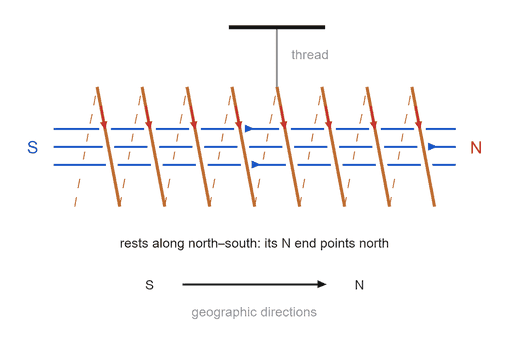
When the solenoid is freely suspended, the earth's magnetic field acts on its poles, as it does on the poles of a freely suspended bar magnet. Its north pole is pulled towards the north and its south pole towards the south, so it turns until it lies along this direction and then rests there.
Step 3 — State the direction.
It comes to rest in the north–south direction, with its north pole pointing north. Strictly this is the direction of the magnetic meridian, which is very nearly geographic north–south.
The figure shows the suspended solenoid at rest along the north–south line with its N end towards the north.
Watch out: A solenoid behaves like this only while the current flows; with the current off it rests in any direction.
Therefore, a freely suspended current-carrying solenoid behaves like a bar magnet and is turned by the earth's magnetic field until it rests in the north–south direction, with its north pole pointing north.