
Question 273 marksEasy
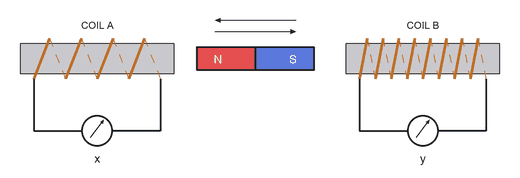
A magnet kept at the centre of two coils A and B is moved to and fro as shown in the diagram given below. The two galvanometers show deflection. State with a reason whether : or .
Confirming your payment
Sign up now and get 250 free tokens.
Electro-magnetism · Question 27 of 136
A magnet kept at the centre of two coils A and B is moved to and fro as shown in the diagram given below. The two galvanometers show deflection. State with a reason whether : or .
Solution:
Concept: Faraday's laws: (1) Whenever the magnetic flux linked with a coil changes, an e.m.f. is induced in it, and it lasts only while the change goes on; (2) the size of the induced e.m.f. is directly proportional to the rate of change of the flux linked with the coil. For N turns, e = N × (change of flux ÷ time taken) in size.
Step 1 — Compare the change of flux per turn.
The magnet is midway between the two coils and moves to and fro, so it moves towards one coil just as fast as it moves away from the other. The rate of change of the magnetic flux through each turn is therefore the same for both coils.
Step 2 — Bring in the number of turns.
The same e.m.f. is induced in each turn, and the e.m.f.s of all the turns add up, so the total induced e.m.f. in a coil is proportional to its number of turns N.
Step 3 — Compare the two coils.
The figure shows 4 turns on coil A and 8 turns on coil B, so the e.m.f. induced in B is about twice that in A. With similar circuits, the larger e.m.f. drives the larger current, so galvanometer y shows the larger deflection.
Watch out: The speed of the magnet is the same for both coils here, so the only difference between them is the number of turns.
Therefore, x < y, because coil B has more turns than coil A, so a larger e.m.f. and current are induced in coil B.